
… and yet remaining clueless about what’s in them. PART II
The $80 Million Math Problem
Now, let’s talk about the Money. We’re not talking about “adjustments.” We’re talking about a Capital Explosion. If you’re running a typical supermarket with one of those “Large” R-404A racks, you’re looking at a $400,000 bill per location.
If you’ve got a 300-location responsibility and two-thirds of them are running these old f^&ks, you need $80 million. Just like that. $80 million to replace a bunch of stuff that (let’s remember) is currently working perfectly fine.
But here’s the best part: the Lead Times. You want a CO₂ transcritical rack? That’ll be 18 months. You want an Ammonia system? See you in two years.
The EPA says the deadline is January 1, 2027. It’s currently January 2026. You have 12 months left. Do you see the problem? You need 18 months of lead time, but you only have 12 months on the clock.
The math doesn’t work. Unless you have a time machine or you ordered your equipment six months ago(before you even knew what the rules were), you are officially screwed. It’s a race where the finish line is behind the starting blocks.
Supply chain issues have caused delays in the availability of new equipment and components, making it even harder to meet compliance deadlines.
The EPA intends to focus its resources on compliance with new compliance dates established by the Technology Transitions Rule Reconsideration.
And because you don’t have the Equipment Tagging, you don’t even know which 200 locations to panic about first!
You can’t calculate the $80 million, you can’t order the gear, and you can’t meet the deadline. But don’t worry, the EPA “recognizes the need for flexibility.”
That’s government-speak for “We’ll let you know how much the fine is once you’ve officially failed.”
You aren’t “managing a transition.” You’re watching a slow-motion train wreck from the conductor’s seat, and the brakes were sold for scrap three years ago.
Equipment Labeling: The Three Profiles
EPA Section 84.58 mandates specific equipment labels. To maintain compliance, consider your readiness for GHG emissions reporting. Three profiles based on equipment type:
Profile 3 – Chillers & Complex Systems
| Equipment Types | Required Label Information |
| * Chillers | * ASHRAE Chemical Name |
| * Large heat pumps | * Full Date of Manufacture – Listed |
| * Industrial process cooling systems | * Capacity weight listed or labelled GWP < 150 |
| * Condenser type and cooling medium | |
| * Evaporator type | |
| * Compressor type | |
| * Servicing parts GWP > x must be labeled | |
| * Durable – Weather Proof | |
| * Readily Visible | |
| * Contrasting Color |
Note: Profile 3 includes additional component-specific requirements (condenser type, cooling medium, evaporator type, compressor type) due to the complexity of chillers and large process cooling systems.
Profile 1 (Self-Contained)
Stand-alone refrigerators, vending machines, residential AC
Profile 2 (Remote Condensing)
Commercial refrigeration, supermarket racks, split HVAC. Remote condensing unit systems and related equipment, such as supermarket racks and split HVAC systems, are subject to specific labeling and compliance requirements under EPA regulations. Certain condensing units, particularly those in the heat pump subsector, are also subject to specific EPA standards and upcoming compliance requirements as part of ongoing technology transitions.
Profile 3 (Chillers)
Industrial chillers, large heat pumps, process cooling
Sectors such as industrial process refrigeration equipment, semiconductor manufacturing, and the semiconductor manufacturing industry have unique labeling and compliance needs under EPA technology transitions, especially for chillers and process refrigeration equipment.
Each requires specific information: refrigerant type, GWP value, charge size, and manufacturing date.
What location audits find:
40-60% of equipment has missing or illegible labels.
Without labels, you can’t verify which profile applies. Can’t confirm GWP values. Can’t prove equipment was compliant at installation.
The Solution: One Photo. We Do the Rest.
Systematically document every piece of refrigeration and HVAC equipment you own.
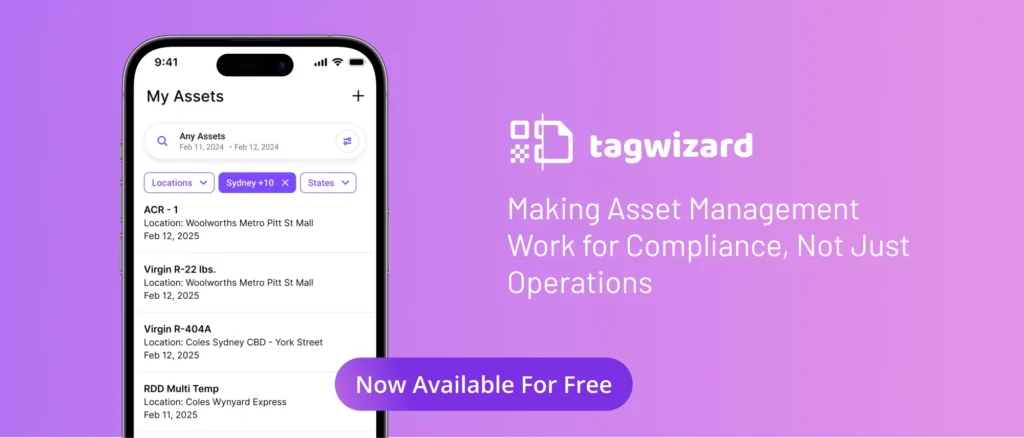
Modern equipment tagging (Tag Wizard):
- Voice input: Hands-free data entry
- OCR scanning: Photograph nameplate, software extracts text automatically
- Offline capability: Works without WiFi
- QR code generation: Print and apply unique asset tags on-site
Organizations like the Refrigeration Institute support the adoption of advanced refrigeration technologies and industry standards, helping drive the transition to more sustainable solutions.
Systematic documentation helps address concerns related to regulatory compliance, supply chain disruptions, and industry impact by providing transparent and accurate equipment records.
Demonstrated field performance from 500+ location audits: See how states are leading the charge in refrigerant-aligned compliance for sustainability and regulatory best practices.
📱 Download Tag Wizard
| Facility Type | Equipment Count (see Insights for Those Who Own or Operate a Commercial AC Unit for best practices in managing HVAC equipment) | Tagging Time |
|---|---|---|
| Small retail | 5-15 assets | 45 – 90 minutes |
| Large grocery | 50-80 assets | 2 – 3 hours |
| Distribution center asset management can be streamlined with solutions like the Asset Tagging App – Tag Wizard. | 60-100 assets | 2.5 – 3.5 hours |
| Proven efficiency 100+ pieces of equipment tagged in under 3 hours with a 2-person team. |
What Gets Captured
Basic identification
Equipment type, location, unique QR code, and GPS coordinates
Technical specs
- Full charge/design charge,
- Refrigerant type,
- GWP value,
- Capacity,
- Serial number and,
- Temperature measurement.
Documentation should also include data for conditioning and heat pump systems, as well as air conditioning and heat equipment, to ensure compliance with regulatory requirements and capture all relevant system types.
Regulatory data
- Installation date,
- Nameplate photograph,
- Equipment labeling photograph,
- Configuration.
→ For insight on compliance and closing trust gaps in refrigerant leak detection in HVAC, read more.
For refrigerated transport intermodal containers, it is essential to capture box temperature as part of regulatory compliance.
These containers are subject to unique regulatory provisions, including specific exemptions, measurement criteria, and compliance thresholds related to refrigerant GWP limits and temperature control in cold chain logistics.
Accurate temperature measurement ensures both compliance and product safety.
Compliance assessment
Current status, applicable deadline, estimated retrofit/replacement cost
This is the asset documentation you should have maintained for 40 years. Better late than never.
QR Codes: Workforce Enablement
Every piece of equipment gets a unique QR code. Technician scans with smartphone, sees complete equipment history, logs work, system auto-calculates leak rate, alerts if threshold exceeded.
Time required
Under 60 seconds from scan to complete documentation.
QR codes aren’t surveillance. They’re workforce enablement. Giving technicians instant access to information instead of making them hunt for it.
Alternative Refrigerants: Pick Your Poison
Now we get to the new stuff: the “Alternative Refrigerants.”
We’re moving beyond HFCs into a world of “purpose.” And what is that purpose? To make you memorize a whole new set of numbers.
First, you’ve got the Natural Refrigerants.
Hint: they are not natural at all. There are no trees with ammonia on them: all of these come from Chemical plants, just like the other refrigerants.
They want to go back to the basics: Carbon Dioxide, Propane, and Ammonia. Think about that.
To save the environment, we’re going back to the stuff that either chokes you, explodes, or smells like a litter box that hasn’t been cleaned since the Bicentennial. “Ultra-low GWP,” they say. “Ultra-high chance of a localized disaster,” says I.
Then you’ve got the A2L blends. R-454C. Sounds like a robot’s serial number. They tell you these have “proven performance characteristics.”
That’s a fancy way of saying “it’s slightly less flammable than the other stuff, but keep your matches in your pocket.”
And who decides which of these magic potions you’re allowed to use? The SNAP program. The Significant New Alternatives Policy. They “evaluate” and they “approve.”
They’re the gatekeepers of the gas. They tell you the “right” choice improves efficiency and secures “operational continuity.”
Operational continuity is just a $10 term for “staying in business.” It’s a wonderful system: they break your current setup with a regulation, then “shape your decisions” by selling you the fix.
It’s the only business model where the guy who sets the fire also owns the fire extinguisher company.
The Cost of Finally Knowing What You Own
Equipment Tagging Cost Comparison – 300 Locations:
| Cost Component | Traditional Consultant | Tag Wizard In-House | Savings |
|---|---|---|---|
| Per location | $600-$800 | $300-$400 | 50-63% |
| Year 1 Total | $180K-$240K | $90K-$120K | $90K-$120K |
| 5-Year Total | $180K-$240K | $110K-$140K | $70K-$100K |
| Per-location breakdown: |
- Traditional: $600-$800 one-time, then they leave
- Tag Wizard: $300-$400 year 1, then ~$17 annually, plus you retain the capability
What does this prevent per location
- Technology Transitions retrofit surprise: $200K-$400K unplanned capital
- Equipment labeling violations
- Installation date confusion
- State registration failures
ROI: $300-$400 investment prevents $200K+ surprise capital requirements.
The Timeline That Should Terrify You
- Today: January 2026
- Deadline: January 1, 2027 (12 months)
- Equipment lead time: 12-18 months
2027 Equipment Requirements – CRITICAL DEADLINE
January 1, 2027 – 12 Months Away – Immediate Action Required
| SUBSECTOR | EQUIPMENT TYPE | TRIGGER DATE | GWP LIMIT | PROFILE |
|---|---|---|---|---|
| ■ SUPERMARKET REFRIGERATION | ≥200 lb charge (excl. high-temp cascade) | January 1, 2027 | 150 | Profile 2 |
| ■ SUPERMARKET REFRIGERATION | <200 lb charge | January 1, 2027 | 300 | Profile 2 |
| ■ SUPERMARKET REFRIGERATION | High-temp cascade | January 1, 2027 | 300 | Profile 2 |
| Cold Storage Warehouses | ≥200 lb charge (excl. high-temp cascade) | January 1, 2027 | 150 | Profile 2 |
| Retail Food – Food Processing | 500g or less refrigerant (outside UL 621) | January 1, 2027 | 150 | Profile 2 |
| Retail Food – Food Processing | >500g refrigerant (outside UL 621) | January 1, 2027 | Prohibit R-404A, R-507A | Profile 2 |
| Retail Food – Ice Cream Makers | Within UL 621 scope | January 1, 2027 | Prohibit R-404A, R-507A | Profile 2 |
| Commercial Ice Machines | Batch: >1,000 lb/24 hrs | January 1, 2027 | Prohibit R-404A, R-507A | Profile 1 |
| Commercial Ice Machines | Continuous: >1,200 lb/24 hrs | January 1, 2027 | Prohibit R-404A, R-507A | Profile 1 |
| Data Centers, Computer Room AC | All CRAC/CRAH units | January 1, 2027 | 700 | Profile 3 |
■ CRITICAL: This deadline applies to EXISTING EQUIPMENT already installed.
Equipment orders must be placed Q2 2026 (April-June) for 12-18 month lead times.
If you start tagging today:
- Complete tagging: March 2026
- Identify gaps: April 2026
- Place orders: May 2026
- Delivery: November 2026 – May 2027 (some before deadline, some after)
Best-case scenario with perfect execution starting immediately.
If you haven’t started
You’re planning for either EPA deadline extensions (hope is not a strategy) or operating non-compliant equipment Q1 2027.
📱 Download Tag Wizard
Integration: Tagging Solves Six Problems
Equipment tagging enables:
- Technology Transitions Compliance – Identify R-404A equipment, calculate capital requirements
- ALDS Planning – Identify equipment ≥1,500 lbs requiring automatic leak detection
- Refrigerant Tracking – Calculate leak rates, track 12-month verification periods
- California SB 253 – 100% emissions inventory
- New York Part 494 – Equipment registration
- Capital Planning – Data-driven replacement decisions
One tagging deployment, six compliance applications. One $90K-$120K investment prevents $80 million in unplanned capital.
That’s infrastructure, not overhead.
The Environmental Impact of Phantom Assets
Consider the hidden costs of invisible assets. Phantom equipment represents more than financial inefficiency. It creates a measurable environmental impact.
Every untracked industrial refrigeration system, every forgotten air conditioning unit, every undocumented heat pump becomes an emission source.
The Environmental Protection Agency monitors more than compliance data.
They track high-GWP refrigerants from aging equipment, energy waste from outdated systems, and cumulative climate effects.
Refrigeration and air conditioning equipment rank among the largest direct emission sources in commercial buildings. Unknown installations mean unknown performance, unknown leaks, unknown impact.
This creates regulatory exposure while contributing to the challenges EPA regulations address.
Phantom assets operate with outdated refrigerants, exceed GWP thresholds, and miss modern efficiency standards.
Energy waste increases. Utility costs compound. Carbon footprint expands.
These outcomes stem from simple documentation gaps.
EPA technology transition provisions systematically phase out high-impact industrial refrigeration and air conditioning systems.
Accurate inventory enables strategic transitions, planned upgrades, and precise reporting.
Unknown assets prevent all three, compromising both compliance objectives and ESG performance.
Every phantom asset represents lost efficiency, regulatory risk, and environmental impact. The solution requires comprehensive documentation of all refrigeration and heat pump systems.
Complete asset visibility protects both environmental goals and operational performance.
Future Outlook
Action Timeline for January 1, 2027 Compliance
| TIMEFRAME | REQUIRED ACTIONS | STATUS |
|---|---|---|
| 2025 (MISSED) |
Should have completed equipment inventory and identified R-404A/R-507A systems | Past due – urgent catch-up needed |
| Q1 2026 (NOW) Jan-Mar |
• Complete equipment tagging • Identify all R-404A/R-507A systems ≥200 lbs • Calculate total capital requirements • Photograph nameplates and EPA labels |
IMMEDIATE ACTION REQUIRED |
| Q2 2026 Apr-Jun |
• Place equipment orders for CO2/ammonia • Finalize retrofit vs. replace decisions • Secure contractor commitments • 12-18 month lead times |
CRITICAL – Last chance for on-time delivery |
| Q3 2026 Jul-Sep |
• Equipment delivery begins • Installation scheduling • Contractor coordination • Staff training on new systems |
Installation phase begins |
| Q4 2026 Oct-Dec |
• Accelerated installations • Final equipment deliveries • System commissioning • Verification testing |
Final push before deadline |
| Jan 1, 2027 | DEADLINE – All existing supermarket refrigeration ≥200 lbs must comply | NON-NEGOTIABLE COMPLIANCE DATE |
| Q1 2027 (Post-deadline) |
• Late installations complete • EPA enforcement begins • Penalty exposure period |
Operating non-compliant equipment |
The future of refrigeration and air conditioning unfolds now. Low-GWP alternatives define tomorrow.
The EPA’s Technology Transitions Rule and the AIM Act guide the industry toward natural refrigerants, A2L blends, and climate-conscious solutions.
Those who track regulatory requirements and plan ahead position themselves for success. Those who don’t face unnecessary complexity and cost.
Facilities will embrace natural refrigerants. Advanced leak detection becomes standard. Data-driven asset management ensures compliance.
American innovation and manufacturing advance with purpose, guided by the EPA’s thoughtful framework.
Understanding your options creates opportunity.
Staying proactive transforms regulatory compliance into a competitive advantage. Together, we shape a more sustainable, efficient future for the industry.
📱 Download Tag Wizard
The Bottom Line
Equipment tagging isn’t complicated. It’s basic asset management applied to refrigeration equipment.
Per-location investment: $300-$400 Per-location risk prevented: $200K-$400K retrofit surprises
Facility audits reveal:
- 33% of facilities: zero refrigerant documentation
- 30-50%: can’t verify refrigerant type
- 40-60%: lack documented design charge
- 50-70%: lack verified installation dates
This creates operational inefficiency at the location level. Strategic crisis at the portfolio level. Regulatory disaster on January 1, 2027, deadline.
📌 You can’t comply with Technology Transitions without knowing what equipment you have.
Let us help you with the EPA Technology Transition.
Tag your equipment. Every location. Every asset. Photograph every nameplate. Document every installation date. Build the database you should have built forty years ago.
The January 1, 2027, deadline is 12 months away. Equipment procurement takes 12-18 months. The math doesn’t work unless you know what you’re ordering.
The EPA Technology Transitions Rule, under the American Innovation and Manufacturing (AIM) Act, is a key driver of American innovation, pushing the industry to adopt climate-friendly refrigerants and advanced asset management practices.
The program promotesthe reclamation and reuse of HFCs, reducing reliance on virgin HFC production.
It encourages the adoption of next-generation low-GWP refrigerants, such as R-32, R-454B, and A2L refrigerants—A2L refrigerants are considered a future-ready solution for AIM Act compliance and sustainability goals.
The program also serves as a mechanism for meeting national climate goals and implementing the Kigali Amendment to the Montreal Protocol.
By driving industry R&D toward natural refrigerants like ammonia and CO2, the policy positions U.S. companies for competitive advantage in global markets.
Energy efficiency improvements often result from the transition to low-GWP alternatives, reducing costs for consumers and industry.

The Geriatric Grind: Why Your “Large” Systems Are Tired of Your Lies
Let’s stop the whining. You think you’re the victim of an EPA witch hunt? You think some guy in a cardigan in D.C. woke up and decided to ruin your Tuesday? Grow up.
Your beef isn’t with the government, and it’s certainly not with the machines. Look at them. These are large, fat, overworked geriatric gearboxes grinding away way too late into their twilight.
They’ve been up there on the roof, baked by the sun and choked by the smog, doing the heavy lifting for forty years while you ignored their check-ups and forgot their birthdays.
They’re not “assets.” They’re old dogs. And they are tired. They’ve been vibrating themselves to pieces since the days of hair metal and shoulder pads, and you’re shocked—shocked!—that they’re finally starting to leak?
They’re incontinent! They’re weeping from the seals because they’ve been run ragged by a “status quo” that treats maintenance like a suggestion and documentation like a fantasy.
The Status Quo is Dead (And It Didn’t Leave a Will)
We’ve perfected the art of the “Clueless Owner.” We spend $20 million a year on HVAC services and have the same level of data as a medieval peasant.
We call them “Large Systems” because we’re too polite to say they’re fat. We say they’re “aging” because we’re too soft to say they’re rotting.
But the status quo just checked out. It’s over. The era of “I think it’s R-22” and “The manual is in a crawlspace somewhere” is dead.
You’ve been running a mechanical senior center and pretending it’s a high-tech facility.
These old farts on the roof aren’t your enemies—they’re your responsibility. They’ve given you everything they had, and now you’re mad because the EPA is finally telling you to put them out of their misery?
Getting the Senior Center on the Mend
It’s time to find a way to get this geriatric ward on the mend. It starts with looking at the machine. Get up there. Clean the bird shit off the nameplate. Photograph the “Bad Tattoo.”
Actually find out if that “Large System” is carrying 1,800 pounds of poison or just a thousand pounds of hope. You can’t fix what you don’t acknowledge, and you can’t transition into the future if you’re still tethered to a mechanical corpse from 1984.
Landing into the Night
This isn’t just a deadline; it’s a reckoning. January 1, 2027, is coming for you like a dust storm on a West Texas horizon. It’s loud, it’s dirty, and it doesn’t care about your feelings.
The “Landman” knows the truth: you don’t own the land, you just lease the chaos. And right now, your lease on ignorance has expired. The math says you’re late.
The lead times say you’re screwed. But out here, we don’t look for excuses—we look for the valves. We look for the leaks. We look for the truth.
The lights are flickering, the pressure is dropping, and the band has already packed up the van. You can’t stay in the dark anymore.
The status quo is buried in the dirt, and it’s not coming back. So grab a camera, grab a tag, and get your boots on the steel. Go out there into the night and face the weight.
Read the blurry ink on those old f&^kers before the government writes the final chapter of your story in red ink.
Out here, you’re either the one holding the tag or the one getting tagged.
Goodnight, and keep your head down. It’s gonna be a long shift.
Stop pretending you know what you own. Start documenting reality.
📌 Tag Wizard: One Photo. We Do the Rest.