
What Your Refrigerant Compliance Program Actually Looks Like With the Lights On
Before you land in Vegas for AHR Expo, here’s the uncomfortable truth about what’s waiting back on your roofs. Spoiler: Gary’s still not answering his phone.
#1 The “We Have an Asset List” Lie
You don’t have a list. You have a vibe. You have a mood board. Without unique identification for each asset, it’s impossible to maintain accurate asset information or connect equipment to a centralized asset register.
It’s a spreadsheet of folklore passed down through generations of middle managers like a sacred, broken oral tradition.
It’s a work of fiction that would make Stephen King weep, because without proper equipment tagging, your assets lack a digital identity and can’t be reliably linked to a trustworthy asset register.

#2 Phantom Assets (Accounting’s Favourite Ghost Story)
You’re currently depreciating equipment that got hauled to a scrapyard during the Obama administration. You’re paying insurance on a ghost.
You’re protecting a machine that has already been recycled into soda cans and razor blades.
#3 Invisible Assets (Ops’ Favourite Surprise)
On the flip side, there’s a massive unit on the roof humming along, keeping $50k of product alive, and it’s not in the database. It doesn’t exist.
It’s a “mechanical undocumented worker.” It’s not real until it fails, and then suddenly everyone is looking for a birth certificate that was never printed.
#4 Nameplates and Asset Tags as a Disappearing Art Form
The most important piece of data in your company is on a metal tag placed in a location accessible only to a contortionist with a headlamp and a death wish.
Choosing the right label material is crucial for ensuring equipment tags can withstand harsh environments (such as exposure to chemicals, water, rough handling, and outdoor elements) and remain legible over time.
If you do find it, it’s either been painted over six times or corroded into an industrial Rorschach test.
Regulatory requirements often specify marking permanence, and regulatory standards are an excellent resource to consult for information on durability requirements for asset tags and labels.
#5 Service Tickets and Maintenance History: The “Added Refrigerant” Mystery
The invoice says “Added Refrigerant.” Period. Added what? Hope? Holy water? A blend with a name that sounds like a gate at O’Hare?
You’re paying $80 a pound for “Mystery Juice” because the guy in the truck was too tired to write down four numbers.
#6 Birth Weight vs. Lifestyle Choices
The EPA cares about the Design Charge: the system’s birth weight. But you’re dealing with its “current lifestyle choices.”
The machine has been leaking for six months; it’s on a forced diet, but the regulators are still judging it by its high school graduation photo.
#7 “Large System” Body-Positivity
We won’t say the system is fat or a massive liability. We call it “Large.”
It’s corporate body-positivity for hardware. Large equipment requires specialized consideration for inventorying, labeling, and tracking, and proper asset tags are essential for managing these substantial assets efficiently.
Like calling a 1,000-pound gas leak “big-boned” makes it emotionally safer for the shareholders.
#8 Wi-Fi Password Refrigerants
Every two years, the industry invents a new blend. You finally memorise one, and they replace it with something that looks like a Wi-Fi password or a robot’s serial number. R-454B?
Sounds like a droid that cleans toilets in a Star Wars movie.
#9 The Mystery Meat Blend
Someone topped off the system with “whatever was on the truck” back in 2016. Now the system’s chemical identity isn’t a refrigerant: it’s just “fluid-ish.”
It’s a chemical cocktail that would make a lab rat grow a second head.
📱 Download Tag Wizard
#10 Legally Important, Physically Doomed
The law (Section 84.58) assumes a plastic label will survive twenty years of sun, salt, grease, vibration, and pigeons with gastrointestinal courage.
Foil labels, specifically designed for durability in harsh environments, offer superior protection and longevity, making them a better choice for outdoor or rooftop equipment.
It’s a legal requirement written by people who have never actually been on a roof in July. Selecting tags that can withstand harsh environments is essential for meeting regulatory requirements and ensuring long-term label legibility.
#11 The Retired Guy’s Memory
The only record of the install date is in the brain of a guy named Gary. Gary is currently on a boat in the Ozarks. He’s happy. You’re screwed.
Your entire compliance program is held together by a man who no longer answers his phone.
# 12 Equipment Witness Protection
Units move like witnesses in a mob trial. Moveable assets require special attention in asset management, as their location and status can change frequently.
They get relocated, swapped, or cannibalised for parts, and nobody updates the database because “we were busy.”
You’re looking for a compressor in Ohio that’s currently living under an assumed name in a warehouse in Kentucky.
Asset tagging provides real-time asset visibility, including ownership, location, and user assignments, making it easier to track moveable assets.

#13 Invoices as a Database
Your “System of Record” is a stack of coffee-stained PDFs with a typo, an abbreviation, and a line item that simply reads “Misc.”
You’re running a $100 million company off of a “Misc” folder. That’s not a business; that’s a garage sale.
#14 The Parts Cannon
The “Parts Cannon” approach to leak repair: “Try replacing everything that resembles rubber.”
Congratulations, you haven’t fixed a leak; you’ve just invented gambling with gaskets.
#15 Nightlife Leaks
The system doesn’t leak during business hours. That would be too easy. No, it waits until 2 a.m., when everyone is home asleep, to express itself.
It’s not a mechanical failure; it’s a nightlife decision.
#16 The Technician/Compliance Gap
You’re so short-staffed that the smartest person on the job is the one who can actually find the valve.
Meanwhile, the paperwork is burning quietly in the corner, and nobody has a fire extinguisher.
#17 The Single Point of Failure
Your operational continuity is one guy with a truck and a decent memory. That’s not a strategy; that’s a superstition.
You’re one heart attack away from total systemic amnesia.
#18 The Roof Delivers Jazz
Corporate wants certainty and “Standard Operating Procedures.” The roof delivers Jazz.
Every site is a different remix: different retrofits, different controllers, and “field modifications” held together by zip ties and spite.
The working environment and environmental conditions at each site should influence the choice of asset tags, as factors like temperature, humidity, and exposure to chemicals can impact tag durability and effectiveness.
Choosing the right type of asset tag depends on the specific needs of the business, including environmental conditions and asset types.
#19 CAPEX Cosplay
You’re asked to forecast capital costs for 300 locations without knowing what’s actually installed at any of them. That’s not planning. That’s cosplay.
You’re just dressing up as an executive and playing with numbers.
#20 The Grand Slam of Cluelessness
It’s the only industry on Earth where you can spend $20 million a year and still answer the question “what refrigerant is in your systems?” with: “Depends who worked on it last.”
Bonus points…
#21 The Contractor Carousel
You’ve had six different service companies in three years. Each one has its own “system” for documentation. One uses a tablet.
One uses carbon paper like it’s 1987. One just texts you a photo of their handwritten notes taken on a Taco Bell napkin.
Your “maintenance history” looks like a ransom note assembled from different magazines.
#22 The Equipment Tag Archaeology
There are four different tags on one unit. Each tells a completely different story about the refrigerant type and charge amount.
It’s not documentation: it’s layers of geological deception. You need carbon dating to figure out which lie to believe.
#23 The “It’s Been Fine” Defense
When you ask why there’s no documentation, the answer is always: “It’s been running fine for years.” Yes, and the Titanic was fine until it wasn’t. “Fine” is not a compliance strategy; it’s a prayer disguised as engineering.

#24 Regulatory Roulette
You have equipment in multiple states.
Labelling requirements and regulatory compliance can vary significantly by state and industry, making it essential to understand and implement the correct standards for each location.
California wants one thing. New York wants another.
The EPA wants a third thing. You’re not managing compliance—you’re running a regulatory arbitrage operation out of a filing cabinet held together by fear.
Equipment labeling must adhere to regulatory requirements from various governing bodies, depending on the industry.
#25 The “We’ll Fix It During the Next Upgrade” Trap
That upgrade has been “next year” for seven consecutive years.
You’re not deferring maintenance; you’re building a time capsule of regulatory violations for future archaeologists to study.
#26 Cloud-Based Amnesia
You moved to a “modern cloud platform” that was supposed to solve everything.
Instead, you now have digital chaos that requires a password you reset every 90 days and can’t remember.
Your data is both everywhere and nowhere, like Schrödinger’s compliance program.
Asset tagging opens up a wide range of data tracking possibilities, especially when paired with asset tracking software, which enables real-time data collection, location tracking, and maintenance history, significantly improving operational efficiency.
📱 Download Tag Wizard
#27 The Merger Apocalypse
Your company acquired another company. They have completely different equipment, different vendors, different naming conventions, and “definitely have documentation somewhere.”
You didn’t acquire assets; you acquired archaeological mysteries wrapped in legal obligations.
#28 The Temperature Tango
The system should hold 38°F. It’s currently holding 52°F. Has been for months. Nobody noticed because the product “seems fine-ish.”
You’re not managing refrigeration; you’re managing optimism.

#29 The Midnight Cowboy
Your emergency vendor charges triple after 5 PM and quadruple on weekends.
Your equipment knows this. Your equipment waits for maximum financial damage before failing.
It’s not mechanical: it’s strategic.
#30 The Certification Fiction
The tech who worked on your system is “EPA certified.” So is everyone who took an open-book test online while watching Netflix.
That certification is to actual competence what a mall security guard is to actual law enforcement.
The Asset Tagging System: Stickers, Sharpies, and the Art of Pretend Control
Consider your asset tagging approach. The reality: inconsistent labels, fading identifiers, and systems that promise control but deliver confusion.
True asset tagging serves as the foundation of operational clarity—each tag designed to transform equipment chaos into organized intelligence. Current practice falls short.
Assets remain invisible, untrackable, and unmanaged.

Effective asset tagging creates transparency. RFID tags, barcode systems, and QR codes enable precise tracking, delivering the visibility your operations demand.
Yet most organizations settle for superficial solutions—quick fixes that create the appearance of control without substance.
The outcome: systems that fail when reliability matters most, leaving critical equipment lost in operational blind spots.
Strategic tagging transcends simple identification. It establishes comprehensive lifecycle management where every asset becomes trackable, scannable, and accountable.
RFID technology and QR codes serve specific purposes: they feed your asset management software with accurate data, preventing costly oversights and compliance gaps.
True asset management begins when you move beyond inadequate labeling practices. Effective tagging systems deliver visibility, control, and confidence.
Without readable, scannable, and accessible identifiers, you’re not managing assets; you’re simply marking them.
📱 Download Tag Wizard
The Meta-Point: Corporate Chicken With the EPA
Here’s the ultimate corporate hallucination that ties all 30 points together: The belief that any of this is going to get fixed before January 1, 2026.
Everyone knows the deadline. Everyone knows the problems. Everyone is waiting for someone else to panic first. It’s corporate chicken played with EPA regulations and $44,000-per-day fines.
The lights are on now. The question is: what are you going to do about what you’re seeing?
📌 You can’t comply with Technology Transitions without knowing what equipment you have.
Let us help you with the EPA Technology Transition.
There’s a Better Way
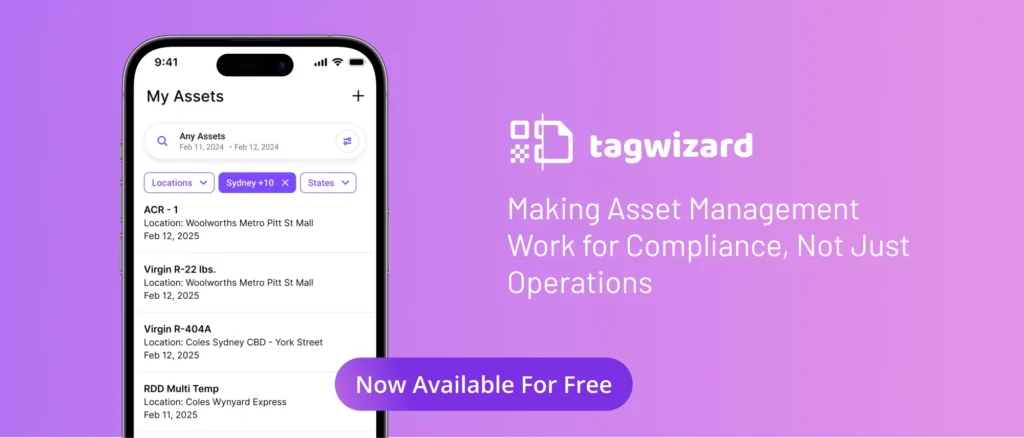
Tag Wizard transforms equipment documentation from 15 minutes per asset to 90 seconds with voice, OCR, and photo-guided capture, enabling fast, accurate data collection without typing or guesswork.
Our software automatically enriches your asset records by adding OEM specs like capacity, refrigerant type, efficiency, and age instantly, so you get complete records without manual lookups.
When choosing the right tags for your asset tagging system, important factors include environmental conditions, regulatory requirements, and the types of assets being tagged.
Selecting the right tags (such as barcode tags, QR code tags, RFID tags, GPS trackers, or NFC tags) ensures effective tracking and compliance.
Tag Wizard supports applying labels and attaching tags through a step-by-step guide, breaking the process into manageable steps to help users apply labels carefully for best adhesion and easy scanning.
The system integrates with various asset tagging systems and asset tracking software, supporting inventory management, asset visibility, and improving efficiency in daily operations.
Tag Wizard is cost-effective, supporting barcode tags and QR codes that can be scanned with a mobile phone or other mobile devices, enabling users to access asset information and essential information readily.
RFID tags and radio frequency identification, along with RFID readers, allow for bulk scanning and real-time tracking of valuable equipment, high-value assets, and other assets, while GPS trackers provide precise location data for moveable assets and products sold.
NFC tags support field communication and close-range asset management.
Tamper-evident asset tags help deter theft and make it obvious if someone has tried to remove a tag, while regular assessment and updating of asset tags is essential for long-term accountability.
Each tag carries a unique ID number, enabling tracking of specific assets, lost or stolen equipment, and supporting compliance with labeling requirements.
The system enables users to access asset data, supports field communication, and streamlines daily operations by making information readily available for audits and regulatory compliance.
Tag Wizard can also track carbon footprints and energy efficiency metrics for ESG compliance, and is compatible with electronic devices to ensure asset data is always accessible.
Built-in taxonomy ensures consistent data across stores and vendors, eliminating multiple descriptions of the same unit.
Simply take one photo, and we take it from there: feeding your equipment manager or any downstream system with a single source of truth for vendor bids, retrofit budgets, and compliance reporting.
We don’t sell asset tags: you can use any tags you want. We’re seasoned industry professionals who built techy solutions to make your job simpler and more efficient.
📌 Tag Wizard: One Photo. We Do the Rest.