
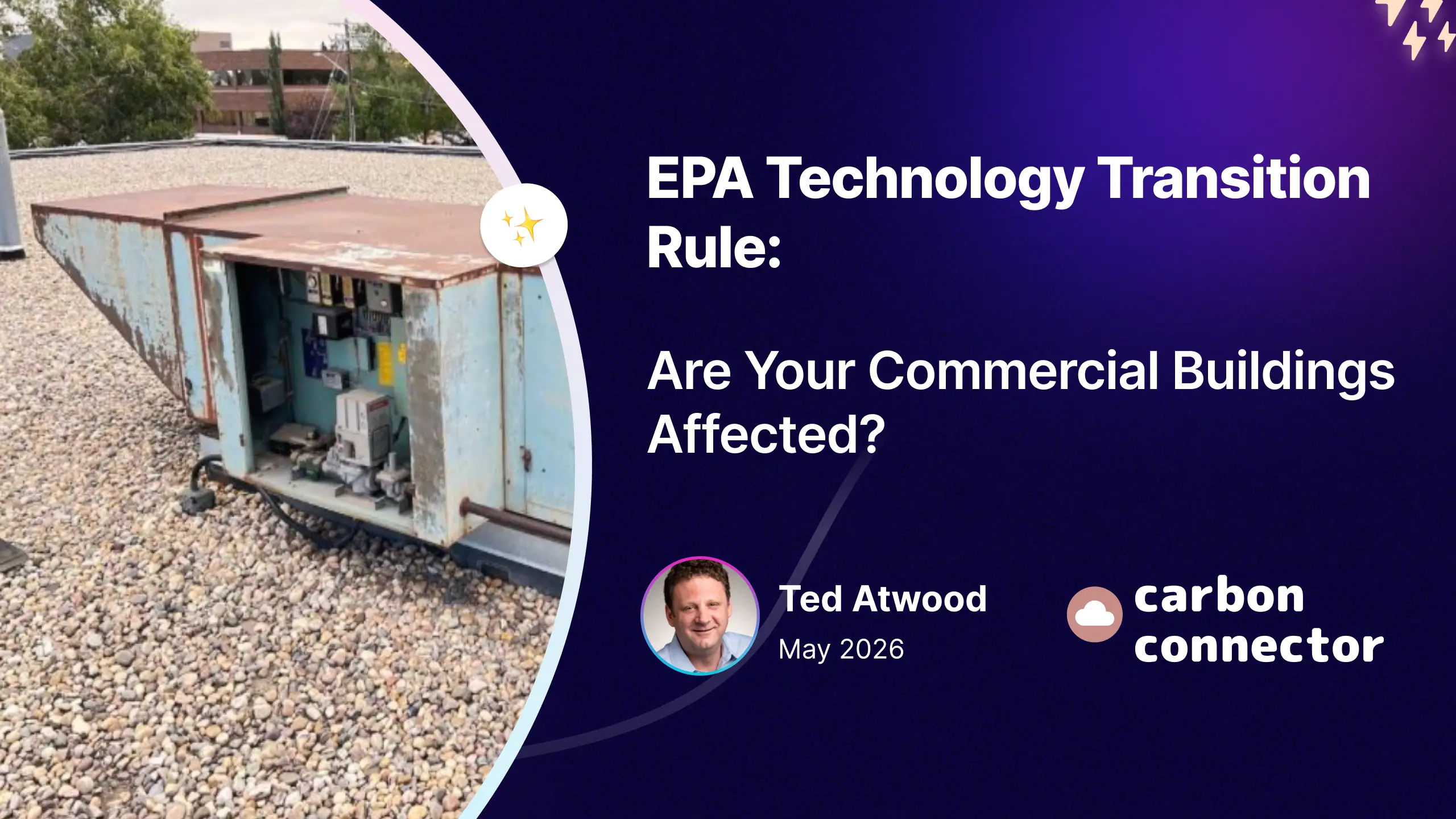
We Spent Two Years Building the Response. It Starts With Your Phone.
Bigger Than Compliance
When the Tag Wizard team started down this road, the goal was broader than building a compliance tool.
We wanted to understand how technology could solve more problems for building owners and operators, and do it in a way that actually worked for the people on the front line.
My background is in chemical engineering, refrigerant reclamation, and service management.
That means I lean hard into the operational side of regulations, not the legal side; though I have more experience than I care to admit navigating EPA enforcement.
I’ve never received a violation, and I have a 100% track record defending companies through their own EPA challenges.
That record didn’t come from knowing the law better than the lawyers.
It came from knowing the operations well enough that the documentation was never the weak point.
Those compliance lessons turned out to be exactly the foundation Tag Wizard needed.
Understanding how to tag assets properly, create a uniform classification structure, and build consistent identification systems isn’t a compliance exercise; it’s a data architecture problem.
And data architecture problems have clean solutions when you’re willing to work through them methodically.
The development journey involved dozens of people (advisors, operators, technicians, and industry colleagues) many of whom had no interest in tagging assets specifically for the Technology Transition.
But the more we talked through the problem, the clearer it became that the same principles applied regardless of the regulatory driver:
Good governance, simple steps, and an absolute commitment to reducing keystrokes for the frontline people actually capturing the data.
If the tool is hard to use in the field, it doesn’t get used. If it doesn’t get used, the record doesn’t exist. If the record doesn’t exist, none of the rest of it matters.
That’s the design philosophy behind Tag Wizard. Compliance is one reason you need it, but we bootstrapped it as an affordable, accessible operational tool, and we believe that’s why it works.
So whether you are considering TW for compliance or you have a manufacturing plant and need to log and record your assets, we’ve got you.
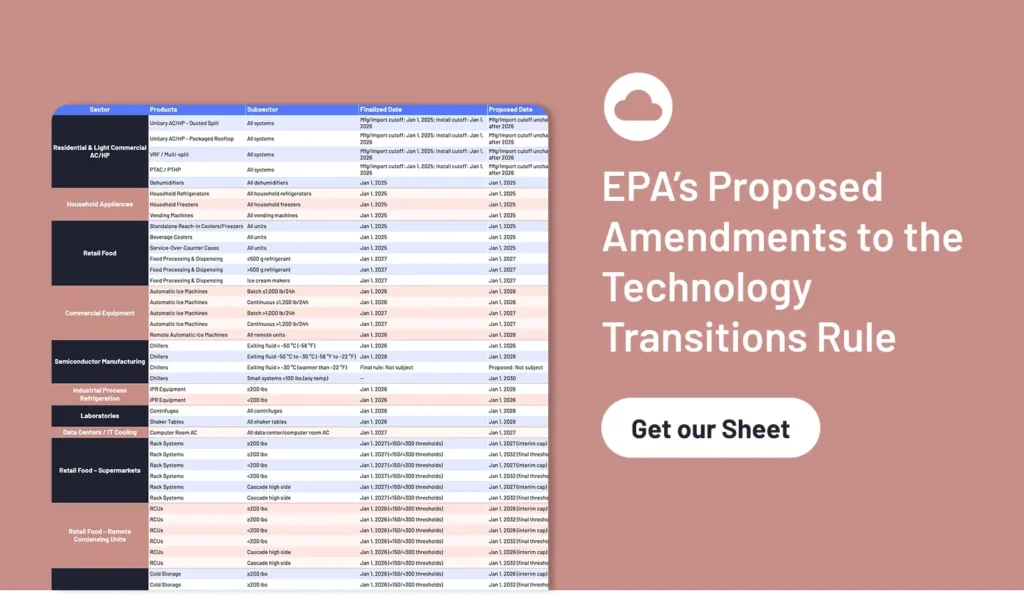
Background: What Is the EPA Technology Transition Rule?
The EPA Technology Transition Rule is a federal regulation that restricts the use of high-global-warming-potential (GWP) hydrofluorocarbon (HFC) refrigerants in the HVAC and refrigeration sectors.
The rule establishes sector-based restrictions targeting specific segments of the HVACR industry, such as heat pumps and refrigeration, to limit the use of high-GWP refrigerants and promote the adoption of sustainable technologies.
It is one of three programs implemented under the American Innovation and Manufacturing (AIM) Act of 2020, which mandates an 85% reduction in HFC production and consumption over 15 years.
It applies to commercial refrigeration, supermarket systems, cold storage warehouses, industrial process refrigeration, chillers, data centers, residential and light commercial HVAC, heat pump systems, VRF systems, refrigerated transport, and automatic commercial ice machines
The Technology Transitions Rule enforces that phasedown at the equipment level — setting sector-specific GWP limits and compliance dates for the manufacture, import, sale, and installation of refrigeration, air conditioning, and heat pump systems.
Key definitions
Technology Transitions Rule
The Environmental Protection Agency (EPA) regulation under AIM Act Section 84.54 that restricts the use of high-GWP HFCs in new RACHP equipment by sector and date, driving the transition to low-GWP refrigerants, including A2L refrigerants, CO₂, ammonia, and hydrocarbons.
The technology transitions program is an EPA-led initiative designed to manage and facilitate the phasedown of high-GWP HFC refrigerants, supporting the shift to next-generation, low-GWP technologies.
The technology transitions provisions are part of the regulatory requirements promulgated under the AIM Act.
The Technology Transitions Program was implemented to support the HFC phasedown by forcing a transition to next-generation equipment that does not utilize HFC refrigerants.
AIM Act
The American Innovation and Manufacturing Act of 2020. Federal law requires a 15-year phasedown of HFC production and consumption in the United States, from baseline to 15% by 2036.
HFC Phasedown
The congressionally mandated reduction schedule for hydrofluorocarbon refrigerants.
National allowances currently sit at approximately 60% of baseline, dropping to 30% in 2029 and 15% in 2034–2036.
This schedule is locked in statute and cannot be altered by EPA rulemaking.
ER&R Rule
The Emissions Reduction and Reclamation rule, finalized in October 2024 under AIM Act Section 84.58(h).
Establishes national leak repair requirements, automatic leak detection mandates, recordkeeping obligations, and mandatory use of reclaimed HFCs for service starting January 1, 2029.
GWP (Global Warming Potential)
A measure of how much heat a greenhouse gas traps relative to CO₂ over 100 years. R-404A has a GWP of approximately 3,922. R-410A is approximately 2,088.
The AIM Act’s ER&R rule covers systems using refrigerants with a GWP above 53.
RACHP Systems
Refrigeration, air conditioning, and heat pump systems.
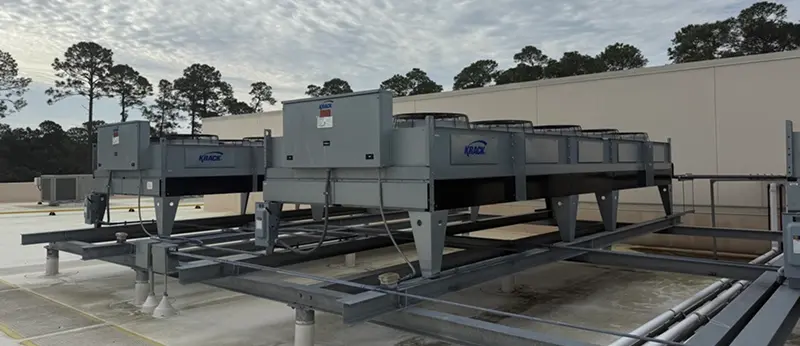
Specifically, the remote, assembled, chiller-based category covered under Section 84.54(c), which includes supermarket rack systems, chillers, remote condensing units, and large-scale commercial refrigeration.
A2L Refrigerants
Lower-GWP refrigerants such as R-32, R-454B, and R-466A are classified as mildly flammable.
The next-generation replacement for R-410A in residential and light commercial HVAC and heat pump systems.
Section 84.58
The labeling provision of the Technology Transitions Rule.
Defines four equipment labeling profiles specifying the data that must be physically attached to every covered piece of equipment, and by extension, the minimum data any compliant asset record must contain.
Final Rule
In the EPA’s rulemaking process, the final rule establishes specific compliance deadlines, restrictions, and implementation details for regulations like the Technology Transitions rule, marking a key milestone in the regulatory lifecycle.
Before You Read Another Word
Answer these three questions:
- Do you own or manage a commercial building?
- Is that building larger than 25,000 square feet?
- Does it have air conditioning?
If you answered yes to all three, there is a federal compliance obligation either already in effect or arriving within the next 24 months that governs how you manage, track, and report the refrigerants running through your building’s cooling systems.
📌 You don’t need to panic. You need to get started.
Grab your phone. Go to tagwizard.ai.
If you want to know exactly what you’re dealing with and why we spent two years building this, keep reading. It’s worth five minutes of your time.

The Short Version
The AIM Act affects approximately 4 million of the roughly 6 million commercial properties in the United States. That’s 2 in 3 buildings.
The rule has teeth.
Systems with 15 pounds or more of HFC refrigerant with a GWP above 53 are subject to mandatory leak-repair timelines, recordkeeping requirements, and (for larger systems) automatic leak detection mandates.
Non-compliance triggers retrofit or retirement obligations. The core requirements are already in effect as of January 1, 2026.
The EPA technology transition rule establishes specific compliance requirements and compliance deadlines for manufacturers, contractors, and building owners, dictating when certain equipment can be sold, installed, or serviced under the new standards.
Most building owners and facility managers don’t know they’re in scope. Most don’t have the asset documentation the rule requires. Most are one inspector visit away from a problem. Additionally, supply chain issues have affected the availability of compliant equipment and refrigerants, making it more challenging to meet compliance deadlines.
Tag Wizard was built to fix that. Two years in development. Purpose-built as an asset tagging solution for compliance-heavy HVAC and refrigeration operations.
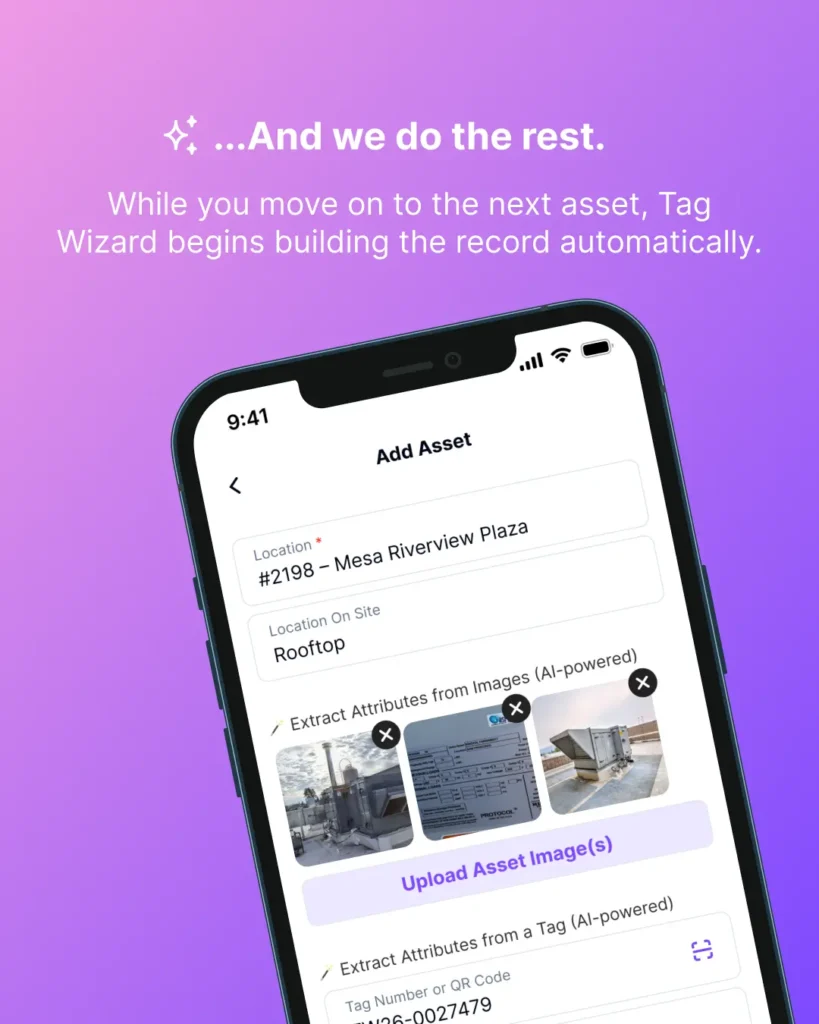
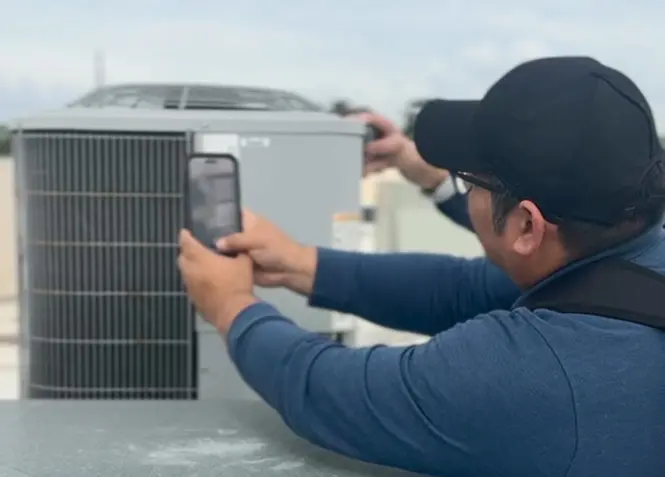
The concept is simple: you take the picture, Tag Wizard does the rest.
Your phone’s camera becomes the starting point for a complete, audit-ready asset record — refrigerant type, charge size, installation date, service history, all of it.
$100 per seat per location per year. No hardware. No consultant. No spreadsheet. No limit on assets, users, or the size, or how fancy or plain the building is.
Ready To Get Started?
You can be tagging assets today. Literally today.
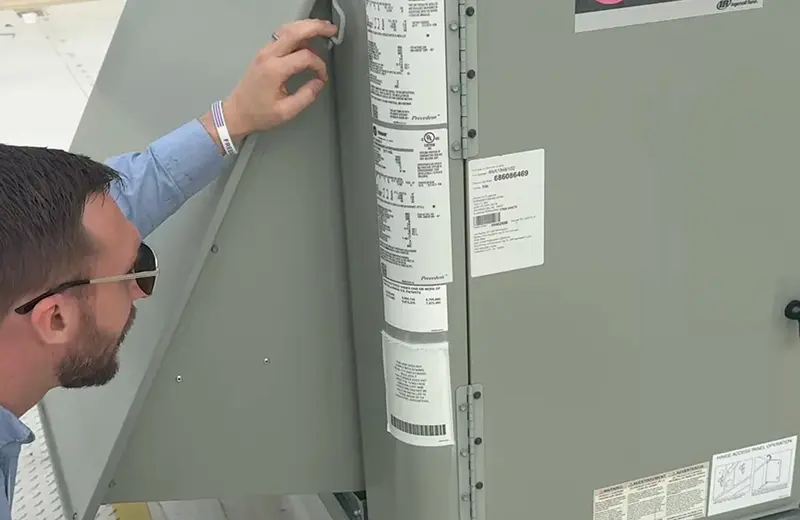
Download the app, point your phone at a nameplate (or just take a picture of any part of the system), and Tag Wizard builds the record. No training course. No implementation project. No waiting for a vendor to show up.
If you have ten minutes and want to understand the full regulatory picture (who’s affected, what the deadlines actually are, and what happens if you wait), read on.
The detail matters, and knowing the context will change how you think about your building portfolio.
But if you’re ready to move, download the app.
📱 Download Tag Wizard
What EPA Actually Said (and Didn’t Say)
Last August, EPA Administrator Lee Zeldin stood next to J.D. Vance at a refrigeration shop in Georgia and announced what the industry wanted to hear: relief. Extended deadlines.
Sell-through provisions. Flexibility.
A reprieve from the Technology Transitions Rule that had been keeping facility managers and HVAC contractors up at night.
The sell-through provision allows for the sale and installation of equipment manufactured before the compliance deadline, helping businesses manage inventory during the transition period.
I’ve been in this industry for more than 30 years. I’ve seen a lot of announcements, especially those influenced by supply chain issues related to the availability and timely delivery of HVAC system components.
This one is a market mirage, and if you mistake it for a destination, it’s going to cost you.
The EPA is reconsidering the rule and intends to provide more regulatory flexibility as part of the reconsideration of the Technology Transitions Rule. The proposed rule is also part of the EPA’s efforts to address stakeholder concerns regarding the Technology Transitions Program.
📌 Ready to transform your asset tracking?
Book a demo or start a free trial today and see how easy managing your assets can be.
What Changed
The reconsideration under OIRA review (RIN 2060-AW39) proposes to adjust some Technology Transitions Rule use restrictions — sell-through windows, installation timelines, and targeted carve-outs for specific sectors.
The proposed rule removes the installation compliance date for residential and light-commercial AC and heat pump systems, allowing existing R-410A inventory to be sold and installed for an extended period.
Compliance timelines are being reconsidered to provide regulatory flexibility and address industry concerns about meeting deadlines amid supply chain impacts.
For supermarket systems and cold storage warehouses, EPA has proposed raising the GWP threshold to 1,400 (up from 150 or 300) through January 1, 2032, before reverting to the original limits.
These changes are a response to real supply chain constraints: A2L refrigerants and compliant equipment have not reached the market in sufficient volume to support an abrupt transition.
Sell-through provisions prevent stranded inventory — factory-completed products manufactured or imported before the import compliance date of January 1, 2025, can still be legally sold and installed for a defined window afterward.
The proposed rule allows the installation of new HVAC systems using a regulated substance with a GWP of 700 or greater if all components were manufactured or imported prior to January 1, 2025.
Similarly, new residential and light commercial air-conditioning and heat pump systems using a regulated substance with a global warming potential of 700 or greater may be installed, provided all components were manufactured or imported before January 1, 2025.
For Variable Refrigerant Flow (VRF) systems, installation deadlines for high-GWP VRF systems have been extended to January 1, 2027, or to January 1, 2028, for certain permitted projects.
Systems with an approved building permit prior to specific cutoff dates may be eligible for these extended installation deadlines, allowing continued installation of high-GWP refrigerant systems under evolving regulations.
What Didn’t Change
The AIM Act’s statutory HFC phasedown is locked in law.
National allowances fall from roughly 60% of baseline today to 30% in 2029, and to 15% by 2034–2036.
No proposed rule touches that cap. Not this one. Not any rulemaking under OIRA review.
📌 Important distinction: The timeline for when certain refrigerants are no longer allowable changed. The obligation to tag and document every system that contains them did not.
What the reconsideration actually does is allow more legacy HFC systems (more R-410A heat pump equipment, more high-GWP supermarket racks) to stay active and enter the field right as supply tightens on a congressionally mandated schedule.
More demand. Less supply. Washington solved the political problem of stranded inventory. In doing so, it amplified the long-term business problem of scarcity.
That’s the supply shock. That’s what leaders need to plan for.
I’ve Watched This Play Out Before
I founded Polar Technology, where we recycled more than 3 million pounds of refrigerant annually and were founding members of the first carbon market in the United States.
We pioneered blockchain-based refrigerant tracking before most of the industry had even heard the word (2009).
We used that operational insight to launch Trakref — the first rules-engine-driven software application built specifically for refrigerant/HVAC service technicians.
I built the compliance infrastructure for refrigerant management at scale before most of the industry acknowledged it needed one.
I’ve watched companies operate without asset visibility and pay for it — in emergency refrigerant purchases at panic pricing, in EPA enforcement actions that started with a single missing service record, in audit failures that should never have happened.
The underlying problem has always been the same: the equipment is real, the refrigerant charge is real, the regulatory liability is real — but the record doesn’t exist.
Most facilities today don’t have a clean, current, auditable record of their refrigerant-containing assets. Not really.
They have spreadsheets that are six months out of date. They have service records scattered across three different contractors.
They have units in the field with no charge documentation, no installation date, no refrigerant type logged anywhere that survives a technician turnover.
That’s an operational failure in a normal market. In a supply-constrained, price-volatile, enforcement-intensifying market, the real cost of refrigerant leaks turns it into an existential one.
The regulatory waves that have shaped this industry (including the AIM Act’s core compliance requirements and the regulatory requirements promulgated under the American Innovation and Manufacturing (AIM) Act of 2020) have evolved through rulemaking, petitions, and ongoing stakeholder input.
Stakeholder concerns have directly influenced the timing and structure of regulatory changes, such as the delay of certain compliance dates and adjustments to technical thresholds.
For the most up-to-date and official information on these rules and regulatory updates, the Federal Register serves as the authoritative source.
Two years ago I decided to stop describing the problem and build the solution.
That’s Tag Wizard. And the compliance clock that makes it urgent isn’t theoretical, it’s already running.
One Photo. We Do the Rest.
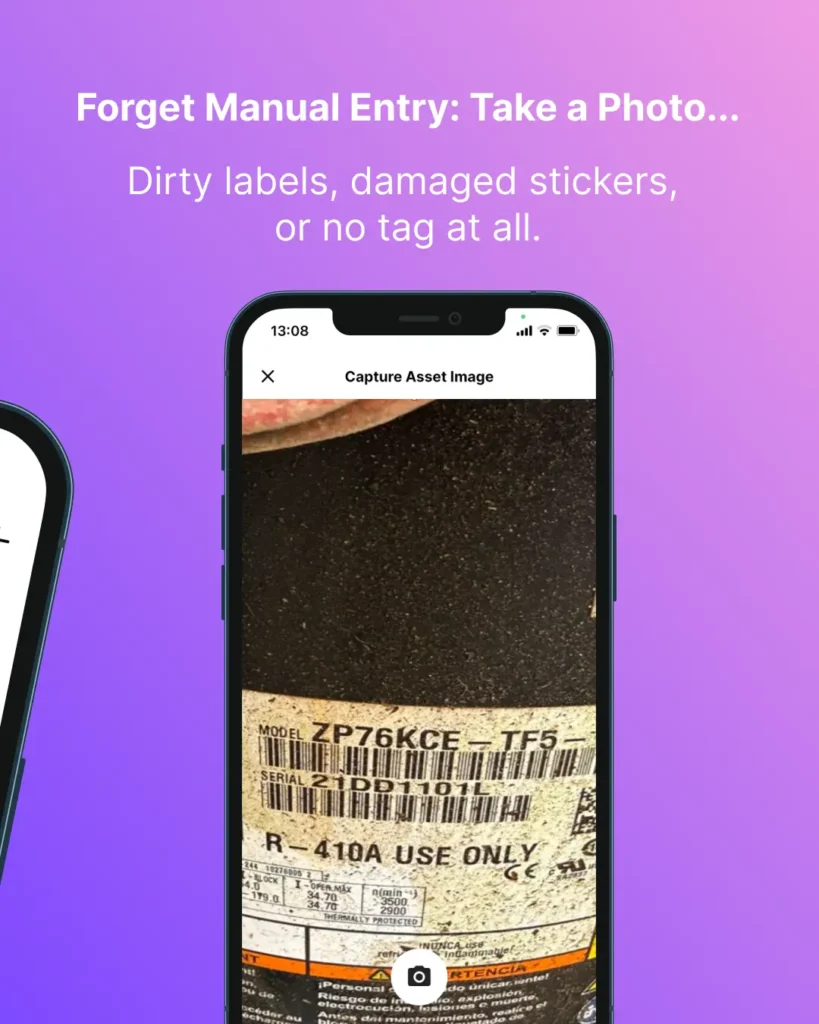
Simply snap a photo of the asset tag or label, and Tag Wizard’s AI extracts and completes the data for you, making tagging effortless.
📱 Download Tag Wizard
The Math Gets Ugly Fast
Let me make this concrete, because boards respond to numbers.
A typical centralized supermarket rack carries around 4,000 pounds of R-404A. At historical leak rates without best practices, that system loses roughly 25% of its charge per year — about 1,000 pounds.
At today’s pricing (~60% allowance band), that’s approximately $20,000 per year, per rack, walking out the door as atmospheric loss.
At the 30% band in 2029? That same leak costs $40,000–$55,000 per year.
At the 15% band in 2034? You’re looking at $80,000–$100,000 or more — per rack, per year.
💰 What a 25% annual leak rate costs — per rack, per year
| Allowance Band | Timeframe | Annual Loss Per Rack |
| ~60% (today) | Now | ~$20,000 |
| 30% | 2029 | $40,000–$55,000 |
| 15% | 2034+ | $80,000–$100,000+ |
Based on a 4,000 lb R-404A system at 25% annual leak rate. Multiply by your store count.
Now multiply that across a 50-store chain. Across a regional cold storage portfolio. Across a data center campus running legacy HFC cooling.
This is not a compliance problem. This is a capital allocation problem. And as the future of owning and operating refrigeration equipment makes clear, it has a solution.
How We Got Here: Thirty Years of Slow, Then One Rule That Wasn’t
I keep a slide I built back at Trakref — a pyramid that shows the scale and scope of refrigerant regulation in America from 1994 to today. I’ve updated it several times. Every time I do, I’m struck by the same thing: the industry had decades of gradual ramp, and then the AIM Act happened.
EPA 608 (1994–2004) covered refrigeration, grocery, and chemical plants with systems over 50 pounds — roughly 200,000 US properties. One decade. One sector. Slow enough to absorb.
SCAQMD (1995–2010) added Southern California AC systems over 50 pounds — another 120,000 properties over 15 years.
ARB R3 (2010–2022) expanded California’s footprint for grocery and chemical refrigeration — 600,000 total properties by 2022.
SNAP and state registration requirements in New Jersey and Washington pushed the total to around 880,000.
Scale and scope of Refrigerant Regulations
| # of US Properties that must manage refrigerants | Regulation | Region | Regulation Requirements | Regulatory Impact | Total |
|---|---|---|---|---|---|
| 200k | EPA 608 1994-2004 | Nationwide | Refrigeration, Grocery, and Chemical plants with units that have over 50lbs of refrigerant must track transactions and emissions | 5% | 5% |
| 320,000 | SCAQMD 1995-2010 | Southern California | AC units that had over 50lbs of refrigerant must track transactions and emissions | 3% | 8% |
| 600,000 | ARB R3 2010-2022 | California | Refrigeration, and overall refrigerant use in Grocery, and Chemical plants must track transactions and emissions | 7% | 15% |
| 880,000 | SNAP Program | Nationwide | Regulates what refrigerants can be used in HVAC/R systems | 7% | 22% |
| 1,160,000 | State Registrations | New Jersey Washington | Adds all HVAC/R systems to registry if systems have over 50lbs of refrigerant | 7% | 29% |
| 3,160,000 | Aim Act | Nationwide | 15 LB and larger systems | 50% | 79% |
| 4,000,000 | Cylinder Tracking | Nationwide | Any cylinders containing any GWP 53 and greater will require tracking | 100% | 100% |
Source: Trakref
Each of those waves gave the industry time.
A decade, sometimes more, to adapt — to build compliance infrastructure, train technicians, develop software, change procurement behavior.
Then the AIM Act landed.
A single federal rule — 15 pounds of refrigerant, GWP above 53, nationwide — and the compliance universe jumped from 880,000 properties to more than 3.1 million almost overnight, reshaping what it means to own or operate a commercial AC unit.
That’s not an expansion.
That’s a 3.6x step function. More than 2.2 million operators who had never tracked a pound of refrigerant in their lives suddenly had federal compliance obligations.
Residential and light commercial HVAC systems — mini-splits, rooftop units, heat pump systems — entered the regulatory universe for the first time.
With the expansion of regulatory coverage, sector based restrictions now apply, and certain technologies are subject to new compliance requirements — a theme we explore often in our HVAC/R regulation and sustainability insights.
Beginning January 1, 2025, certain technologies may no longer use high global warming potential (GWP) HFCs or HFC blends.
When you include cylinder tracking requirements for any container holding a refrigerant with GWP 53 or greater, you’re looking at 4 million US properties eventually in scope, thats 2 in 3 commercial buildings in America.
The industry didn’t have a decade to build toward this. The rule arrived, and most of those 2.2 million newly-regulated operators are still figuring out what hit them.
That’s why we built Tag Wizard when we did, not in response to the deadline, but two years ahead of it.

Who’s on the Hook, and When
Let me be precise about this, because I’ve watched too many operators misread the AIM Act compliance calendar and get caught.
The EPA technology transition rule sets compliance triggers based on the type of equipment, installation date, and the refrigerant used.
Systems that use a regulated substance—such as certain HFC refrigerants—are subject to these requirements, including compliance deadlines and specific compliance requirements under the AIM Act.
January 1, 2026 — Already Here
The ER&R rule’s core leak repair and management requirements are in effect now for any system with 15 pounds or more of HFC refrigerant with a GWP above 53.
That threshold covers a massive swath of operating America: every supermarket, every convenience store with reach-in cases, every warehouse with a mechanical room, every office building with a commercial chiller, every data center, every cold storage facility, every food manufacturing plant, every pharmaceutical facility with temperature-controlled storage.
Any of those systems leaking above the threshold (30% annual leak rate for commercial refrigeration, 20% for industrial process refrigeration) triggers a mandatory repair timeline and, if unresolved, a retrofit-or-retire obligation.
This isn’t a future requirement. It is the law today.
January 1, 2026 — New Large Systems Need ALD
Any new commercial or industrial refrigeration system with 1,500 pounds or more of HFC refrigerant (GWP > 53) must have automatic leak detection (ALD) installed within 30 days of commissioning. No grace period.
January 1, 2027 — Existing Large Systems Need ALD
Existing commercial and industrial refrigeration systems installed between January 1, 2017 and December 31, 2025, carrying 1,500 pounds or more of HFC refrigerant, must have automatic leak detection in place. One critical caveat: systems installed before January 1, 2017 are exempt — but only if you can document the original installation date. No documentation, no exemption. Which brings us directly back to the tagging problem.
January 1, 2029 — Reclaimed Refrigerant Only for Service
Supermarket systems, refrigerated transport, and commercial ice makers must be serviced and repaired using reclaimed HFCs. Not virgin. Reclaimed. The reclaim supply chain only functions if the recovery, documentation, and reclamation loop has been operating for the three years before this deadline. Operators who have been leaking and topping off with no records will find themselves in a tight market competing for reclaimed supply that doesn’t yet exist at scale.
State Overlays That Don’t Wait for Federal Timelines
California ARB RMP
CA has required automatic leak detection for commercial refrigeration above 50 pounds for years — predating the federal rules entirely.
Washington
WA requires ALD program compliance and 14-day leak repair. Facilities with 200–1,499 pounds of refrigerant had to register by March 15, 2026; small facilities (50–199 pounds) have until March 15, 2028.
New York Part 494
NY carries ALD expectations and annual reporting obligations.
These state refrigerant compliance programs don’t pause because federal enforcement posture softens.
📌 Ready to transform your asset tracking?
Book a demo or start a free trial today and see how easy managing your assets can be.
Who Specifically Is Affected
If you operate any of the following, you are in scope now or within 36 months: grocery retail, convenience retail with reach-in cases, cold storage and food distribution, food manufacturing and processing, data centers, pharmaceutical and life sciences facilities, restaurants and food service with walk-in units, hotels and hospitality with central chiller plants, healthcare campuses, and industrial process refrigeration.
That is most of commercial America.
HVAC installers and the food industry association play key roles in ensuring compliance for retail food refrigeration equipment as these sectors adapt to new EPA technology transition rule requirements.
The compliance calendar is running right now.
And every obligation on it assumes one thing: you either have, or you don’t have, a documented, current, auditable record of your assets.
Why We Built Tag Wizard — And Why a Simple Scan Tool Was Never Going to Be Enough
When the AIM Act landed, and I looked at what it was actually requiring of 4 million newly or newly expanded scope operators, I didn’t see a gap in awareness.
I saw a gap in executable tools — and I started working on filling it two years ago.
📌 The tagline for Tag Wizard is simple: You take the picture. Tag Wizard does the rest.
But getting to that simplicity required solving a problem that turned out to be far more layered than it appears from the outside.
Navigating the complexity of specific designated labeling without asking the operator to do more work, so that operators don’t have to closely track compliance timelines and deadlines to ensure they meet all regulatory obligations under the EPA Technology Transition Rule.
Tag the asset, load them into your compliance systems (like Trakref), and you are on your way.
The Installed Base Problem Nobody Talks About
When most people imagine taking inventory of their refrigerant-containing equipment, they picture walking through a facility with a clipboard and writing down what’s there.
That’s a reasonable model for a facility built last year with clean documentation.
It is not a reasonable model for the installed base that actually exists in commercial America today.
The equipment running in most commercial buildings was manufactured, delivered, and installed over a 20-year span during which documentation standards were inconsistent, contractor record-keeping was fragmented, equipment was expanded and modified after original installation, refrigerant types were changed during service, and building ownership transferred multiple times with incomplete records.
The same physical rack system might appear three different ways in three different systems (original installation record, service contractor database, facility management spreadsheet) with different model numbers, different charge weights, and different installation dates, none of which fully agree.
The inventory isn’t a list. It’s an archaeological dig.
And it is 20 times more abundant and more complex in the HVAC/R space than in almost any other compliance domain, because of the way this industry built and delivered equipment across two decades of rapid commercial expansion.
In addition to these documentation challenges, the HVAC industry is currently facing significant supply chain issues related to the transition to A2L refrigerants, even as a new era in refrigerant leak detection and safety systems emerges to support that shift.
Shortages of A2L refrigerant cylinders have affected the availability of these refrigerants for HVAC installers and service contractors, making it difficult to meet regulatory compliance deadlines.
The hoarding of A2L refrigerants has contributed to regional shortages and driven up installation costs for consumers needing new air conditioning systems.
As a result, contractors are seeking alternative solutions, such as installing equivalent HFC systems, to address these supply chain issues.
The transition to A2L refrigerants is further complicated by the need for proper equipment and training to handle these new refrigerants safely.
The HVAC industry must also navigate a complex regulatory landscape during this transition, making specialized refrigerant leak detection services for grocery, data centers, and CRE increasingly central to day-to-day operations.
To avoid future supply shortages and price volatility as HFC production allowances drop, industries must transition to alternatives like A2L refrigerants, CO2, or ammonia.
The Code Council has developed the A2L refrigerant ‘Hot Topics’ page to assist industry professionals in managing these changes.
A scan tool alone was never going to solve that. Scanning gets you what’s on the nameplate. And the nameplate, it turns out, is only the beginning.
What’s on a Nameplate Versus What AIM Act Compliance Actually Requires
A typical equipment nameplate gives you the model number, serial number, manufacturer name, refrigerant type, nominal charge weight, electrical specifications, and (sometimes) a manufacture date.
That’s what the factory put on it. That’s what was true the day it shipped.
Here is what AIM Act compliance actually requires, beginning with what Section 84.58 of the Technology Transitions Rule defines as mandatory label content for covered equipment:
The ASHRAE chemical name of the refrigerant currently in the system — not just the blend designation, the full chemical name.
The full date of manufacture.
The refrigerant charge weight and capacity as labeled or listed.
A GWP notation if the refrigerant falls below 150.
Labeling on any servicing parts whose replacement refrigerant has a GWP above the applicable threshold.
All labels must be durable, weatherproof, readily visible, and in a contrasting color.
Labeling must also reflect the refrigerant charge capacities of the system, as the charge size threshold applicable to the equipment determines which regulatory requirements and compliance dates apply.
For systems with refrigerant charge capacities greater than certain thresholds, such as 200 pounds, additional requirements and restrictions are triggered under the rule.
For RACHP systems (the remote, assembled rack and chiller systems that cover most commercial refrigeration) the rule requires additional data that does not appear on any nameplate:
The commissioning date: the date the system was installed and put into service in the field, not the date it left the factory.
A system manufactured in 2019 and installed in 2023 has two different dates that matter for two different regulatory purposes.
The nameplate carries one of them, if either.
An explicit indication of whether the system charge is above or below 200 pounds, because that single threshold determines which GWP limit applies, which compliance date governs, and whether the system triggers automatic leak detection requirements under the ER&R rule.
For ice machines, the harvest rate in pounds per 24 hours, because that figure determines which compliance tier applies.
None of this is on the nameplate. The commissioning date lives in a contractor’s installation record, if it was documented at all.
The current charge weight may have drifted from the nameplate spec through years of service top-offs, partial recoveries, and refrigerant type changes.
The charge-size classification requires a current verified charge weight, not a factory spec.
The Four Labeling Profiles: Section 84.58 Explained –
You won’t see this anywhere else
Most operators and even most HVAC professionals think of the Technology Transitions Rule as a manufacturer problem — a list of refrigerants that can no longer go into new equipment after certain dates. That’s true as far as it goes.
What almost nobody talks about is Section 84.58 — the labeling provision — where the Technology Transitions Rule reaches off the factory floor and into the field.
The rule defines four labeling profiles, each tied to specific equipment categories, including refrigeration equipment, related equipment, certain condensing units, split systems, and light commercial air conditioning.
Every covered piece of equipment must carry a label meeting its applicable profile.
For profiles 3 and 4, this includes remote condensing unit systems, new supermarket systems, industrial process refrigeration equipment, laboratory equipment, certain laboratory equipment such as refrigerated laboratory shakers and refrigerated laboratory centrifuges, as well as equipment used in semiconductor manufacturing and the semiconductor manufacturing industry.
Profiles 2 and 4 also cover refrigerated transport intermodal containers and their compliance considerations.
When discussing technical requirements, the rule addresses cascade systems, direct heat exchange systems, and emphasizes that the box temperature and temperature measurement are critical for determining compliance—specifically, the temperature at which equipment is designed to operate determines its regulatory status under the rule.
Here is exactly what each profile requires.
Profile 1 — Self-Contained Equipment
Applies to: residential and light commercial AC and heat pumps, household refrigerators and freezers, vending machines, data center cooling, industrial process refrigeration units, retail food standalone units, retail food processing and dispensing equipment, self-contained commercial ice machines, cold storage warehouses, VRF systems, certain condensing units, split systems, and light commercial air conditioning equipment such as rooftop units.
Required label content: ASHRAE chemical name, full date of manufacture, refrigerant charge weight and capacity, GWP notation if below 150, servicing parts labeling if replacement refrigerant GWP exceeds threshold.
Durable, weatherproof, readily visible, contrasting color.
Profile 2 — Self-Contained Refrigerated Transport
Applies to: intermodal containers, refrigerated transport intermodal containers, road self-contained products, marine self-contained products.
Same requirements as Profile 1, with manufacture date recorded as model year rather than full calendar date.
For refrigerated transport intermodal containers, compliance is determined using box temperature and temperature measurement.
Regulatory thresholds, such as exclusion temperatures, are based on the actual box temperature inside the container, and accurate temperature measurement is essential for determining whether a container meets or is exempt from specific requirements.
📌 With the problem defined, let’s look at the guiding principles that shape Tag Wizard’s approach to asset visibility.
Profile 3 — RACHP and Light Commercial Air Conditioning Systems
Applies to:
- refrigeration equipment,
- related equipment,
- chillers for industrial process and comfort cooling,
- ice rinks,
- data centers (chiller-based),
- industrial process refrigeration equipment (including those not using chillers),
- cold storage warehouses (remote systems),
- retail food supermarket rack systems,
- remote condensing unit systems,
- retail food remote condensing units,
- retail food remote processing and dispensing equipment,
- remote commercial ice machines,
- laboratory equipment,
- certain laboratory equipment (such as refrigerated laboratory shakers and refrigerated laboratory centrifuges), and
- equipment used in semiconductor manufacturing and the semiconductor manufacturing industry.
Same base requirements as Profile 1, plus: commissioning date (not just manufacture date), explicit charge size indication above or below 200 pounds, and for ice machines, harvest rate.
When determining compliance thresholds, factors such as the use of a cascade system, the charge size threshold applicable, and refrigerant charge capacities greater than specified limits are critical, as they influence regulatory requirements, applicable GWP limit, compliance deadline, and ALD obligation under the ER&R rule.
These are not administrative details — they are the fields that determine regulatory tier, applicable GWP limit, compliance deadline, and ALD obligation under the ER&R rule.
Profile 4 — RACHP Refrigerated Transport
Applies to: intermodal containers with chiller systems, road systems (chiller-based), marine systems (chiller-based), refrigerated transport intermodal containers, and direct heat exchange systems.
Same requirements as Profile 3 with model year as the date format.
For refrigerated transport intermodal containers and direct heat exchange systems, regulatory status is determined by the temperature at which the equipment is designed to operate (operate determines).
Compliance is based on temperature measurement, specifically the box temperature inside the container, rather than just the refrigerant entry temperature.
This ensures that equipment meeting or exceeding certain box temperature thresholds, such as the exclusion temperature of -35°C, is properly classified under the EPA technology transition rule.
Why the Profiles Matter in the Field
The labeling profiles are the EPA’s attempt to make every piece of covered equipment self-documenting.
The theory: an inspector, a technician, or a facility manager can look at the equipment and immediately know what refrigerant is in it, when it was commissioned, how much charge it holds, and which regulatory tier it belongs to.
The reality is different. Labels fade. Labels get painted over during remodels.
Labels get obscured by insulation.
Equipment installed before the rule may carry no label at all, or a label missing required Profile 3 fields.
And even a fully legible label still has to get into a record somewhere — a record that survives technician turnover, contractor changes, and building sales, and can be produced on demand during an audit.
That is exactly what Tag Wizard was built to capture. The technician photographs the nameplate.
Tag Wizard reads the ASHRAE chemical name (if it’s not there, we go and retrieve it), the manufacturer or commissioning date, the charge weight, the model, and the serial number.
It maps that data to the applicable labeling profile and populates the asset record.
It flags any missing required fields. It evaluates the charge weight against the 200-pound threshold and automatically classifies the system’s compliance tier.
If the commissioning date isn’t on the nameplate, it prompts for it.
📱 Tag Wizard. One Photo, We Do the Rest.
Beyond the Nameplate: The Records That Compliance Actually Runs On
The nameplate is a birth certificate. What the regulation requires is a complete, continuously updated medical record for every covered asset in your portfolio. Meeting compliance requirements means not only maintaining these records, but also ensuring you are prepared for compliance deadlines and tracking compliance timelines as regulatory obligations evolve.
Here is what compliance actually requires that goes beyond anything a label or nameplate can provide:
Service history
Every repair event, every refrigerant addition, every recovery, every top-off, with dates, quantities, technician certification numbers, and reclaimed vs. virgin refrigerant used. You cannot calculate annual leak rate without a time-series of charge additions against a verified full charge baseline. You cannot prove ER&R compliance starting in 2029 without traceability to reclaimed refrigerant use going back through every prior service event.
ALD calibration records
Required annually for systems subject to automatic leak detection mandates, stored and producible on demand. Not on any nameplate. Created and maintained through service records only.
Post-repair verification tests
Mandated under Washington state’s program and several other state overlays. The repair happened. The verification confirmed it held. That record must exist and be retrievable.
Installation date documentation for pre-2017 systems
The ER&R rule exempts systems installed before January 1, 2017 from ALD requirements, but only if you can document the original installation date. No documentation, no exemption. The nameplate manufacture date is not the same as the installation date. A unit manufactured in 2015 and sitting in a distributor’s warehouse until 2018 carries a manufacture date that appears to qualify for the exemption — but the installation date disqualifies it. Without the commissioning record, that determination cannot be made.
Reclaimed vs. virgin refrigerant traceability
Required for ER&R compliance beginning January 1, 2029. The traceability chain has to start now, from the first service event recorded in Tag Wizard, so there is a complete documentation history when the mandate takes effect.


The Tag Wizard Four-Stage Workflow
Every existing tool in the refrigerant compliance market was solving one piece of this problem and leaving the other pieces to the operator. Scan the nameplate. Now figure out the rest yourself.
That is not a solution for 4 million properties. It is a solution for a facilities director with a full-time compliance staff. Most operators newly in scope under the AIM Act don’t have that. They have a building engineer, a service contractor they call when something breaks, and a spreadsheet that hasn’t been updated since the last time someone asked about it.
Tag Wizard had to solve four things simultaneously — and all four had to be true at once, or the tool didn’t work.
Accurate.
Not approximately right — precisely right. Wrong regulatory profile means wrong compliance conclusions means real legal exposure.
We built the profile mapping against the actual Section 84.58 regulatory text and the specific subsector classifications in the Technology Transitions Rule.
The four labeling profiles are built into the classification engine.
The 200-pound charge threshold is a hard decision point in the workflow, not a field the operator has to determine independently.

Fast.
Executable at field level by a technician who is not a compliance expert and does not have time to stop and read a regulation.
The scan-and-capture workflow had to work in the time it takes to walk up to a piece of equipment, photograph the nameplate, and move to the next unit.
The profiling and evaluation logic runs in the background automatically.
Regulation-aligned.
Not a generic asset tracker mapped onto refrigerant compliance after the fact — a tool built from the ground up against the specific data requirements of Section 84.58, the ER&R rule’s recordkeeping provisions, and the state-level ALD programs in California, Washington, and New York.
The asset record Tag Wizard creates is structured to satisfy an audit, not just internal tracking.
Affordable.
$100 per seat per year.
If the price puts it out of reach of the independent grocery operator, the regional cold storage company, the mid-size hotel chain, or the food manufacturer who just found out they’re in scope, the tool fails the mission regardless of how good it is.
The 2.2 million newly-regulated operators are not all enterprise accounts. The solution had to be accessible or it wasn’t a solution.
Tag Wizard is designed to help users meet compliance requirements, stay ahead of compliance deadlines, and effectively manage compliance timelines associated with the EPA Technology Transition Rule.
What You Get When You Use It
A technician points their phone at a nameplate. Tag Wizard captures the model number, serial number, refrigerant type, charge weight, and manufacture date. It cross-references that data against the Technology Transitions Rule subsector classifications to determine the applicable labeling profile. It flags missing required fields. It evaluates charge weight against the 200-pound threshold and classifies the system’s compliance tier. It builds the initial asset record and opens the service history log.
Every subsequent service event — refrigerant addition, repair, recovery, ALD calibration — gets added to that record. Leak rate calculates automatically from the service history. Reclaimed vs. virgin refrigerant tracking starts from day one. The installation date is documented and verifiable. The pre-2017 ALD exemption determination can actually be made.
What you end up with is not a nameplate scan. It is a living compliance record for every asset in your portfolio — built quickly, maintained continuously, and structured to satisfy every obligation on the AIM Act compliance calendar from now through 2034 and beyond.
Detection without documentation is noise. An alarm means nothing if you don’t know what system triggered it, what refrigerant it holds, when it was last serviced, or whether the current charge is even the right number. Tag Wizard is the documentation layer that makes the detection layer worth deploying.
At $100 per seat per year, it costs less than the refrigerant that walks out the door in a single undetected leak on a system you couldn’t classify because you didn’t know what you had.

The Two-Pillar Doctrine
After 32 years in this industry, I’ve distilled the operational response to what’s coming into two pillars that are entirely within your control.
Pillar One: Absolute Asset Visibility.
Tag every rack, circuit, condensing unit, and cylinder. Build the digital twin. Know your refrigerant charge inventory the way a CFO knows the balance sheet — because as HFC prices escalate toward $80 and $100 per pound, that is exactly what it is. Tag Wizard makes this executable at the field level without adding administrative burden. The technician takes the picture. The compliance infrastructure builds itself.
Pillar Two: Proactive Leak Defense.
Deploy Leak Detection as a Service to operationalize automatic leak detection.
Integrate ALD with your CMMS so alarms create work orders automatically — no silent alerts, no ignored notifications. Enforce a no-top-off policy without root-cause repair.
Require post-repair verification.
Run monthly leak-rate dashboards by site. Make it a board-level KPI. AKO USA’s sensor technology paired with Carbon Connector’s layered leak detection framework is how we’re executing this with major food retail operators right now.
These two pillars work together. You cannot run an effective leak detection program without knowing what you’re detecting leaks from.
And asset data without a detection layer is just a record of what you’re losing. Pillar One is where you start.
It is what Tag Wizard delivers. Today.
The Strategic Horizon
The EPA solved a near-term political problem last August. But leaders who treat that announcement as a strategy will find themselves on the wrong side of the HFC scarcity curve.
Sell-through provisions lock more legacy HFC demand (more R-410A heat pump equipment, more high-GWP supermarket refrigeration) into a system where the supply ceiling is dropping by statute. More systems.
Less refrigerant. Rising prices. Intensifying enforcement from state programs that are not waiting for federal signals. That is the trajectory.
The companies that will lead through this are not the ones who buy time.
They are the ones who use the time they are given to build visibility, reduce losses, and transition their capital investments toward next-generation systems (CO₂, A2L refrigerants, natural refrigerants) where the regulatory and supply risk is manageable.
I built Tag Wizard for those companies. Not because refrigerant asset tagging is glamorous.
Because risk you don’t see is risk you can’t price, and in a market heading toward $80-per-pound R-404A, unpriced risk will find you.
What I’d Tell Any Operator Right Now
Don’t wait for the NPRM to drop. Don’t wait for 2029. Don’t wait for the first enforcement action.
Start with visibility. Tag your assets. Build the record. Know what you have, where it is, what refrigerant it holds, and what your charge inventory is worth at tomorrow’s prices.
Then layer in robust refrigerant leak detection solutions. Then build the transition plan toward A2L refrigerants, CO₂, and next-generation HVAC systems — and don’t forget parallel obligations like HFC management in fire suppression and related applications.
The companies doing this work now will have audit-ready records when ER&R kicks in, calibrated detection data when state inspectors arrive, and credible documented improvements to show sustainability-conscious tenants, insurers, and ESG auditors who are already asking these questions.
The companies that don’t will be buying expensive reclaimed refrigerant they can’t account for and hoping no one checks.
I’ve spent 32 years watching the second group get smaller and more expensive every cycle.
Tag everything. Detect early. Repair fast. Document perfectly.
That’s not just an AIM Act compliance strategy. It’s the only rational operating posture for what’s coming.
And it starts with your phone.
Alternative Technologies and Solutions: What Are Your Options?
The Environmental Protection Agency’s implementation of the AIM Act has set the stage for one of the most significant technology transitions in the history of air conditioning, refrigeration, and heat pump systems.
As the phasedown of high global warming potential (GWP) hydrofluorocarbons accelerates, building owners, facility managers, and manufacturers across America are facing a clear mandate: adapt to next-generation technologies or risk falling behind on compliance, cost control, and sustainability.
So, what are your options?