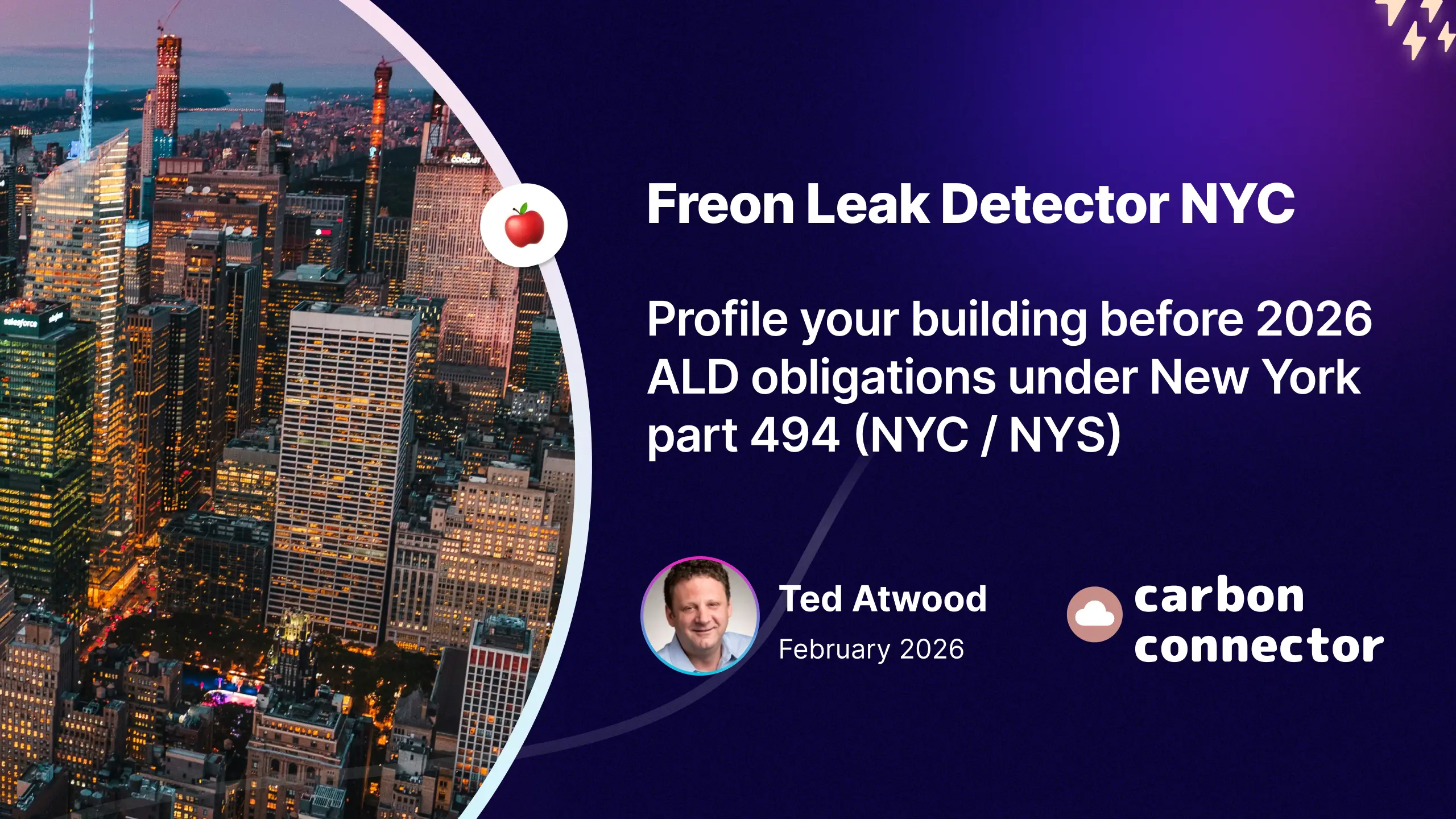
New York’s Part 494 doesn’t ask whether you meant to own regulated refrigerants.
It asks whether you do, and whether your charge sizes and equipment categories put you on the hook for leak inspections, automatic leak detection (ALD), registration, and reporting.
The fastest way to get oriented is to profile your building the way an inspector would: what equipment, what refrigerant, what charge size, what monitoring method, what records.
📌 Part 494 is a New York State regulation that mandates leak detection, reporting, and repair requirements for refrigeration and air conditioning systems containing certain amounts of refrigerants.
Facility operators have had several years to prepare for compliance, with key deadlines culminating in 2026, giving them ample time to profile their equipment, implement leak detection strategies, and ensure regulatory adherence.
New York’s Part 494 regulation defines the responsibility for refrigerant leak detection, reporting, and repair by mandating that facility operators must identify and profile their refrigeration and air conditioning equipment based on refrigerant type and charge size.
Operators are required to conduct leak inspections or install automatic leak detection (ALD) systems according to equipment size categories: small systems (50–199 lb refrigerant) require annual inspections or ALD alternatives; medium systems (200–1,499 lb) require quarterly inspections or ALD alternatives; and large systems (≥1,500 lb) require monthly inspections with mandatory ALD for large refrigeration equipment.
The regulation also requires that only EPA Section 608 certified technicians handle refrigerant repairs, that leaks be repaired promptly, and that proper records, registrations, and reports be maintained and submitted by specified deadlines, including the annual reporting for large systems starting March 31, 2026.
📌 55 days and counting until the deadline.
Facility operators are responsible for ensuring compliance with these requirements to prevent refrigerant emissions, protect the environment, and avoid penalties.
It can significantly contribute to climate change if leaked into the atmosphere, as its GWP is often hundreds or thousands of times greater than carbon dioxide over a 100-year period.
Many companies are now adopting lower GWP refrigerants to reduce their climate impact and comply with evolving regulations.
Proper management of refrigerants (including the use of lower GWP alternatives) is essential to minimize environmental impact and ensure ongoing compliance with state and federal requirements.

NYC and New York State have strict regulations for HFC/HFO refrigerants, making accurate detection tools like infrared detectors critical for compliance.
Many NYC buildings also require a Certificate of Insurance (COI) and specific licenses for HVAC work.
Only EPA Section 608 certified technicians are legally allowed to handle and repair refrigerant-based systems.
Using advanced leak detection services and tools ensures reliable results, supports regulatory compliance, and helps prevent costly HVAC system issues.
NYC shortcut: the rooftop water tank “signal”
New York City has about 1.1 million buildings.
NYC is also commonly cited as having up to ~17,000 rooftop water towers.
That matters because a rooftop water tank is often (not always) a marker for multi-story buildings that are more likely to have central mechanical systems—including chillers.
But here’s the catch: Part 494’s mandatory ALD trigger is not “big building” or “big chiller.”
The most explicit mandatory ALD requirement is tied to large refrigeration equipment (≥ 1,500 lb charge capacity), while large air-conditioning equipment still has monthly inspection requirements but does not land in the same “ALD required” bucket the way “large refrigeration” does.
“Odds” without pretending we have your equipment list
You asked for a building count → likely large chillers → “x% odds”.
The honest way to do that publicly is scenario-based, because public sources do not give a verified count of “large chillers by charge size” citywide.
Known anchors
- Buildings in NYC (DOB framing): ~1.1 million
- Rooftop water towers (commonly cited): up to ~17,000
- Water-tower share of buildings: ~1.5% (17,000 ÷ 1,100,000 ≈ 0.0155). But, this is a big 1.1%.
Scenario estimator you can print
Your “portfolio odds” = (# of your buildings with water towers ÷ your total buildings) × (assumed share with central cooling).
Estimated “central-plant candidates” = water-tower buildings × assumed share with central cooling.
| Assumption: share of water-tower buildings that actually have central cooling equipment | Implied “central-plant candidates” (NYC-wide) | What this means for a random building in NYC |
|---|---|---|
| 30% | ~5,100 | ~0.46% chance (0.0155 × 0.30) |
| 50% | ~8,500 | ~0.78% chance (0.0155 × 0.50) |
| 70% | ~11,900 | ~1.09% chance (0.0155 × 0.70) |
Important nuance for the blog (don’t bury it):
Even if you’re a “central plant candidate,” Part 494 duties still depend on:
- Refrigerant type (“regulated substance”) and
- Charge capacity per system/circuit
Not building height, not the presence of a tank, and not the total refrigerant across multiple pieces of equipment.
Signs of Refrigerant Leaks in HVAC Equipment
Refrigerant leaks demand attention. They compromise performance, elevate costs, and trigger compliance issues.
The skilled facility manager recognizes the early signals. Swift detection preserves efficiency and prevents costly disruption.
Refrigerant leaks reveal themselves through these precise indicators:
Reduced Cooling Capacity
Temperature control falters. Warm air flows where cool air should dominate. Low refrigerant forces systems to overwork, driving energy costs upward while performance declines.
Ice Buildup on Coils
Leaks create excessive cooling at the evaporator coil. Ice accumulates. Efficiency drops. Damage accelerates without prompt intervention.
Hissing or Bubbling Sounds
Listen for the telltale escape. Refrigerant lines emit distinct audio signatures when compromised. These sounds signal that immediate action is required.
Longer Cooling Cycles
Systems run extended periods to achieve desired temperatures. Refrigerant loss forces compensation. Components endure excessive wear. Energy consumption rises.
Visible Water Damage
Condensation and melting ice create pooling around units. Water damage spreads to the surrounding areas. The leak reveals itself through this secondary effect.
Higher Energy Bills
Sudden cost spikes without a clear cause point to system strain. Low refrigerant levels force equipment to work harder. The meter reflects this struggle.
Early detection and swift repair ensure optimal performance. Compliance remains intact. Your HVAC investment stays protected. Professional inspection and maintenance reveal leaks before they escalate. Problems remain manageable. Penalties are avoided.
Vigilant facility managers maintain efficient operations. Energy costs stay controlled. Equipment life extends. The signs are clear. The choice is yours.
The Part 494 Building Profiler
Step 1 — Are you even in the Part 494 universe?
| Profiling question | If “Yes” | If “No / Not sure” | Why it matters |
|---|---|---|---|
| Is the equipment located in New York State (including NYC)? | Continue | Stop (or isolate NY sites) | Part 494 is location-based. |
| Do you have stationary refrigeration or AC equipment with a ≥ 50 lb refrigerant charge capacity? | Continue | Likely out of Part 494 leak-monitoring scope | Part 494 leak monitoring starts at 50 lb (“small”). |
| Does the equipment contain a regulated substance (DEC generally frames this as GWP > 10)? | Continue | If not regulated, Part 494 leak requirements don’t attach | “Regulated substance” drives applicability. It is important to determine your refrigerant footprint to ensure compliance and support environmental responsibility. |
Keyword reality check (common search patterns):
If your staff is googling “What is freon?” or “What is a freon leak?”, you’re already in the “inventory first” phase, because the compliance question starts with “what’s in the system?” not “do we think it’s leaking?”
Note
Scheduling regular professional inspections is essential to detect and address problems before they escalate.
During these inspections, technicians assess HVAC or refrigeration systems to evaluate and diagnose issues such as mechanical faults, refrigerant deficiencies, and leaks early.
Technicians use advanced handheld devices or professional-grade tools for refrigerant leak detection, not just traditional methods.
For effective HVAC system maintenance, inspections should be conducted at least twice a year. Regular leak detection practices can help catch refrigerant leaks early, reducing their environmental impact.
Step 2 — Classify equipment by charge size (this is where obligations “click”)
| Size Class | Charge Capacity | Typical Triggers/Requirements |
|---|---|---|
| Small | 50–199 lb | Annual leak inspection or ALD alternative. |
| Medium | 200–1,499 lb | Quarterly leak inspection or ALD alternative. |
| Large | ≥ 1,500 lb | Monthly leak inspection; ALD required for large refrigeration equipment; annual reporting deadlines kick in sooner. |
Only EPA Section 608 certified technicians are legally allowed to handle and repair refrigerant-based systems.
Facilities with 15+ lbs of HFC refrigerant must comply with expanded EPA reporting and tracking requirements.
Professional attention from skilled technicians is essential, as their expertise and use of advanced tools ensure accurate leak detection and reliable repairs.
The cost to repair a refrigerant leak typically ranges from $200 to $1,500, depending on the severity of the leak, and repairs usually take a few hours to complete.
Timely refrigerant leak repair is crucial to restore HVAC performance, prevent system damage, and improve energy efficiency.
A dedicated team of certified technicians can fix leaks quickly and reliably, helping customers save money by preventing ongoing expenses and reducing energy costs.
Two details that decide real exposure:
- “Large” is about an individual system/circuit, not the building total.
- “Large refrigeration” and “large air conditioning” do not behave identically under the ALD rule structure.
Partnership with AKO: Advanced Sensor Technology for Reliable Leak Detection
Carbon Connector partners with AKO, a leading manufacturer of precision NDIR (Non-Dispersive Infrared) sensors, to deliver state-of-the-art leak detection technology as part of the LDaaS offering.
AKO’s sensors are renowned for their high sensitivity, accuracy, and reliability in detecting refrigerant gases, making them ideal for continuous monitoring in demanding HVAC environments.
Infrared detectors are highly recommended for Freon leak detection in NYC due to their accuracy and resistance to false alarms, and both NYC and New York State have strict regulations for HFC/HFO refrigerants that emphasize the need for such accurate detection tools.
This partnership combines AKO’s cutting-edge sensor hardware with Carbon Connector’s data platform and compliance expertise, providing facility operators with a robust and scalable solution to detect refrigerant leaks early and accurately.
The integration of AKO’s sensors ensures minimal false alarms and precise leak localization, which helps reduce downtime, prevent costly repairs, and maintain optimal performance of HVAC equipment.
→ Learn More about AKO’s solutions
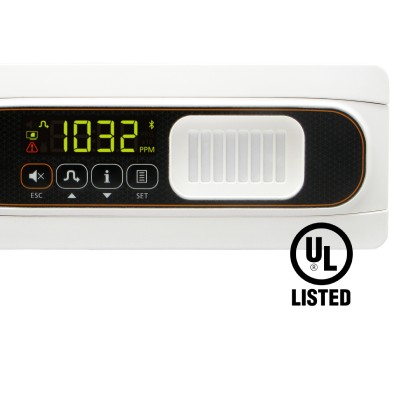
By leveraging the strengths of both companies, Carbon Connector and AKO offer a comprehensive and innovative approach to refrigerant leak detection that meets stringent regulatory requirements while supporting sustainability goals.
Facility managers can trust this partnership to provide reliable monitoring and actionable insights to keep their systems compliant and efficient.
Step 3 — ALD leak detection required vs optional
| What you have | Default monitoring (year-round operation) | ALD status under Part 494 and how states are leading the charge in refrigerant-aligned compliance | What “qualifies” you |
|---|---|---|---|
| Large – Refrigeration equipment (≥1,500 lb) | Monthly leak inspections until replaced by ALD | ALD required (existing compliance date referenced in DEC materials; new installs typically require ALD within a short window) | Charge capacity ≥1,500 lb on refrigeration equipment |
| Large – Air conditioning equipment (≥1,500 lb) | Monthly leak inspections | ALD is generally treated as an alternative, not the same mandatory trigger as “large refrigeration.” Think of an ALD in this scenario as a “backup” workforce in case you miss a mandatory leak inspection | Charge capacity ≥1,500 lb on AC equipment |
| Medium (200–1,499 lb) | Quarterly leak inspections | ALD can replace periodic inspections | Charge capacity in the medium band |
| Small (50–199 lb) — 24/7 Refrigerant Leak Detection | Annual leak inspections | ALD can replace periodic inspections | Charge capacity in the small band |
Seasonal operations
Part 494 changes cadence if not operated year-round (startup inspection + periodic checks while operating).
Keyword trap to call out
A handheld refrigerant leak detector (or freon leak detector / ac leak detector) is not the same thing as ALD.
Part 494’s ALD requirements are about continuous automatic monitoring + documented response, not just having a tool in a tech’s bag.
Step 4 — If you use ALD (or must): what “counts” as compliant under §494-2.3
| ALD approach | Annual audit/calibration | Trigger/Alert requirement | What must happen after an alarm |
|---|---|---|---|
| Direct ALD (detects refrigerant in air) | Must be audited/calibrated annually; rule language includes specific ppm performance targets | Must alert at a defined ppm threshold | Leak inspection within 24 hours, using a calibrated leak detection device or bubble test to confirm and locate the leak |
| Indirect ALD (infers leak from measurements) | Must be audited/calibrated annually | Alert when measurements indicate a loss of 50 lb or 10% of full charge (whichever is less) | Same 24-hour inspection requirement |
Question
Under NY Part 494, can an operator replace the scheduled physical leak inspection cadence for Small (50–199 lb), Medium (200–1,499 lb), and Large–Air Conditioning (≥1,500 lb) equipment with an automatic leak detection system?
Answer
Yes. For those equipment categories, the operator may substitute the scheduled physical leak inspections by installing and properly operating an Automatic Leak Detection (ALD) system that meets Part 494 requirements.
Coverage rule that bites
If ALD covers only part of a system, the remainder may still require manual inspections.
(In practice, this is where owners discover they have “ALD on paper” but “inspection exposure” in the field.)
Step 5 — 2026 dates that force a decision (inventory vs. guesswork)
| 2026 milestone | Who it hits | Why it matters operationally |
|---|---|---|
| March 31, 2026 — Annual reporting for Large equipment | Large systems (≥1,500 lb) as defined in §494-2.6 | Reporting turns “Do we have it?” into “Prove it.” You need the inventory and records. |
| June 1, 2026 — Registration for medium HVAC leak detection equipment | Medium systems (200–1,499 lb) | Medium portfolios often have more units; registration is where gaps in naming, IDs, and charge documentation surface. |
NYC “How to profile your building” (what to do Monday morning or any morning)
This is the practical “no drama” workflow that keeps people out of spreadsheet fantasy land:
| Action | What you’re looking for | Why does it map to Part 494 |
|---|---|---|
| Walk the roof: Is there a water tower? | Yes/No | It’s a fast signal to check for central plant equipment (not a legal trigger). |
| Find the central plant / mechanical room | Chiller nameplates, rack systems, packaged units | You can’t answer Part 494 without equipment identification. As part of regular maintenance, inspect the entire unit—including coils, filter, and drain—to ensure all components are functioning properly. |
| Capture refrigerant type and charge capacity from nameplates/service docs | “Refrigerant: *” and “Charge: __* lb” | Charge capacity drives the small/medium/large classification. |
| Separate refrigeration from air conditioning | Racks/process vs comfort cooling | Mandatory ALD exposure is most clearly tied to large refrigeration equipment. |
| Decide on your monitoring method | Manual inspection cadence vs ALD | Part 494 allows ALD as an alternative in multiple bands and requires a defined response behavior when ALD alarms. |
Conclusion
At the heart of effective refrigerant leak detection lies not just advanced technology, but a deep commitment to solving one of the most pressing challenges in HVAC and refrigeration today.
The refrigerant experts at AKO and Carbon Connector bring together unmatched expertise and cutting-edge NDIR sensor technology to do more than simply deploy devices.
They deliver a comprehensive solution that identifies leaks early, ensures regulatory compliance, and protects both the environment and your bottom line.
Our unique building profiling approach enables us to tailor leak detection strategies precisely to your facility’s equipment and needs, creating a powerful bond between our technology and your operations.
This partnership empowers customers to confidently tackle refrigerant leaks, reduce emissions, and maintain optimal system performance.
Together, AKO and Carbon Connector stand as your trusted allies in addressing this critical issue, turning data into actionable insights and devices into dependable guardians of your HVAC system’s health and sustainability.