
AI is changing everything; the moat the industry built is now its prison; and the market is repricing it.
This article explores how artificial intelligence is fundamentally transforming the competitive landscape for asset management, field service, and CMMS (Computerized Maintenance Management System) software.
We focus on the implications for facility managers, maintenance teams, and buyers of CMMS/asset software, providing actionable insights for those making critical technology decisions.
Why does this matter?
The rapid evolution of AI is turning long-standing industry moats (once considered unassailable competitive advantages) into liabilities.
As the market shifts, organizations relying on legacy approaches risk falling behind, facing increased costs, and missing out on new efficiencies.
Understanding these changes is essential for anyone responsible for selecting, implementing, or managing asset management solutions in today’s environment.
The week of June 24, 2026, NPR ran a story under a blunt headline: “Is AI ‘one big bubble?’” Investors were selling.
NVIDIA and Alphabet fell for a second straight day; the chipmaker Micron dropped more than 13 percent; and the Nasdaq slid over 2 percent.
The reporting captured the mood as a market oscillating between two stories—AI is going to be enormous, and these companies will win, or AI is a waste of money, and the whole thing is a bubble.
More than half a trillion dollars went into AI in the past year alone, on top of a trillion before it, and the question underneath the sell-off was simply: are we going to see the returns?
That is a fair question, and the bubble framing is the easy answer. But it is the shallow one.
The more useful question isn’t whether AI as a whole pays off. It is why the market suddenly got nervous about companies that, a year ago, looked unassailable.
To see what investors were really reacting to, it helps to step out of the stock charts entirely and into a decision you can actually feel.
Imagine you run a newsroom, and you’re about to spend a million dollars putting a camera in the hands of every journalist on your team.
The proposal is on your desk. The vendor is reputable.
Then someone asks a quieter question: what if you handed each journalist a hundred dollars to shoot on the phone already in their pocket instead?
📌 Contact us to see how AI-first asset management can transform your operations.
Do the math on what that actually saves. A thousand dollars for a camera, gone. The film and developing costs behind every shot are gone.
There is nothing to roll out and no one to train—they already know how to use the phone, so onboarding is instant.
The photos don’t sit on a roll waiting to be processed; they’re captured in the moment, saved to the cloud, and retrievable the second you need them.
Cheaper, faster, and better, all at once. Put that way, it is a no-brainer—and you already know exactly what you’d do.
That is the choice now sitting in front of buyers in our corner of the world—HVAC/R, field service, asset management.
Not “which expensive system do we buy,” but “do we still need to buy the expensive system at all?”
And if you, as a buyer, can see that the answer is changing, then so can the market.
That is what the sell-off was really about. Not fear of AI—recognition that the companies built on the old answer may be worth less than their assumed price.
Because the deeper question is not whether AI makes money, it is whether the things that used to make a software company safe (the deep platform, the proprietary data, the years of accumulated code) are still worth what we paid for them.
The market is beginning to answer no. To understand why, you have to look not at the technology, but at what the technology was really protecting.
The Shift
From Invoice-Centric to Asset-Centric
CMMS systems are a digital version of the paper invoice, and for two decades, the CMMS software that ran field service was, underneath the interface, an invoice.
CMMS platforms, asset-management systems, service tools—strip away the dashboards, and the organizing logic was the work order, because the work order was how you got paid.
The data model bent toward the transaction.
You captured what was billable, then reconstructed a thin shadow of the equipment from the billing trail.
Why the Old Model Persisted
That was never the right architecture. It was the affordable one.
The asset (the actual compressor, the actual coil, the actual rooftop unit) was always the real thing in the world. It fails, it gets serviced, it needs tracking.
The invoice was only ever a consequence of something happening to the asset.
The builders put the invoice at the center, not because that was correct, but because capturing the asset richly, cheaply, at the moment of work, was impossible with the tools they had.

How AI Changes the Equation
AI removes that constraint.
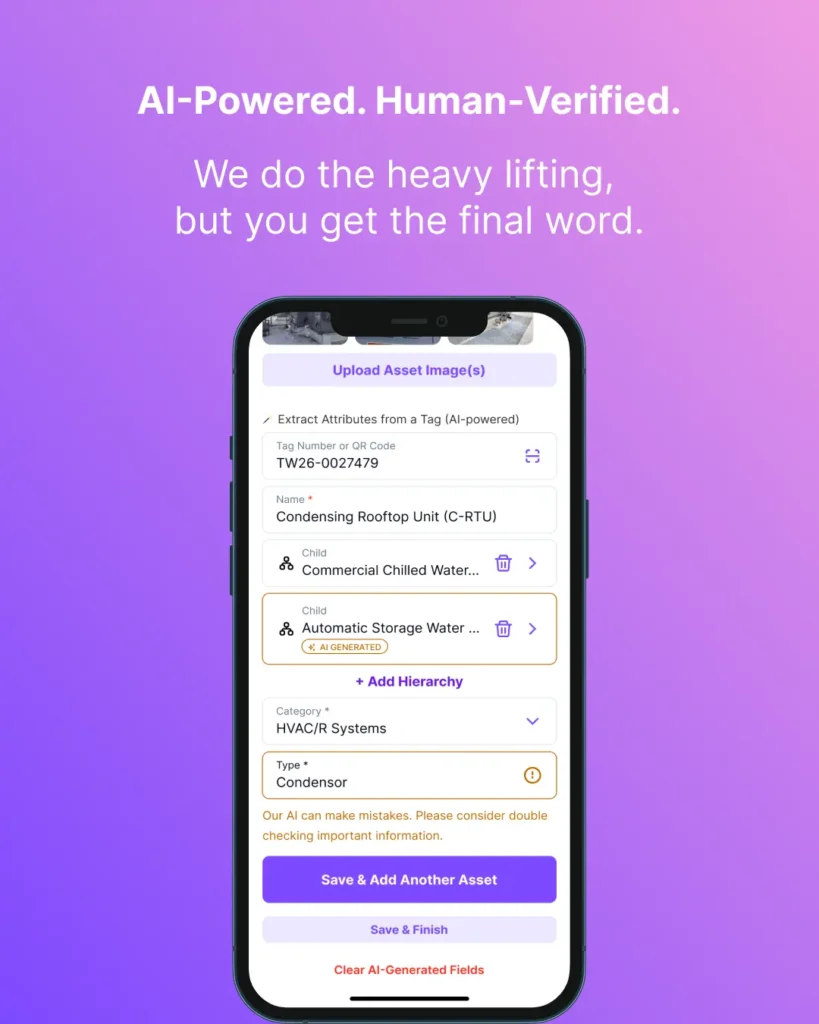
When capture costs almost nothing (point a camera at the nameplate, talk to the system, let it read and structure what it sees), you are no longer forced to collect only what the invoice needs.
You can finally organize around the asset and let the invoice fall out of it as one derived record among several.
The inversion the original builders wanted and could not afford is now buildable.
→ Learn More about AI-Powered Asset Capture
“We live in a world changing so rapidly that what we mean frequently by common sense is doing the thing that would have been right last year.”
— Edwin Land, founder of Polaroid (to employees, 1958)
Land built a camera that collapsed the darkroom into the click of a shutter—a partner in perception, he called it, a tool that let people see the thing in front of them more vividly than they could unaided.
That is a fair description of what asset-first capture does for a technician: it makes the equipment legible in the moment, instead of after the fact, on a form, back at the truck.
Transition
The shift from invoice-centric to asset-centric models is only possible because of changes in the underlying mechanisms of control and value in software.
Let’s examine how the industry’s traditional moats are being redefined.
📌 The old moat is becoming the new weakness. Ready for what’s next?
The Mechanism
The Moat and Control in CMMS Software
Here is the part most commentary gets wrong. The incumbents’ advantage was never really superior technology. It was control.
A business moat is a structural competitive advantage protecting market share.
Control over the data, locked inside a proprietary lake. Control over the infrastructure. Control over who could afford to build kept competitors out.
Control over the roadmap, the contract, and ultimately the buyer.
The data lake was the castle, and the moat around it was containment.
The whole strategy rested on a single assumption: that data is valuable because you hold it and others don’t. Scarcity through control.
A nine-figure raise went into digging the lake and reinforcing the walls.
How AI Inverts the Value of Containment
AI inverts the value of containment itself.
When a model can read open, unconstrained information (manufacturer manuals, nameplates, model and serial numbers, public service patterns), the walled garden stops being an advantage and becomes a cost.
The competitor who never built the lake, who works across open data unbound to any one infrastructure, is lighter and faster and is not paying to maintain walls that no longer keep anyone out.
The moat didn’t get crossed. Its defensive value drained away.
📌 The reframe
The old guard built a moat around the castle they were protecting, then kept reinforcing it—more data, deeper lake, higher walls, more acquisitions bolted on. Every reinforcement made the moat wider. And then the weapon outside changed. Now, the same walls that kept competitors out keep the defenders from maneuvering. The moat stopped protecting and started isolating. That is what the market repriced this week. Not the technology. The control—and the discovery that control is no longer where the value lives.

The Kodak Case Study: When Moats Become Traps
If you want to know how this ends for the ones who defend the moat too long, the case study is already written, and it happened in photography.
In 1975, a young Kodak engineer named Steve Sasson built the first portable digital camera—a device the size of a toaster, assembled by a company that sold more film than anyone on earth. He showed it to management.
They patented it. And then they buried it.
“My prototype was as big as a toaster, but the technical people loved it. But it was filmless photography, so management’s reaction was, ‘That’s cute—but don’t tell anyone about it.’”
— Steve Sasson, inventor of the digital camera, on Kodak’s response (to The New York Times)
They didn’t miss the technology. They invented it, held it, and understood it.
They rejected it on its flaws (too heavy, too slow, too low-resolution) and could not see the value of “good enough” to millions of people who didn’t care about any of that.
Kodak kept earning patent royalties on digital while its rivals built the future with it. The patent expired in 2007. Kodak filed for bankruptcy in 2012.
The lesson is not that Kodak’s leaders were foolish.
They were protecting a profitable, rational business—the film franchise was real, the early digital product was genuinely clumsy, and cannibalizing your own cash cow on an unproven format is exactly the kind of thing a disciplined management team is built to resist.
That is the trap. The moat does not require villains or idiots to become fatal. It only requires people to defend what they built.
The moat makes the rational choice the fatal one—and the better the moat, the more rational it feels to keep defending it right up to the end.
Transition
This shift in control leads directly to the question of who actually delivers value in the new landscape.
Who actually solves the problem
The Enduring Value of Expertise
There is a longer arc underneath all of this, and it runs through the people, not the platforms.
For as long as this industry has existed, the hard problems have been solved by subject-matter experts—the people who have stood in front of ten thousand pieces of equipment and know why the thing actually failed, not what the manual says failed.
AI is already revolutionizing industries from manufacturing to healthcare. The senior technician. The reclaim operator.
The person who has walked six hundred facilities and can tell you in thirty seconds that it will take three weeks to confirm.
How Expertise Was Encoded and Scaled
For twenty years, the dominant move was to take that expertise, convert it into process, encode the process into software, and scale the software with less-specialized labor.
It worked often.
In finance, machine learning models process vast streams of data for instant fraud detection, while retail systems use AI for inventory management to prevent stock issues at an enormous scale.
But it quietly treated expertise as a cost to be engineered out, and the expert as a dependency to be reduced.
Capital bought code; code captured process; process replaced the person.
The New Scarcity: Judgment and Context
What changes now is that if software becomes abundant, the scarce input is no longer code.
It is the judgment to know what matters, what to ignore, when the model is wrong, and how to turn an output into a decision.
That applies as much to inventory decisions as it does to code generation or process capture.
In healthcare, algorithms analyze medical imaging for faster diagnostics and personalized medicine, while AI accelerates drug discovery by analyzing extensive research datasets.
In logistics and engineering, AI optimizes route planning and supply chain management, enables autonomous vehicles, cuts transit times and fuel consumption, and deploys AI-powered robots to increase efficiency in manufacturing and engineering.
But let us be clear: AI systems can inherit biases from training data, and automated decisions based on historical datasets can entrench societal biases.
The expert stops being the dependency you minimize and becomes the asset you amplify.
The same insight that was once extracted and buried in a workflow can now be expressed directly, with generative AI as the amplifier rather than the replacement.
“The business of science is not to forecast the future but to create it.”
— Edwin Land
Transition
As expertise becomes the new differentiator, organizations must adopt a disciplined approach to integrating AI—one that adds value without introducing new risks.
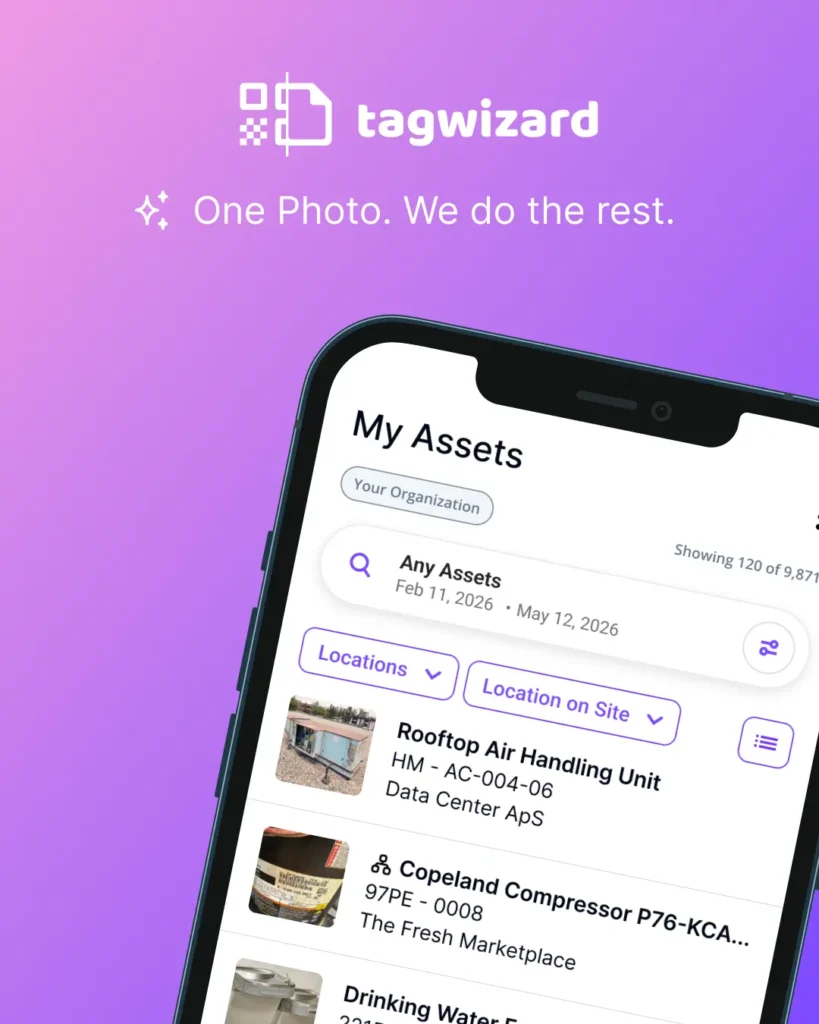
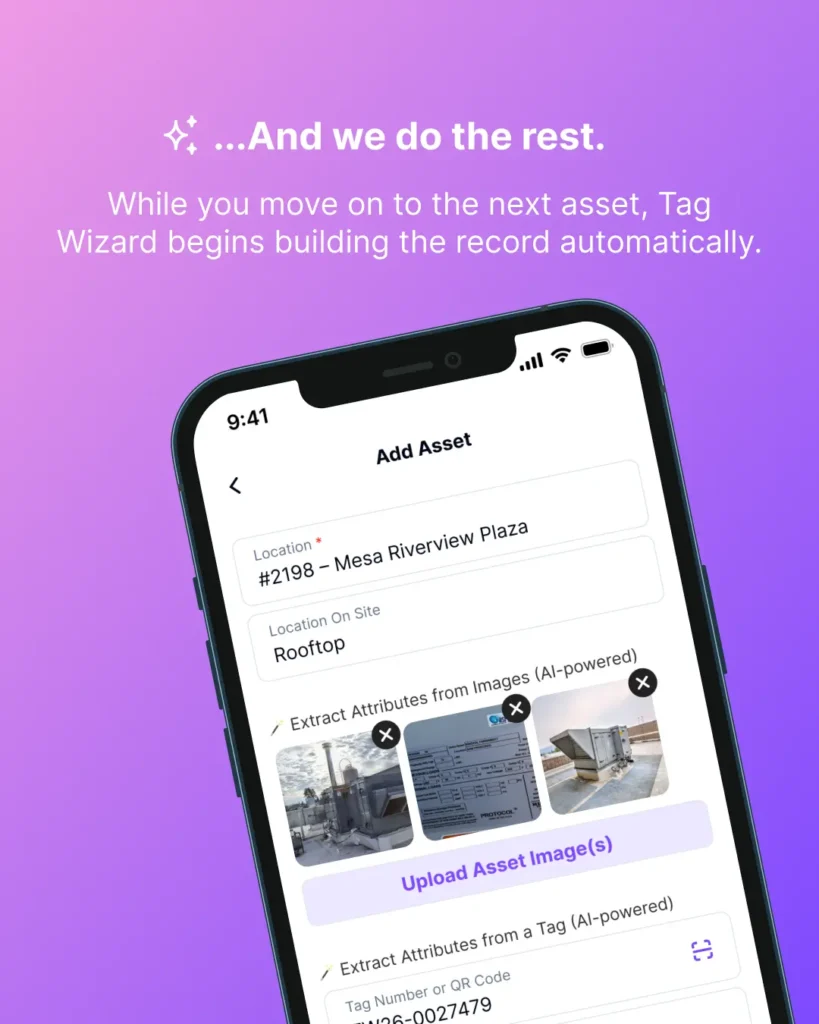
📱 Download Tag Wizard

A Necessary Discipline
The Importance of Additive Change
None of this is a license to chase AI for its own sake.
If you run a service business, you probably feel two things at once right now: real enthusiasm for what this could do, and real anxiety about getting the decision wrong.
Both are correct. The enthusiasm is earned. So is the caution.
Change for change’s sake is a tax, not a gift.
The only shift worth making is one that is additive (it adds capability without subtracting what already works) and qualified, meaning proven rather than promised.
How to Pilot and Evaluate AI Solutions
The proof is a pilot inside modern CMMS solutions. Not a demo, not a deck. A real pilot, with your equipment and your people.
That proof should establish whether predictive maintenance extends asset lifecycles and reduces costs, whether it gives you a defensible read on asset condition, and whether real-time data from IoT sensors genuinely sharpens asset monitoring.
Pilot Evaluation Steps
- Run a pilot with your actual equipment and team.
- Measure whether predictive maintenance extends asset lifecycles and reduces costs.
- Assess if real-time data from IoT sensors improves asset monitoring.
- Confirm that the system supports compliance and regulatory requirements.
- If the pilot is hard, expect the launch to be harder.
→ Run the pilot with Tag Wizard
And here is the honest rule of thumb: if the pilot is hard, the launch will be harder. Transitions are genuinely difficult, and they break teams when they are forced.
The right AI should make the transition smoother, not add a second one on top of the work you already do.
If it makes the migration heavier, it is the wrong tool, however impressive the model.
The Risks of Bad Data
The part nobody wants to say out loud
AI built on bad data does not fail quietly. It fails confidently and at scale.
Deploy a capable model on a messy asset history and you don’t get a tool that’s a little off—you get one that is wrong faster, more fluently, and with more authority than the spreadsheet it replaced.
For a team that already trusts the data too much, that is worse than no AI at all.
Computerized maintenance management systems are judged on core functionality: tracking maintenance tasks, enforcing maintenance procedures, and preserving compliance records with enough integrity to survive regulatory audits.
Automated compliance monitoring also reduces human error in maintenance operations. Some AI is ready.
Some are thin wrappers. Some is dangerous precisely because it is convincing.
You cannot tell these apart from a sales demo. That is what the expert is for.
📌 Contact us to see how AI-first asset management can transform your operations.
The Role of Domain Expertise
Which is the resolution to the anxiety, and it is more reassuring than it first sounds: the thing that protects a nervous buyer from a wrong decision is not a bigger vendor or a safer brand.
It is domain expertise, validating the solution against reality.
The subject-matter expert is the trust element.
They are how you tell ready from wrapper, good data from bad, additive from disruptive.
The relevant test is whether the system can improve asset reliability and support it across multiple sites.
A CMMS reduces unplanned downtime by 79%, but only when the underlying data and workflow are trustworthy.
And you are not relying on the vendor’s expert alone. You have your own.
The senior people on your team (the ones who know the equipment and the field) are not bystanders to this decision; they are the safeguard.
That review is part of an asset management strategy, not merely a software comparison.
The vendor’s SME and your SME, in the same room, pressure-testing the same pilot, are the actual mechanism that de-risks the purchase.
In HVAC/R, that scrutiny has to reflect EPA Section 608, California CARB requirements, and the AIM Act’s mandated HFC reductions.
Refrigerant emissions account for 2-3% of global greenhouse gases, and the cold chain consumes 10% of global energy.
Predictive maintenance can cut cold chain energy use by 20%, low-GWP refrigerants can reduce emissions by up to 90%, and better cold chain management can cut food waste by 30%.
The old control model treated your experts the way it treated your technicians: as people the software was done to.
The model worth buying treats them as partners who shape it.
That is how better asset maintenance is built on real evidence about asset health, not software control.
Put the two experts together and let them tell you, honestly, whether it smoothed the work or added to it.
That is collaboration replacing control—the broken moat, handed back to you as leverage.
Transition
With discipline and expertise as your guides, the next challenge is navigating the evaluation and onboarding process in a rapidly changing market.

If you’re the One Signing
The Buy and Onboarding Cycle: Old vs. New
If you are evaluating field service, CMMS, or asset software, your buying cycle is probably eight or nine months.
That timeline was used to protect you. It gave you room to vet a vendor’s stability and confirm they’d be standing in five years.
The slow cycle was a filter against betting on something that wouldn’t last.
It is also worth confronting the scale of the shift: the global asset tracking market is projected to reach $36.3 billion by 2026.
It now works against you.
In a market where firmware evolves quarterly, where capture models improve with every release, where a small team ships in months what once took a decade, a nine-month evaluation can end with you signing for technology that was current when you started and obsolete by the time you deploy.
You can diligence your way into the wrong answer.
And the buy cycle is only the first clock. Behind it sits a second one: the replace-and-onboard cycle, which can run just as long.
Eight or nine months to choose, then another eight or nine to rip out the old system, migrate the data, and get the team actually using the new one.
Nearly two years, end to end, much of it spent standing still.
The hidden assumption underneath that timeline is that the status quo is your only safe option and that change is necessarily slow and expensive.
Neither is true anymore.
Comparison Table: Old vs. New Onboarding Timelines
| Process Step | Old Model Timeline | New Asset-First Model Timeline |
|---|---|---|
| Evaluation | 8-9 months | 2-8 weeks |
| Onboarding | 8-9 months | 2 weeks – 2 months |
| Total Time to Value | ~18 months | 1-3 months |
If you want to accelerate the remedy rather than endure it, the move is to shorten both halves. Short pilot, short onboarding.
Less money, fewer resources.
The new model makes this possible because it is not ripping out and reconstructing a proprietary system—it is capturing the asset and letting the records form.
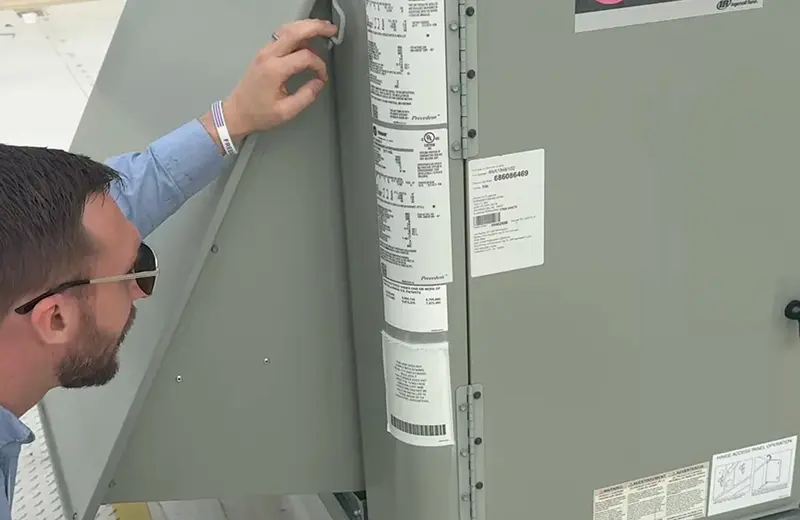
The asset tagging process is an essential process for accurate tracking and faster onboarding, which is precisely why asset-first capture compresses onboarding.
📌 The old moat is becoming the new weakness. Ready for what’s next?
Asset Tagging Methods
Barcode labels
Cost-effective method for asset management.
RFID tags
Enable automated asset identification without direct line-of-sight and can transmit data for automated tracking.
Durable RFID tags
Used depending on the environment and risk.
Onboarding is measured in two months at the outside, two weeks as the realistic target; modern CMMS platforms increasingly combine CMMS and broader asset governance capabilities, which matters when buyers are comparing categories.
If a vendor tells you onboarding takes most of a year, they are describing the architecture you are trying to leave, not the one you are trying to buy.
The New Criteria for Vendor Selection
So the criteria move. It is not that the vendor’s balance sheet stops mattering—it is that it stops sitting at the top of the list.
What rises above it is the rate of change, how fast the solution improves on its own, and how much freedom you have to shape the relationship: control the contract terms, influence the roadmap, and get your problems solved rather than queued.
The old question was “What is this vendor?” The better question is “how fast does this move, and how much can I move it?”
A smaller, faster partner who will build for your team can be worth more than a large one who will sell you what they already have and tell you to wait for the next release.
📌 There are two clocks, not one.
The buy cycle is the first. The replace-and-onboard cycle is the second—and it can be just as long. Choose for nine months, then migrate for nine more, and you’ve spent nearly two years mostly standing still. The status quo is not your only safe option, and change is no longer necessarily slow. Shorten both halves: short pilot, short onboarding, less money, fewer resources. Onboarding in two months at the outside. Two weeks is the realistic target. If a vendor needs most of a year to get you live, that is the old architecture talking—not the one you’re trying to buy.
And solve for the right people. For two decades, this software was sold to the buyer and inflicted on the user.
The person signing was the owner or the ops manager; the technician was who it got done to. Asset-first capture changes who the tool is for, so evaluate it from the phone, not the boardroom.
The operational stakes are not abstract: healthcare staff waste 6,000 hours monthly searching for equipment, while job site theft costs the construction sector $1 billion annually.
For high-value assets such as medical equipment or IT equipment, faster field visibility is not a luxury; it is operational control.
In HVAC specifically, look for solutions that reduce keystrokes, cut the time a tech spends on a ticket, inform better decisions in the moment, and meet your team where they actually are on their journey—not where a vendor’s workflow assumes they should be.
If it doesn’t make the work lighter for the person doing the work, it doesn’t matter how clean the dashboard looks to the person who bought it.
Transition
With these principles in mind, here are the key questions every buyer should ask before signing a contract for asset management or CMMS software.
Questions Worth Asking Before You Sign
Not a scorecard. Just the questions that separate a tool that keeps pace from one that locks you to where the industry was the day you signed.
Is it built around the asset or the invoice?
Does the record in the asset management software serve the equipment and the outcome—or the billing?
And does the platform act as a central hub for facilities management across complex assets and multiple sites?
Does it work across open data, or trap me in someone’s lake?
And can I get my own data back out, cleanly, if I leave?
How much does it improve between releases?
What actually shipped in the last 90 days—capability or just screens?
How much can I shape it?
Contract terms, roadmap influence, problems solved rather than queued.
Does it make the work lighter for the user, not just the buyer?
Fewer keystrokes, less time per ticket, a better decision in the moment.
Will it still be current when my evaluation closes?
Or am I delving into obsolete tech on an eight-month clock?
Did a real pilot prove it—with my data and my people?
If the pilot was hard, the launch will be harder. And where those needs exist, do the vendor’s CMMS tools or advanced CMMS platforms support inventory control and depreciation tracking?
How fast can I actually be live?
Onboarding in weeks, not most of a year, with mobile device access for field users from day one. A long onboard is the old architecture talking.
Transition
Applying this rigor ensures you select solutions that are agile, proven, and aligned with your operational needs—rather than locking you into legacy approaches.
📱 Download Tag Wizard
What was this week?
The Market Is Repricing Control in Real Time
Come back to where we started.
The sell-off was read as fear of AI. It is closer to a recognition: a generation of companies was built and valued around moats that AI has turned from protection into isolation.
The reinforced castle is being repriced for the very reinforcement that used to justify its premium.
That is the macro version of the choice in front of every buyer—the same event, at the scale of a stock chart instead of a contract.
None of it means the castles will fall tomorrow.
The customers still exist, the contracts still exist, and the brands still exist.
What has changed is the certainty.
For the first time in a long while, the defenders can hear the catapults being assembled outside the walls—and that changes behavior long before it changes ownership.
The stock moved first. The buyers will move next.
The opportunity in that is real, and it is not about novelty.
It is about finally being able to organize the work around the thing that always mattered (the asset, the outcome, the person holding the phone) instead of the artifact that happened to be affordable to capture.
That is the adoption test for facility managers, maintenance managers, and maintenance teams working across multiple sites.
The invoice still prints. It just no longer gets to decide the shape of everything else.
“A mistake is a future benefit, the full value of which is yet to be realized.”
— Edwin Land
Be ambitious about this. Be disciplined about it, too.
Want the change—and qualify it, pilot it, build it on real solutions and real data, and put your experts and theirs in the room together before you commit. The technology gate is open now.
The judgment about how to walk through it is still, and more than ever, the work of people who know the difference.
Summary: How AI Turns Industry Moats into Liabilities—and What Buyers Should Do
How is AI turning industry moats into liabilities, and what should buyers do about it?
AI is changing everything; the moat the industry built is now its prison.
Traditional business moats—structural competitive advantages like proprietary data, deep platforms, and high switching costs (which refer to the pain customers experience when leaving a product)—once protected market share.
Today, AI’s ability to process open, unstructured data and rapidly improve solutions has eroded the value of these moats.
What once kept competitors out now isolates incumbents, making legacy approaches a liability rather than an asset.

Key Takeaways for Buyers and Industry Professionals
Prioritize asset-centric solutions
Choose platforms that organize around the asset, not just the invoice or transaction.
Demand open data and easy exit
Avoid vendor lock-in by ensuring you can access and export your data cleanly.
Insist on rapid onboarding and improvement
Select vendors who can get you live in weeks, not months, and who demonstrate meaningful updates every quarter.
Validate with real pilots
Test solutions with your own data and team before committing. If the pilot is hard, the rollout will be harder.
Leverage domain expertise
Involve your subject-matter experts in every stage of evaluation and implementation.
Focus on user experience
Ensure the solution makes work easier for technicians and field staff, not just for management.
Stay agile
The market is moving fast. Long evaluation cycles and legacy checklists can leave you with obsolete technology.
Be disciplined and ambitious
Embrace change, but qualify it rigorously with real-world evidence and expert input.
By following these principles, facility managers, maintenance teams, and asset software buyers can avoid the pitfalls of legacy moats and position themselves to thrive in the AI-driven future of asset management.
📱 Download Tag Wizard