
How Tag Wizard makes CMMS maintenance records readable across every system, every role, and every audit.
This article is for maintenance professionals, asset managers, finance teams, operations professionals who manage assets, and regulatory or compliance officers seeking to improve the quality and audit readiness of their CMMS maintenance records.
Or maybe you just bought a CMMS system, and you need to get quality data into your CMMS.
We’ll explain how Tag Wizard can make that happen by bridging data gaps, ensuring consistency, and supporting compliance across all systems and roles.
In today’s complex maintenance environments, data quality, audit readiness, and operational efficiency are more critical than ever.
Maintenance records are often scattered across multiple platforms, each with its own language and structure, making it difficult to maintain a single source of truth.
This is especially true for Computerized Maintenance Management Systems (CMMS), which are designed to centralize maintenance data and optimize physical equipment management.
However, without consistent asset data, even the best CMMS can fall short.

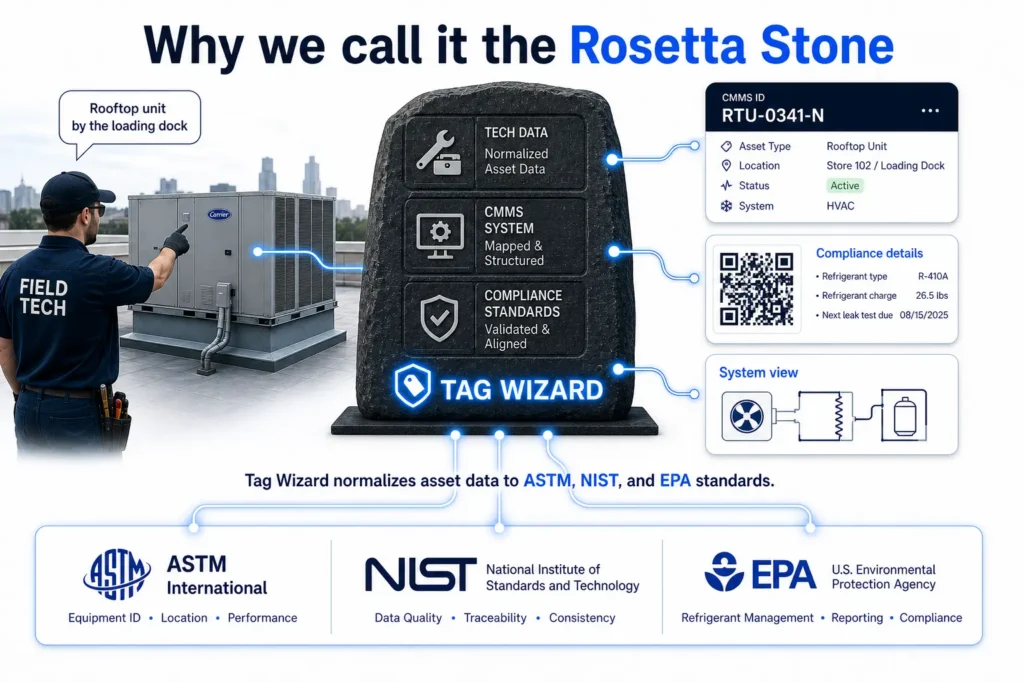
Tag Wizard acts as the Rosetta Stone for asset data, translating and unifying maintenance records so they are readable and actionable across every system, every role, and every audit.
Whether you’re a technician in the field, an asset manager overseeing multiple sites, or a compliance officer preparing for regulatory review, Tag Wizard ensures your CMMS records are accurate, consistent, and audit-ready.
📱 Download Tag Wizard
Why do we call TagWizard the Rosetta Stone?
The original Rosetta Stone is a slab of rock with the same message carved on it three times — once in Ancient Greek, once in Egyptian hieroglyphs, once in a third Egyptian script in between. Scholars in the 1800s could read Greek. They could not read the hieroglyphs. An entire civilization’s worth of inscriptions had been sitting in plain sight, unreadable, for fourteen hundred years.
The stone broke the lock. Same message, three languages, side by side. If you could read one, you could work backward into the others. That is the whole reason we can read hieroglyphs today.
Maintenance has the same problem twice — once between systems, and once between people.
Systems
The tech in the field calls it the rooftop unit by the loading dock.
Your CMMS calls it RTU-0341-N. Your compliance officer calls it a serial number (56898095U 890W) with a refrigerant charge attached to it. Your reliability analyst calls it a token in a dataset.
Same equipment. Four languages. Nobody agrees on the words.
People
A convenience store chain has 4,200 reach-in freezers across the fleet. Two are identical units from the same manufacturer.
One was tagged at installation as a reach-in freezer. The other was tagged six months later as a glass-door freezer.
A third identical unit was tagged by a regional manager as a beverage cooler — because that store was using it for beverages, even though the equipment itself is identical to the reach-in freezer two aisles over.
For years, I knew about the problem, but only in the last 2 years did I have the time to go deep and research this, and I was surprised at the scale, which was so massive that industries and companies across the US banded together under NIST (National Institute of Standards and Technology) to study this, and they even named it “Nestor”, a software toolkit.
Nestor takes the messy, abbreviated, inconsistent technician shorthand in maintenance work orders and groups the variants (“cmprsr,” “compressor,” “comp”) into a single canonical concept.
Different spellings, same idea. Same Rosetta Stone job, applied to the text instead of the asset.
Why this is a Rosetta Stone problem
Every stakeholder in the asset lifecycle needs something different. The tech needs a fast capture. The facility manager needs a clean hierarchy.
Compliance needs a defensible audit trail. Purchasing needs a sourceable spec. Maintenance needs a predictable service profile.
Finance needs depreciation and useful life. Each one is right. Each one is asking for something the others are not.
When those needs collide inside a single asset record, the platform usually responds by adding more fields.
The form gets longer. The taxonomy gets configurable to accommodate each department. T Purchasing pulls together a sourcing list and gets back 500 entries that mean nothing because every site filled out the form differently.
The same chiller is usually listed 2 or more times, and then there is the record set that includes the components, even messier. The forces meant to align the team are instead pulling it apart.
Two institutions had already done important work on this problem, in two different rooms. And a third group was influencing the outcomes without any awareness of their impact
- NIST built Nestor, a discipline for resolving the messy shorthand inside maintenance work orders.
- AIM Act, EPA, local permitting, AHJ codes — and even the manufacturers’ own conformity requirements- evolve at a different pace and vary by jurisdiction
- ASTM published E3257, a standard for classifying assets by their innate characteristics.
What we found when we started this journey was that you are left with at least 5 stakeholders, relying on at least 4 standards, and a stack of rules written by groups that never coordinated with each other, all governing the same piece of equipment.
And everyone speaks a different work language.
Our research showed that the same forces pulling teams apart could instead become a unifying momentum — if someone listened to the people actually using the products and tied the standards together on their behalf.
Each asset gets the attribute fields it actually needs, drawn from the standards that govern it and shaped by the people who work with it every day.
A walk-in cooler does not need the same fields as a rooftop unit. A rooftop unit does not need the same fields as a slicer.
Captured once, served the right way to every stakeholder who asks. Compliance sees compliance language. Purchasing sees a sourceable spec. Maintenance sees a service profile. The tech sees a picture and a name.
The Rosetta part is accommodating all these needs at once.
The Wizard part is knowing which language each stakeholder speaks, which standard applies to which asset, and which fields the people in the field actually need to do their jobs.
We built Tag Wizard so you do not have to.
📱 Download Tag Wizard
What data quality actually takes to solve this
Before diving into Tag Wizard’s specific features, it’s important to understand what high-quality asset data requires.
The asset data market is full of partial solutions that address only fragments of the problem, often leaving gaps that undermine the effectiveness of your CMMS.
The Four Pillars of Asset Data Quality
A complete solution to the asset data problem must address four key requirements, all within a single workflow at the moment of capture—before a CMMS can reliably track assets, schedule work, and monitor inventory for operational efficiency:
- Capture: The asset is recorded in the field by the person standing in front of it, on whatever device they’re carrying.
- Identify: The asset receives a canonical identity that remains consistent across all downstream systems. Not a different ID per system—one identity.
- Structure: The record fits a taxonomy—equipment type, category, department, hierarchy—that holds across stores, regions, and capture sessions.
- Enrich: The record carries the metadata that downstream systems and auditors actually need: make, model, refrigerant charge, install date, serial number, inspection history, and the spare-parts or stock data that supports inventory control and automated reordering.
Limitations of Current Market Solutions
Most asset data tools in the market address only one or two of these four pillars: in most cases, it’s because they were built to do something else or something else’s (new word)
- Managed tagging services capture and identify assets, but require certified personnel on site, limiting speed and scalability.
- Downstream data cleanup platforms structure and enrich data, but only after messy data has already been produced—fixing what’s broken rather than preventing the break.
- Agentless data enrichment APIs enrich data beautifully, but only on assets that have already been captured and when the nameplate is readable.
Preventive maintenance in a CMMS depends on structured routine servicing data to prevent breakdowns. However, these partial solutions often leave gaps that compromise data quality and operational efficiency, which is why many teams look for Tag Wizard as their app in the race for compliance when labeling HVAC/R assets.
First, some housekeeping…
What is a CMMS, and Why Does Asset Tagging Matter?
Acronyms and definitions can be confusing (mostly for us), so here is a quick reference guide:
A Computerized Maintenance Management System (CMMS) centralizes maintenance data and optimizes physical equipment management. CMMS platforms track assets, schedule work, and monitor inventory to maintain operational efficiency.
By automating maintenance schedules and providing mobile access, CMMS solutions help organizations reduce downtime, minimize emergency repairs, and optimize resource allocation.
TLP In plain language
TLP (Technical language processing) is what turns the mess of technician shorthand, abbreviations, and field notes into data an analyst can actually use.
This is actually a scientific term, not one we made up. Nestor is the open-source toolkit that does it at the work-order text layer.
Tag Wizard does the structurally equivalent work one layer upstream, at the asset itself.
NESTOR stands for Natural Language Extraction of Structured Text and Organization of Records.
That’s the formal expansion, and it tells you exactly what the toolkit does: it takes natural language (the free-text fields in a maintenance work order), extracts the structured information buried inside it, and organizes the records into something an analyst can actually compute on.
- There’s also a more charming origin story, and NIST documents it on the same project page. The name is a nod to Nestor notabilis — the kea, an alpine parrot from New Zealand and the world’s only alpine parrot.
- Keas are famous for two things: their intelligence and their habit of using tools to solve puzzles, often by working together.
NIST chose the name because the parent project is called KEA (Knowledge Extraction and Application for Smart Manufacturing), and the symmetry was too good to pass up. Smart birds, smart tools, smart manufacturing.

What matters is what Nestor does, not what its letters spell. The toolkit is the working implementation of Technical Language Processing for maintenance work orders.
It takes the mess of technician shorthand, abbreviations, misspellings, and field notes (the data your CMMS records but nobody can analyze) and turns it into structured tags that an analyst can build a real model on.
That capability is what makes the Tag Wizard compatibility statement meaningful.
Tag Wizard structures the asset before the work order gets written. Nestor structures the work order after the fact. Same principle. Different layer.
You can find the toolkit, the documentation, and the source code at Nestor — open-source, public domain, free to use.
📱 Download Tag Wizard
How does this all relate to The Role of Asset Tagging
Asset tagging is the process of affixing tags or labels to assets to identify each one individually and track data from real-time location to maintenance history.
An asset tagging app purpose-built for HVAC and refrigerant systems makes this process scalable across portfolios.
Effective asset tagging is foundational for any CMMS, as it ensures that every piece of equipment can be uniquely identified, tracked, and managed throughout its lifecycle.
How Tag Wizard Integrates with CMMS
Tag Wizard & CMMS Integration: it’s simple, we provide an export structured for your CMMS.
Data Flow
Tag Wizard captures and structures asset data at the source, ensuring that every asset record is clean, consistent, and ready for import into your CMMS.
Enhanced Maintenance Management
With accurate asset identification and enriched metadata, CMMS platforms can more effectively track assets, schedule preventive maintenance, and automate inventory control.
Operational Benefits
Integrating Tag Wizard with your CMMS results in reduced maintenance costs by minimizing emergency repairs and optimizing resource allocation. Maintenance teams benefit from improved data quality, faster audits, and greater operational efficiency.
The case for rigidity
Most CMMS platforms are sold on flexibility. Configure it for your workflow. Build your own taxonomy. Customize the fields to match how your team thinks.
It sounds like a feature. It functions as a transfer of risk.
Here’s what flexibility actually does to a regulated environment: it hands the entire interpretive burden back to the customer.
The EPA does not care that your CMMS lets you name a chiller anything you want.
The EPA cares whether you can produce a clean list of every chiller in your portfolio, its refrigerant type, its charge, its GWP, and its install date.
If the platform lets each site, each tech, and each fiscal year invent its own categories, every regulatory question becomes an archaeology project.
This is the part of the asset data problem that does not get talked about in CMMS sales pitches.
The flexibility that the rep called a feature is the same flexibility that makes the AIM Act audit a fire drill.
The Wednesday Argument
The Wednesday Argument is the moment a facility leader asks the room, “Can we stand behind this asset data if audited today?”
The private answer is almost universally the same. No. And the reason isn’t that nobody tried. The reason is that the tools were built to let everyone try differently.
The cost of that flexibility is no longer a guess. Recent industry analysis puts the annual ghost-asset cost (equipment that exists on paper but not in the building, or in the building but not on paper) at up to five million dollars per enterprise.
Up to 25% of IT budgets evaporate on assets that exist in the registry but not in reality.
Roughly eighty percent of CMMS implementations fail to deliver their promised value, with data quality the most consistent root cause.
When competitors describe their own product as solving “a grueling cycle of walking the floor with a clipboard,” the problem is not in dispute. The dispute is about what to do.
📌 Ready to take the blindfold off your maintenance teams?
Shop our distributed leak detection solutions now and pinpoint leaks instantly.
Look at where the structural responsibility lands across three different system architectures:
Who owns the regulatory burden?
Three system architectures, three different answers. Whoever owns the burden determines whether audit-ready data is the product, or the customer’s problem to solve.
Read down each column. The pattern is what matters.
In a flexible CMMS, every layer of structural responsibility (taxonomy, naming, hierarchy, regulatory mapping, audit readiness) lands on the customer.
The platform is a container. What goes in the container, how it gets named, how it relates to the rule, how it gets pulled for an audit: all of that is the customer’s problem to solve.
The flexibility marketed as freedom is, in practice, a permanent, unpaid job.
In Tag Wizard, every one of those layers is the platform’s responsibility. The taxonomy is canonical and applied at the moment of capture.
The naming is generated, not invented. The structure is enforced, not configured. Regulatory data is captured against the asset identity, not against a service event that may or may not be recorded.
The audit-ready export is the same export the analyst already uses on Tuesday morning.
In NIST Nestor, the responsibility lives in the framework. Aliases unify variant spellings. Ranked tagging classifies concepts by type. Structured output is the standard, not an option.
The customer doesn’t define the structure; the structure is defined for them by people whose job is to define structure for a living.
The Tag Wizard column and the Nestor column are visually parallel for a reason. They are doing the same job at different layers of the data stack.
The rigidity we chose, on purpose
Tag Wizard is opinionated. It means we made decisions at the design stage that we will not unmake at the configuration stage.
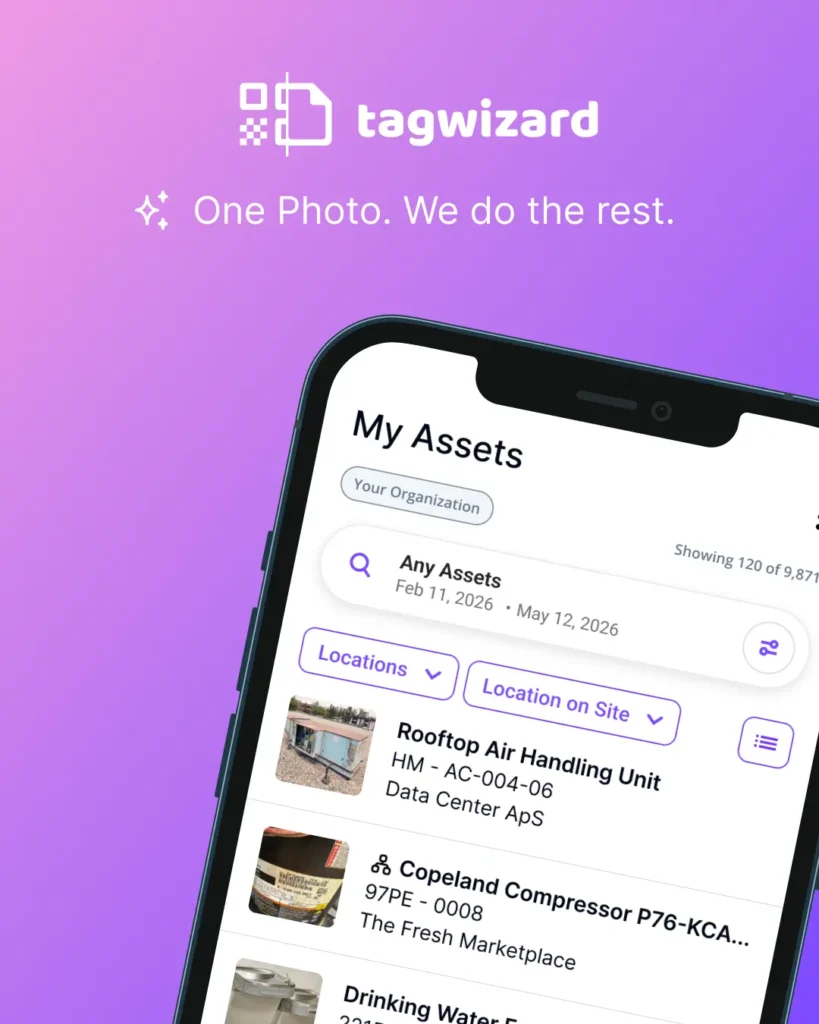
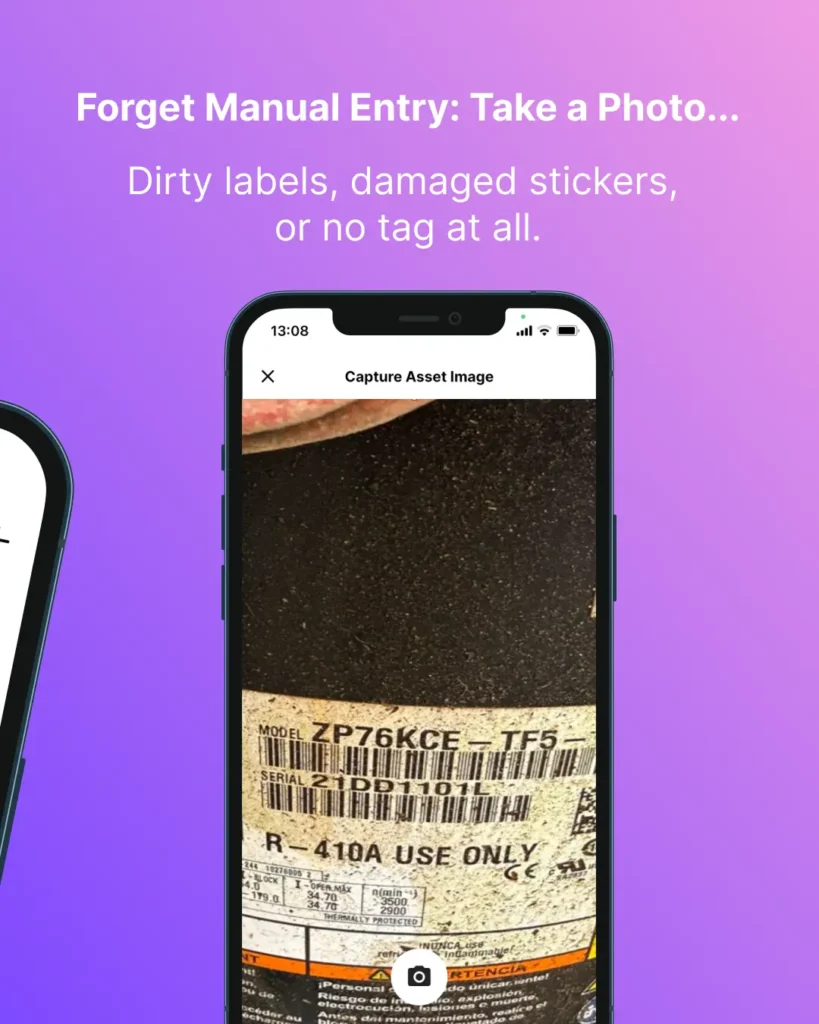
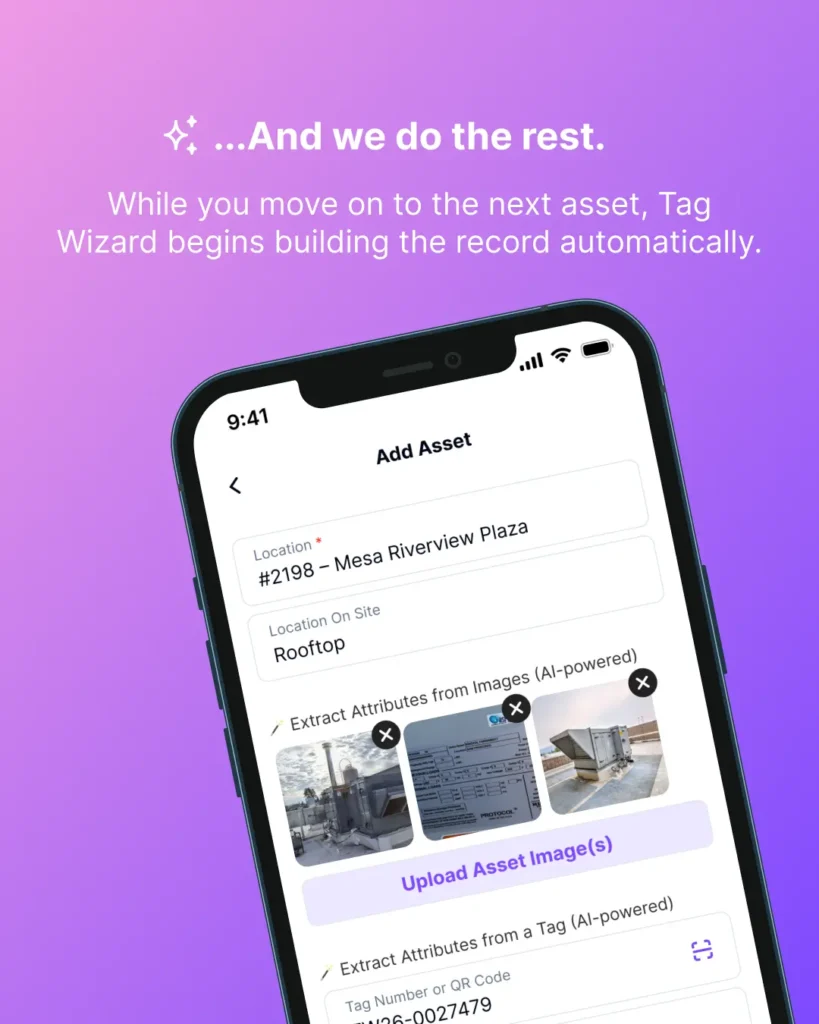
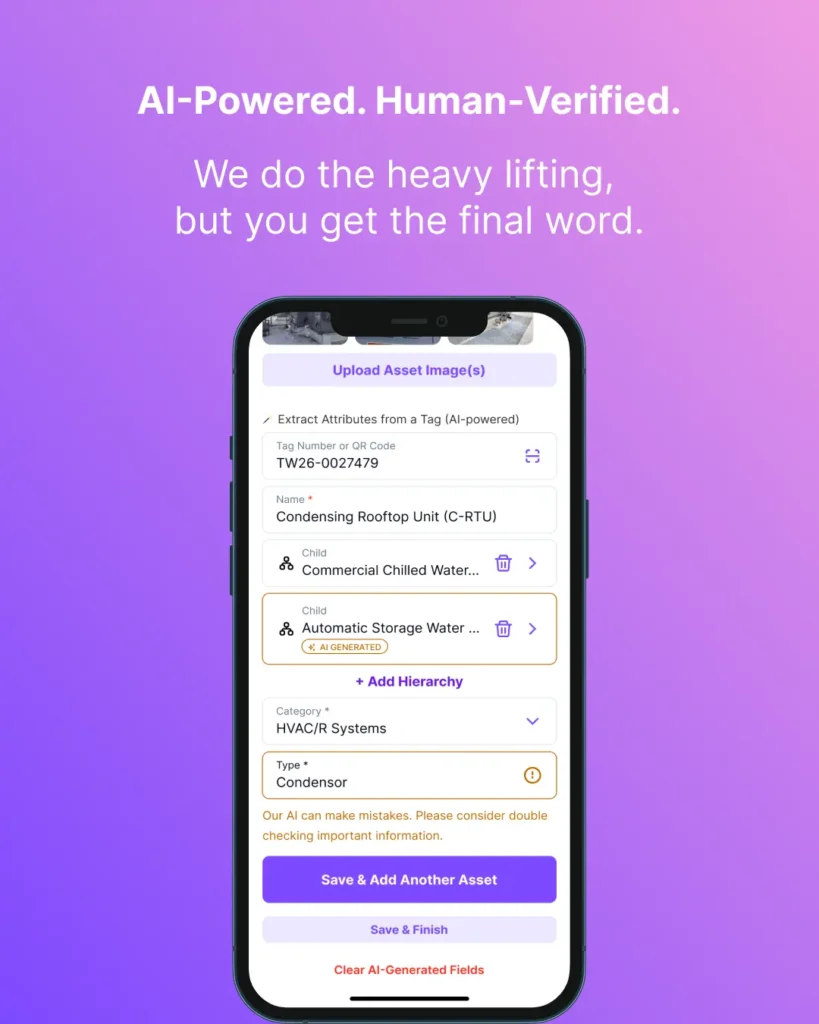
When a tech captures a rooftop unit in store 4127, the equipment type, the category, the parent hierarchy, and the canonical name are determined by Tag Wizard — not by the tech, not by the site, not by the customer’s CMMS administrator. The tech takes the picture. We do the rest.
If we let every customer rewrite the taxonomy, every customer would.
And six months later, every customer would have the same problem they had before — assets named twelve different ways, audit data that cannot be produced on demand, and compliance exposure they did not know they had. Flexibility was the original cause of the problem.
Adding more of it was not going to fix it.
The rigidity is the moat around the asset. The rigidity is the doctrine. The rigidity is why the system produces audit-ready data instead of audit-shaped guesses.
Why Nestor validates the approach
The Tag Wizard position did not emerge from the asset management market.
It emerged from a direction that has been validated independently by the NIST research community over the past decade — through the Knowledge Extraction and Application for Smart Manufacturing project, and the Nestor toolkit that project produced.
Nestor’s central insight, distilled across peer-reviewed work by smart people like Sexton, Brundage, Hodkiewicz, Dima, Lukens, and others, is this:
Technical maintenance text resists analysis because human variation in naming and abbreviation overwhelms the underlying signal.
The fix is not to add more flexibility for the human. The fix is to absorb the variation into a structured layer (aliases, canonical concepts, ranked tagging) that lets the analyst treat “the same idea written differently” as the same idea.
That is the same argument Tag Wizard makes, one layer upstream. Nestor structures the text after it is written.
Tag Wizard structures the asset before the text gets written about it. Same principle. Different layer.
When the tag is missing, the asset isn’t — because triangulation kicks in to identify it from the library, and the canonical record gets produced anyway.
The reason Tag Wizard is aligned with Nestor is not a happy coincidence.
This is because both systems start from the same foundational position: rigidity in the structure layer makes downstream flexibility possible in the analysis layer.
The structure has to come from somewhere. If the platform does not supply it, the operator has to.
And when the customer has to supply it, the customer fails — not because they are not trying, but because they were never built to be a standards body.
NIST did not expect the EPA to invent its own taxonomy.
The EPA does not expect the customer to invent the EPA’s taxonomy.
Tag Wizard does not expect the customer to invent Tag Wizard’s taxonomy, just as leading states do not expect individual operators to improvise their own refrigerant standards when state‑level refrigerant compliance initiatives spell them out in detail. That is the entire point.

What this means for the buying decision
When a CMMS vendor describes their platform as “configurable to your needs,” what they are describing is a system architecture in which the regulatory burden, the taxonomy burden, the data quality burden, and the audit burden all stay with you.
Their flexibility is your liability.
When Tag Wizard says we are opinionated about taxonomy, what we are saying is that we absorb those burdens at the moment of capture. Our rigidity is your protection.
The structure travels with the data into your CMMS, into your compliance reports, into your audit packages, into your reliability analysis — in a form that NIST researchers, EPA auditors, and your own analysts can all read in their own languages.
One canonical record. Readable across every system you run, every role that touches it, and every audit you have to pass. Structured at capture, not cleaned up later.
Asset truth is a doctrine, not a feature. You cannot configure your way to it. You have to build it from the start.
You take the picture. Tag Wizard does the rest. ✨
When the asset tags are missing, the asset isn’t
A real-world scenario: a technician approaches a rooftop unit that’s been exposed to the elements for fifteen years.
The nameplate is sun-faded, paint-flaked, and partially obscured by a service sticker from 2017.
The serial number is barely legible, and any barcode has long since weathered away.
Asset tagging (the process of affixing tags or labels to assets to identify each one individually and track data from real-time location to maintenance history) often fails in these conditions.
Asset Triangulation: Tag Wizard’s Solution
Tag Wizard doesn’t give up when tags are missing.
Instead, it uses asset triangulation: a library of make, model, category, and specification data combined with screening logic that identifies the unit from what’s visible: housing geometry, model fragments, surrounding equipment context, and location pattern.
The technician takes a picture, the app proposes the most likely match, and the tech confirms.
The canonical record is created, ensuring the asset is tracked even when the physical tag is missing or unreadable.
With cloud-based tools, businesses gain the ability to track assets more reliably and reduce the likelihood of assets going missing. Better identification also cuts costs tied to loss or theft by keeping critical equipment visible.
This is the difference between a tagging platform and an asset data platform. A tagging platform needs the tag to work. Tag Wizard works whether the tag is there or not, supporting machinery life and long-term asset value.
Transitioning from asset identification, let’s explore how Tag Wizard ensures data consistency across every system and multiple sites.
Readable across every system and multiple sites
Most facilities operate more software than they admit: the CMMS, asset register, work-order platform, compliance system, BMS, procurement system, and even spreadsheets maintained by finance.
Each system has its own asset schema, naming conventions, and setup history.
The Problem of Data Drift
When a new asset enters this ecosystem, it often appears as a typo or duplicate.
Someone creates it in one system, someone else creates a similar-but-not-identical record in another, and soon the same chiller exists three times under three slightly different names.
The cost of reconciliation becomes prohibitive, so the data drifts and reports stop matching reality.
📌 Start tagging today.
Tell us about your facility. We’ll show you exactly where you’re losing money — and how fast we can fix it. No commitment. Just answers.
Tag Wizard as Neutral Infrastructure
Tag Wizard fixes this at the source:
- One capture event.
- One canonical record.
- Clean exports into whichever system needs it—CMMS, asset register, work-order platform, compliance database—in the format that system expects, with the same underlying identity.
Modern platforms also depend on mobile access so technicians can log work and access data on-site. The chiller is the chiller, whether your CMMS calls it RTU-0341-N or your compliance system calls it Asset 88412.
Remote mobile updates to inventories and work orders improve time management and raise productivity. One stone. Many readings.
Practical Results for Maintenance Teams
When your facility team adds a new asset on Tuesday, your reliability analyst can find it in the dataset on Wednesday, your compliance officer can pull it for the AIM Act filing on Thursday, and your CMMS administrator hasn’t had to manually reconcile anything.
Clean exports into downstream workflows also reduce maintenance costs and downtime, because schedules can be automated before minor issues become major failures. The data is structured at capture, not cleaned up later.
With system-wide consistency established, let’s look at how Tag Wizard adapts to the needs of every role in your organization.
Readable across every role
The same asset means different things to different people, and Tag Wizard is built around that.
For the Technician in the Field
They need the asset to be locatable in physical space and identifiable within thirty seconds.
Tag Wizard’s field language is spatial, photo-anchored, and forgiving—RTU-3 is RTU-3 whether the tech types it, scans it, or just takes a picture of the nameplate.
The capture is fast because the structure happens on our side, not theirs.
Mobile capture enables users to access data quickly in the field and monitor assets with accurate continuity from the same record.
Any technician, any device, any site.
For the Facility Manager
They need the asset rolled up into a hierarchy that makes sense for their reporting: Store → Department → Equipment Type → Asset.
Specialty categories match how the team actually thinks about the work, supporting coordination across departments and day-to-day operations.
Tag Wizard produces that hierarchy from the same capture event, without the tech having to think about it.
For the COO or Finance Leader
The asset needs to roll up into spend, depreciation, and lifecycle analysis.
Same record, different lens.
Clean asset records help managers manage revenue exposure by showing the importance of critical equipment to the organization and by clarifying how refrigerant losses feed into Scope 1 emissions red‑flag reporting.
The canonical naming and category taxonomy mean the data joins cleanly to whatever financial system is asking.
For the Reliability Analyst
They need the asset to be tokenized—to behave as a consistent concept across thousands of records, so they can run statistical analysis on it.
This is where Tag Wizard’s compatibility with NIST’s Nestor framework matters most.
📱 Download Tag Wizard
Tag Wizard and NIST’s Nestor Framework
Nestor, as we have discussed, is an open-source Technical Language Processing toolkit developed at the National Institute of Standards and Technology.
It exists because maintenance work orders are full of free-text fields that nobody can analyze—every technician spells, abbreviates, and phrases things differently, and the result is data that resists every attempt to make decisions from it.
Accurate tokenization depends on correct data, accuracy, sufficient detail, and disciplined documentation.
Nestor groups variant spellings and abbreviations into consistent terms called aliases, which lets analysts treat “the same idea written differently” as the same idea.
Tag Wizard does the equivalent work one layer upstream—at the asset itself, at the moment of capture, rather than in the work-order text after the fact.
The output is structurally compatible: a Tag Wizard record maps cleanly onto the kind of input Nestor and any TLP framework is built to consume.
Nestor Alined Tag Wizard
| Problem | Nestor’s Approach | Tag Wizard’s Approach |
|---|---|---|
| Same concept entered three different ways | Group spellings into aliases | Canonical naming at capture |
| Free text resists analysis | Output structured tags | Output structured asset records |
| Human variability degrades data | TLP normalization | Taxonomy plus duplicate suppression |
| Analysts can’t trust the dataset | Semi-structured aliases | Audit-ready export |
| The wider asset-tracking market is projected to reach $36.3 billion by 2025, a blunt measure of how far this challenge now extends across industries. | ||
| We’re not replacing Nestor. We’re feeding it the clean inputs it was built to work with. If your analyst is using Nestor today, Tag Wizard data plugs in. If they’re not, they can hand the output to any researcher familiar with the framework, and that researcher will know exactly what to do with it. |
With every role’s needs addressed, let’s examine how Tag Wizard supports audit readiness and maintenance history.
Readable across every audit and maintenance history
This is where the cost of getting it wrong shows up on a regulator’s desk.
Regulatory Compliance and the AIM Act – & The QR Code
For owners and operators, understanding the AIM Act compliance essentials is non‑negotiable as phasedown schedules tighten and refrigerant choices narrow.
Also, the EPA baked the need to label Assets identified in the Technology Transition.
AIM Act technology transition — already in effect
First-wave equipment categories. The rule has been live since January 1, 2025.
| Subsector | Equipment / product category | GWP limit or restriction |
|---|---|---|
| Residential & light commercial AC and heat pumps | Window units, portable room AC, residential and light commercial AC and heat pump systems | GWP limit: 700 |
| Residential dehumidifiers | Residential dehumidifiers | GWP limit: 700 |
| Household refrigerators and freezers | Household refrigerators and freezers | GWP limit: 150 |
| Vending machines | Vending machines | GWP limit: 150 |
| Motor vehicle AC (light-duty passenger) | Light-duty passenger vehicles | GWP limit: 150 Model Year 2025, no earlier than 1 yr after Federal Register publication |
| Retail food refrigeration — standalone units | Standalone refrigeration units | GWP limit: 150 |
| Refrigerated transport | Intermodal containers, evaporator at or above -50°C | GWP limit: 700 |
| Refrigerated transport | Road, self-contained products | Prohibited substance list |
| Refrigerated transport | Marine, self-contained products | Prohibited substance list |
| Ice rinks | Ice rinks | GWP limit: 700 |
| Chillers — industrial process refrigeration | Exiting fluid below -50°C | GWP limit: 700 |
The AIM Act Technology Transition Rule sets Global Warming Potential limits and prohibited substance lists for refrigerants used in specific equipment categories.
Compliance dates are staggered across 2025, 2026, 2027, and 2028, depending on the subsector.
Residential and light commercial AC, household refrigerators, vending machines, ice rinks, and certain refrigerated transport hit on January 1, 2025.
Variable refrigerant flow systems, most industrial process refrigeration, self-contained ice machines, and certain cold storage hit on January 1, 2026.
Data center cooling and most retail food refrigeration processing equipment hit on January 1, 2027.
Comfort cooling chillers and the last industrial process refrigeration categories hit on January 1, 2028, which is why leaders are increasingly focused on navigating the EPA HFC Technology Transition regulations as a strategic planning exercise, not just a compliance chore.
AIM Act technology transition — already in effect (January 1, 2026)
Second-wave equipment categories. The rule has been live since January 1, 2026.
| Subsector | Equipment / product category | GWP limit or restriction |
|---|---|---|
| Variable refrigerant flow (VRF) systems | Stationary VRF AC and heat pumps | GWP limit: 700 |
| Industrial process refrigeration (non-chiller) | Less than 200 lb charge, evaporator at or above -30°C | GWP limit: 300 |
| Industrial process refrigeration (non-chiller) | High-temp side of cascade, evaporator at or above -30°C | GWP limit: 300 |
| Industrial process refrigeration (non-chiller) | 200 lb or more charge, evaporator at or above -30°C (excl. high-temp cascade) | GWP limit: 150 |
| Self-contained commercial ice machines | Batch type, harvest rate ≤ 1,000 lb ice/24 hr | GWP limit: 150 |
| Self-contained commercial ice machines | Continuous type, harvest rate ≤ 1,200 lb ice/24 hr | GWP limit: 150 |
| Cold storage warehouses | Less than 200 lb refrigerant charge | GWP limit: 150 |
| Cold storage warehouses | High-temp side of cascade system | GWP limit: 300 |
| Chillers — industrial process refrigeration | Exiting fluid from -50°C to -30°C | GWP limit: 700 |
The auditor doesn’t care what your CMMS calls the unit. The auditor cares about the serial number, the refrigerant type and charge, the install date, the inspection history, and whether all of that data is internally consistent.
AIM Act technology transition — approaching (January 1, 2027)
The next live deadline. Data centers and retail food refrigeration take effect on January 1, 2027.
| Subsector | Equipment / product category | GWP limit or restriction |
|---|---|---|
| Data centers, computer room AC, IT cooling | Data center cooling and IT equipment cooling | GWP limit: 700 |
| Retail food — refrigerated processing & dispensing | 500 g refrigerant or less, outside UL 621 ed. 7 scope | GWP limit: 150 |
| Retail food — refrigerated processing & dispensing | More than 500 g refrigerant, outside UL 621 ed. 7 scope | Prohibited substance list |
| Retail food — refrigerated processing & dispensing | Ice cream makers within UL 621 ed. 7 scope | Prohibited substance list |
| Self-contained commercial ice machines | Batch type, harvest rate > 1,000 lb ice/24 hr | Prohibited substance list |
| Self-contained commercial ice machines | Continuous type, harvest rate > 1,200 lb ice/24 hr | Prohibited substance list |
| Cold storage warehouses | 200 lb or more refrigerant charge (excl. high-temp cascade) | GWP limit: 150 |
The Challenge of Audit-Ready Data
Most facilities can’t produce that on demand. Not because the data doesn’t exist—it does, somewhere—but because it exists in three different systems under three different names, and assembling it for an audit takes weeks. We’ve watched it happen.
Tag Wizard’s canonical record is built so the audit lens works as cleanly as the field lens. Refrigerant charge and type are captured against the same asset identity that the tech sees and the CMMS uses. Inspection history attaches to that identity over time. When the audit comes, the export is a single structured record per asset, in the format the regulator expects, with the underlying identity matching whatever the field team and the CMMS already know.
AIM Act technology transition — on the horizon (January 1, 2028)
Comfort cooling chillers and the last industrial process refrigeration category. Plan now.
| Subsector | Equipment / product category | GWP limit or restriction |
|---|---|---|
| Chillers — comfort cooling | Comfort cooling chillers | GWP limit: 700 |
| Industrial process refrigeration (non-chiller) | Evaporator from -50°C to -30°C | GWP limit: 700 |
Data Quality as a Compliance Issue
A 2021 NIST study by Conte, Bolland, Phan, Brundage, and Sexton walked through ten years of HVAC maintenance data and found two patterns that matter for anyone facing an audit.
Pattern One: Close-Out Dates Lie
In their dataset, 93% of work orders were marked closed on a Friday, while opens were distributed evenly across the work week.
That’s batch close-out, not actual completion.
When the researchers corrected for it, the median work order duration dropped from 14 days to 9–10 days—a 30%+ overestimation of labor hours, baked into every report. It doesn’t really apply to us, but a fascinating fact.
Pattern Two: Missing Data Isn’t Random
When the researchers simulated random missing data, the calculated KPIs stayed roughly stable.
When they simulated missing data tied to content (the rare, unfamiliar maintenance jobs that techs don’t know how to describe) the KPIs drifted wildly. The average cost per month doubled in one scenario.
The cause: technicians skip data entry on the work orders that confuse them, which means the data you have is systematically biased toward the work you already understand.
For an auditor, this is the worst kind of bias.
The work that’s hardest to document is exactly the work that’s most likely to involve regulated refrigerants, emergency repairs, and rare equipment configurations.
If your dataset is silent on the hard stuff, your compliance story is being written by what didn’t get captured.
Tag Wizard is built to close that gap at the source. Capture is fast enough and forgiving enough that the hard cases get logged.
Canonical naming means they get logged consistently.
Triangulation means that assets with missing or unreadable tags aren’t skipped.
The audit-ready export is the same export that the analyst and the CMMS administrator pull from—so whatever the audit is asking for, the answer is one query away, not one project away.
With audit readiness addressed, let’s discuss the philosophy behind Tag Wizard’s design.

Why we built it this way
We didn’t set out to be Nestor-compatible. We set out to fix the problem maintenance teams actually face—that the data they collect doesn’t survive contact with reality.
Implementing better monitoring systems is now essential not only for reliability but also for reducing energy waste. Building on traditional control guidelines like ASHRAE 36 best‑practice HVAC sequences with data‑driven analytics closes more of that gap in real time.
The tech speaks one language. The CMMS speaks another. The auditor speaks a third.
The analyst speaks a fourth.
Owners and operators of commercial AC units navigating 2024 refrigerant rules feel this fragmentation every time they try to reconcile field realities with regulatory expectations.
Without a stone in the middle, every translation introduces loss, and every report downstream is built on data that’s already drifted.
The Tag Wizard Approach
When we mapped what “good” looks like at every one of those layers, we kept landing on the same answer: capture cleanly, identify uniquely, structure consistently, enrich completely.
Effective HVAC asset monitoring combines different types of maintenance (preventive, corrective, predictive, and condition-based) into disciplined practices that maximize uptime and equipment life.
Predictive maintenance uses sensor and monitoring data to target issues before they escalate, especially when paired with refrigerant leak detection services for grocery, data centers, and CRE that surface problems before they become compliance or uptime events.
Do all four in one workflow, at the moment of capture, by the person standing in front of the asset. Don’t outsource it to specialists.
Don’t defer it to a cleanup project six months later. Don’t depend on a readable nameplate that might not be there.
In refrigeration, that same rigor supports cold-chain sustainability through lower greenhouse gas emissions and a growing shift to renewable energy, aligning with the future of owning and operating refrigeration equipment under tightening refrigerant rules.
That’s the same answer NIST landed on for free-text work-order data. We got there from the asset side instead of the text side, and we ended up building a stone that fits theirs.
That’s why Tag Wizard is the Rosetta Stone for asset data. One canonical record. Readable across every system you run, every role that touches it, and every audit you have to pass.
What’s next?
AIM Act technology transition — how Tag Wizard maps to the rule
What the rule requires, mapped to what Tag Wizard captures.
| What the rule requires | What the auditor will ask for | What Tag Wizard captures |
|---|---|---|
| Identify which units are subject to GWP limits or prohibited substance lists | Equipment subsector, equipment type, equipment category for every unit | Canonical equipment taxonomy applied at the moment of capture. Same category, every site. |
| Identify the refrigerant in each unit and verify it is not on the prohibited list | Refrigerant type and GWP, attached to a specific asset | Refrigerant type, charge, and GWP captured against the asset identity, not against a service event |
| Identify which units exceed the GWP limit for their subsector | A queryable list: all units in subsector X with refrigerant GWP above the limit | One canonical record per asset means one query, one list — across stores, regions, sites |
| Demonstrate when each unit was installed and when it falls under compliance | Install date for every affected unit | Install date captured during initial tagging; preserved across CMMS exports |
| Demonstrate inspection and repair history for affected units | Inspection records linked to the asset, not floating in a service log | Inspection history attached to canonical asset identity over time |
| Identify aging units where the nameplate is missing, faded, or unreadable | These units still need refrigerant data captured for compliance | Asset triangulation identifies make, model, and category without a readable tag |
| Produce audit-ready export in the format the regulator expects | Single structured record per asset, consistent fields, no manual reconciliation | The audit-ready export is the same export the analyst and CMMS administrator already use |
We’re building out the Tag Wizard data dictionary to map explicitly against standards and structures based on feedback we get from people in the field tagging assets.
The work over the past 2 years has specifically led to a breakthrough in how assets are identified. The data quality problem is solvable. NIST showed the way at the text layer.
We’re doing the same work at the asset layer. But the real results have been in the 11x productivity increases from the guys in the field tagging assets and the speed of use of that same data.
You take the picture. Tag Wizard does the rest. ✨
📱 Download Tag Wizard