
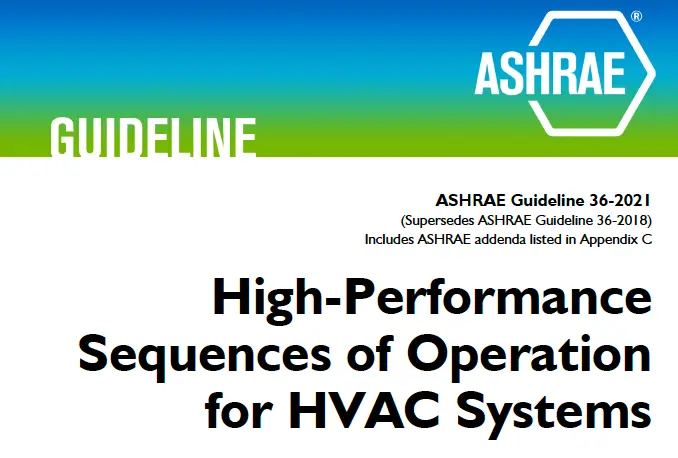
ASHRAE Guideline 36, titled High-Performance Sequences of Operation for HVAC Systems, provides standardized control sequences that optimize HVAC performance, energy efficiency, indoor air quality, and building automation by giving the industry a common, tested framework for how systems should run.
For facility owners, HVAC control manufacturers, designers, contractors, and building automation professionals, that framework matters because better sequences alone do not solve refrigerant management, compliance, or fault response.
Quick answer
ASHRAE 36, Fault Detection and Diagnostics (FDD), and physical zone-level leak detection are three different layers, not competing options.
- ASHRAE 36 standardizes how HVAC systems should be controlled.
- FDD monitors system-wide behavior in real time and flags anomalies.
- Physical zone-level sensors confirm whether an anomaly is a refrigerant leak and pinpoint exactly where.
A compliant, effective refrigerant management program needs all three working together, not one replacing the others.
📌 A compliant, effective refrigerant management program needs all three working together, not one replacing the others.
Fault Detection and Diagnostics (FDD) extends that foundation.
Where ASHRAE 36 defines how a system should behave, FDD watches whether it actually does, and flags the moment it doesn’t. The two aren’t competing standards.
They’re different layers of the same operational stack, and treating them as substitutes for one another is where most facility programs go wrong.
The same is true one layer further down. FDD tells a team something in the system has drifted.
It does not, on its own, tell them where a refrigerant leak physically is.
That’s a separate capability, and closing the gap between “something is wrong” and “here is exactly where” is where system-level FDD and zone-level physical leak detection have to hand off to each other.
This article explains how Guideline 36 fits into HVAC control sequencing, where FDD adds value, why physical leak detection still has to happen at the zone level, what technical implementation issues teams need to plan for, and how these layers support EPA AIM Act compliance and verifiable refrigerant leak management while reducing energy waste, downtime, and avoidable penalties.
Understanding ASHRAE 36’s Role and High Performance Sequences in HVAC Systems
ASHRAE Guideline 36 gives building automation systems uniform sequences of operation, addressing common problems in designing, installing, and testing controls.
By standardizing advanced control sequences, it cuts engineering, programming, and commissioning time, and improves communication between specifiers, contractors, and operators.
Its significance is in the framework itself: high-performance sequences that lead to better control stability and give a system a consistent baseline for automated fault detection.
Facility owners and control manufacturers who adopt Guideline 36 get a tested starting point instead of a custom-built one, which is most of the value.
The guideline’s development, including research initiatives like RP-1711 and RP-1865, focused on building tested, advanced control sequences that optimize both energy efficiency and performance.
The result is a system less dependent on any one installer getting a custom control design exactly right.
Guideline 36 simplifies what has to be built from scratch, and that consistency has been a genuine advance in HVAC control practice.
📌 Let’s make refrigerant compliance easier together
Where Standardized Sequences Stop
Guideline 36 is a strong foundation, but it is a design and control standard, not a monitoring platform. It tells a system how to sequence.
It doesn’t watch, in real time, whether the system is holding to that sequence or drifting from it, and it has no mechanism for detecting a physical refrigerant leak at all.
FDD closes the first part of that gap. Modern FDD platforms apply real-time data analytics and pattern recognition to system behavior, catching inefficiencies and control drift as they emerge rather than waiting for a scheduled inspection to find them.
That shifts maintenance from reactive (fix it when it breaks) toward predictive (catch it before it does).
But FDD built on system-level signals, HVAC data points, liquid-level trends, and run-time anomalies; it has a hard boundary. It can tell a team that a system is behaving abnormally.
It generally cannot tell them which zone, which case, which joint is the source. That’s not a flaw in the technology. It’s a difference in what the technology is built to see.
Current FDD approaches also carry a second limitation worth naming directly: without standardized sequences underneath them, FDD output can be inconsistent from one site to the next, since the diagnostics are only as good as the control logic they’re reading.
And many FDD tools still lean on manual review to interpret what a flagged anomaly actually means, which slows the response and reintroduces the human error the automation was meant to remove.
The fix for both is the same: pair FDD with a standardized foundation (Guideline 36) on one side, and a physical, ground-truth layer (zone-level detection) on the other, so the system isn’t asking a human to guess in the middle.
SZVAV AHU operating states
Figure 5.18.13.2 · Damper/valve position vs. operating state
The OS is distinct from, and should not be confused with, the zone status (cooling, heating, deadband) or Zone Group mode (occupied, warmup, etc.).
OS#1 through OS#4 (see Table 5.18.13.2) represent normal operation during which a fault may nevertheless occur if so determined by the fault condition tests in Section 5.18.13.6.
By contrast, OS#5 may represent an abnormal or incorrect condition (such as simultaneous heating and cooling) arising from a controller failure or programming error, but it may also occur normally, e.g., when dehumidification is active or during warmup.
The Handshake: FDD and Physical Detection Working Together
This is where the two approaches need to meet instead of compete.
System-level FDD is efficient at broad coverage.
It watches equipment behavior across a whole site cheaply and continuously, and it’s good at surfacing the fact that something has changed.
What it can’t do is confirm, with ppm-level certainty, that the change is a refrigerant leak rather than a defrost cycle, a door left open, or a sensor drifting out of calibration. And it can’t say where.
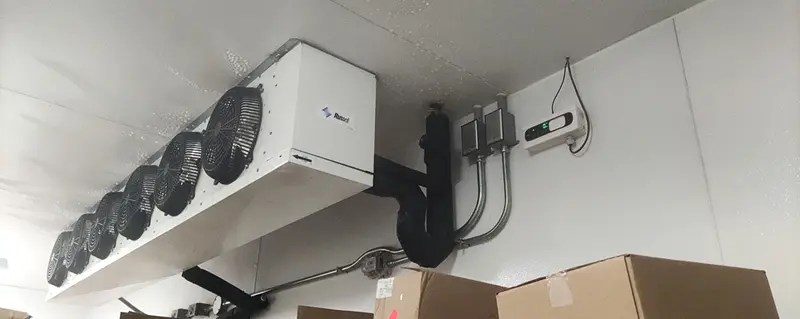
Physical, zone-level leak detection is built for exactly that. A fixed sensor per zone, reading continuously to 1 PPM, gives a location and a concentration, not just a flag.
When a signal fires, the team already knows which device, which zone, which reading triggered it.
The strongest programs run both, in sequence, as a handshake rather than a substitute:
- System-level FDD watches broadly and flags anomalies across HVAC and refrigeration behavior.
- Zone-level physical detection confirms whether an anomaly is a refrigerant event, and if so, exactly where.
- Field action closes the loop, with a technician dispatched to a known location instead of a general area, and a documented, verifiable outcome.
Skip the middle step and a facility is left with the whack-a-mole problem: a flag that something is wrong, and a technician checking every joint in a rack to find it.
Skip the first step and a facility is left reacting one zone at a time, without the broader operational picture FDD provides.
Run them together, and each covers the other’s blind spot.
Technical Considerations for Implementation and Energy Savings
Putting this stack in place takes more than switching on software. A few technical factors determine whether it works:
Control system compatibility
In commercial buildings, HVAC equipment and air conditioning controls need to be designed or retrofitted to support high-performance control sequences before automated fault detection has a reliable baseline to measure against.
Guideline 36 was developed to standardize ventilation, heating, and cooling logic and reduce simultaneous heating and cooling to save energy.
AFDD configuration
Automated Fault Detection and Diagnostics has to be properly configured and integrated with the control system to function. Guideline 36 includes
AFDD as a named component for exactly this reason, using temperature data and sequences such as supply air temperature reset to help systems run more efficiently.
A calibration baseline, not a guess
Settings can be estimated by an experienced engineer, but the more reliable path is collecting live data first and calibrating thresholds against an actual operating baseline as the data accumulates.
Systems tuned this way drift less and false-flag less, which helps capture the full benefits and savings while improving energy performance, lowering energy use and energy consumption, and protecting thermal comfort.
Experienced installation
Guideline 36 can be complex to implement in variable air volume systems and related terminal units, and the process is often time-consuming.
Implementation quality of GL36 varies significantly across projects depending on who executes it, whether that’s the designer, the contractor, or a controls engineer manually adapting sequences, so many buildings fall short of the expected results when installed inconsistently.
Most mid-market buildings lack resources for ongoing operational oversight, which makes correct initial implementation more important.
The same discipline applies one layer down, at the physical sensor level.
A zone sensor calibrated to the refrigerant it’s watching, with a recorded baseline reading, is what makes a leak alert trustworthy enough to dispatch a technician on. Skip the baseline at either layer and the whole stack inherits the noise.
At 12:08 (i.e., 4T), there are four requests (i.e., R = 4). Because R−I = 2, the response component increases the setpoint by 30 Pa (0.12 in. of water) (i.e., 2SPres). Net result: setpoint is 145 Pa (0.60 in. of water).
At 12:10 (i.e., 5T), there are six requests (i.e., R = 6). Because R−I = 4, but SPres max = 37 Pa (0.15 in. of water), the response component increases setpoint by the maximum of 37 Pa (0.15 in. of water) (i.e., not 4SPres = 60 Pa [0.24 in. of water]). Net result: setpoint is 182 Pa (0.75 in. of water).
At 12:12 (i.e., 6T), there are three requests (i.e., R = 3). Because R−I = 1, the response component increases the setpoint by 15 Pa (0.06 in. of water) (i.e., 1SPres). Net result: setpoint is 197 Pa (0.81 in. of water).
At 12:14 (i.e., 7*T), there are zero requests (i.e., R = 0). Because R<1, the trim component reduces the setpoint by 10 Pa (0.04 in. of water). Net result: setpoint is 187 Pa (0.77 in. of water).
Informative Figure 5.1.14.4 shows a trend graph of the example above, continued for a period of an hour.
Example sequence trend graph
Informative Figure 5.1.14.4 · Static pressure setpoint vs. number of requests
The Last 20 Percent: Why a Person Still Has to Confirm It
Automation should carry the bulk of the load: continuous watching, pattern recognition, localization down to a specific zone.
That’s roughly 80 percent of the work, and it’s the part that scales. But the remaining 20 percent, judgment, still belongs to a person, and skipping it is where automated programs get themselves in trouble.
A sensor reading a concentration spike doesn’t know, by itself, whether it’s watching a refrigerant leak, a defrost cycle, a door propped open, or an unrelated gas source nearby. Every one of those can produce a signal that looks like a leak on a dashboard.
The signal is real. What it means is a question only a field confirmation can answer.
That’s why field results outrank platform figures. Nothing is a false alarm, and nothing is a confirmed leak, until someone has actually looked.
The useful way to think about any flagged event is as three separate layers: what the instrument recorded, what the platform reported, and what the field found. When those three layers agree, the automation did its job cleanly.
When they disagree, that disagreement is the actual diagnostic signal, and it’s exactly the kind of case a human needs to be in the loop for.
This cuts against a common assumption that more automation always means fewer people involved.
In refrigerant monitoring, it means the opposite of careless: automation exists so that the right person gets pulled in only when there’s something real to look at, with a location and a reading already in hand, instead of being sent out on every anomaly or, worse, none of them.
📌 Let’s make refrigerant compliance easier together
Meeting EPA Requirements Under the AIM Act
Regulatory pressure makes this handshake more than an efficiency question.
Under the EPA’s AIM Act and the associated refrigerant management requirements at 40 CFR Part 84 Subpart C, businesses are expected to track refrigerant use closely and detect and address leaks promptly. Enforcement under this framework continues to escalate.
That regulatory picture also extends to state energy code adoption: California’s Title 24 incorporates ASHRAE Guideline 36 requirements.
Utility incentives for GL36 implementation are also emerging in several states, often through a state energy office or department.
A monitoring program that can only say “something changed” doesn’t produce evidence a regulator, an auditor, or a board can act on.
A program that can say “this zone, this concentration, this timestamp, this resolution” does.
That evidentiary layer, precise, location-specific, and documented, is what physical zone detection contributes on top of what system-level FDD alone can show.
Why ASHRAE 36 Still Matters
None of this diminishes Guideline 36’s role. It remains the right foundation for how HVAC systems should be sequenced and controlled, and it reduces the engineering and commissioning burden that used to fall on every new installation.
FDD and physical leak detection build on top of that foundation. They don’t replace it.
The full stack- standardized sequences, system-level fault detection, and zone-level physical leak detection- working together is what actually gets a facility from “compliant on paper” to “provably compliant in practice,” while also cutting the energy waste, emergency labor, and unplanned downtime that come from finding problems late; properly implemented controls can save approximately 29% energy.
GL36 can save up to 41% energy in winter. GL36 sequences can achieve 31% energy savings in medium buildings.
California field demonstrations showed 11–35% whole-building electricity savings from GL36.
Future Directions for the FDD, Physical Detection Stack, and Building Automation
FDD and physical leak detection both keep advancing, and the direction is the same for both: closer integration, not louder standalone claims.
Tighter integration with Guideline 36
FDD that reads directly against Guideline 36 sequences produces cleaner, more consistent flags than FDD layered on top of a non-standardized system.
Meeting AIM Act leak requirements directly
Refrigerant-specific detection needs to produce alerts a facility manager and a regulator can act on, not just a general system-health score.
Deeper analytics on top of ground-truth data.
Advanced analytics are only as good as the data feeding them. Zone-level ppm readings give analytics something real to work from instead of an inferred proxy.
Cloud-based access for every stakeholder.
Remote monitoring and shared real-time data let facility teams, service providers, and compliance leads work from the same picture instead of reconciling separate reports.
AI and machine learning applied to confirmed events.
The more reliable the underlying signal- physical, located, quantified- the more useful predictive modeling built on top of it becomes.
None of this replaces the core principle: broad system-level watching plus precise zone-level confirmation, handed off cleanly between the two. Better analytics and better integration make that handoff faster. They don’t remove the need for it.
🚨 Don’t leave compliance to chance
Get in touch to learn how we can support your HVAC operations
Where This Goes Next
The next step for facility teams isn’t choosing between FDD and physical detection.
It’s making sure the two are wired to hand off to each other, so a system-level flag turns into a zone-level confirmation, and a zone-level confirmation turns into a technician standing in front of the right device instead of searching a rack by hand.
See leak, fix, not see flag, search.
Frequently Asked Questions
Does FDD replace the need for physical leak detection sensors?
No. FDD monitors system-wide behavior and flags anomalies, but it generally cannot confirm a flagged anomaly is a refrigerant leak or say which zone it’s in.
Physical, zone-level sensors provide that confirmation and location. The two work as a handshake, not a substitute.
Is ASHRAE 36 a leak detection standard?
No. ASHRAE 36 standardizes HVAC control sequences for energy efficiency and control stability.
It includes Automated Fault Detection and Diagnostics (AFDD) as a component, but it does not detect refrigerant leaks on its own. Separate case studies from one company report that GL36 compliance can deliver 11–35% whole-building electricity savings.
What’s the difference between indirect and physical (direct) leak detection?
Indirect detection infers a possible leak from system-level data, such as liquid-level trends, without a sensor at each zone. It can signal that refrigerant is being lost somewhere in a system but not where.
Physical detection places a sensor at each zone, reading concentration directly, so an alert comes with a location attached.
What does the EPA require for refrigerant leak detection?
Under the AIM Act and 40 CFR Part 84 Subpart C, facilities are required to track refrigerant use and detect and address leaks promptly.
Enforcement under this framework continues to escalate. Documentation needs to show not just that a leak was detected, but where and when.
Why does combining FDD with physical detection matter for compliance?
A flag alone isn’t evidence a regulator or auditor can act on. Pairing broad, system-level FDD with zone-level physical confirmation produces a documented, location-specific, timestamped record, the evidentiary layer compliance actually requires.
Does automated leak detection remove the need for people?
No. Automation should handle the bulk of continuous monitoring and localization, but confirming what a signal actually means still requires a person. Sensor readings can’t distinguish a real leak from a defrost cycle or another gas source on their own.
Field confirmation is what turns a flagged signal into a verified result.