EPA ER&R Leak Repair + ALD (AIM Act Subsection (h)) and How It Intersects with Scope 1 Reporting
AIM Act subsection (h) is the operations lane: it reduces refrigerant releases from existing equipment through EPA’s Equipment, Refrigerant, and Refrigeration (ER&R) leak repair requirements, alternative leak detection (ALD) for certain systems, and stronger reclaim and recordkeeping discipline.
2026 Compliance Outlook
EPA ER&R Leak Repair + ALD (AIM Act Subsection (h))
How It Intersects with Scope 1 Reporting in a Shifting Regulatory Landscape?
Updated June 2026 to reflect the EPA Reconsideration Rule signed May 26, 2026, the SEC’s formal rescission proposal for its climate disclosure rules, and CARB’s adopted regulations for SB 253 and SB 261.
Who Should Read This and Why It Matters
This article is for facility managers, compliance officers, sustainability leads, and anyone responsible for environmental reporting or operational efficiency in organizations that use refrigerants.
The scope centers on refrigerant regulations, leak detection, and Scope 1 disclosures — three areas that have all moved materially in the past four weeks, driven in part by the environmental side of ESG and business responses to climate change.
On May 26, 2026, EPA finalized its Reconsideration Rule amending the Technology Transitions provisions of the AIM Act.
On May 29, 2026, the SEC formally proposed rescinding its climate-related disclosure rules.
Even so, companies are increasingly expected to disclose their climate-related risks and greenhouse gas emissions as part of ESG reporting.
At the same time, California’s SB 253 has its first Scope 1 and 2 reporting deadline on August 10, 2026, and the ER&R leak repair and Automatic Leak Detection (ALD) requirements that took effect January 1, 2026, are fully enforceable today.
For operators, the practical reality is this: federal Technology Transitions has been softened for some sectors; ER&R leak repair is in force and not yet relaxed; the federal SEC disclosure regime is effectively dead; and the state-level disclosure patchwork (led by California) is alive and accelerating.
Operating posture for 2026 has to thread all four needles at once, with Scope 1 transparency now driven by both regulatory demands and expectations from society.
📌 Turn leak detection data into defensible Scope 1 reporting.
Clarifying the Scope and Importance
Refrigerant regulations require operators to track refrigerant types and quantities, calculate the CO2-equivalent of any leaks, and report covered emissions.
Scope 1 emissions are direct greenhouse gas emissions from owned or operated systems, including refrigerant releases.
The two domains share a single data foundation: asset inventory, refrigerant type, and GWP, charge size, service history, leak rate, and reclaim records
What makes 2026 different is that the data foundation now has to satisfy multiple regimes simultaneously.
ER&R compliance requires defensible records to support leak rate calculations, repair verification, and ALD operation.
California SB 253 requires Scope 1 emissions disclosure for U.S. companies with more than $1 billion in revenue doing business in the state, with independent third-party assurance.
Customer ESG procurement requests increasingly ask the same questions from the supply side.
The federal SEC mandate is going away, but the now-rescinded proposal would have required companies to disclose Scope 1 emissions as part of climate-related disclosures, and greenhouse gas emissions disclosure still affects financial performance and reputation even without a final SEC rule; the underlying expectation that operators can produce credible Scope 1 data is not.
Introduction to AIM Act Subsection (h)
The American Innovation and Manufacturing (AIM) Act, enacted December 27, 2020, gives EPA three distinct authorities for managing HFC refrigerants. Subsection (e) phases down production and consumption through an annual allowance system.
Subsection (i) (the Technology Transitions program) restricts what refrigerants can go into new equipment by sector and date.
Subsection (h) is the operations lane: the Emissions Reduction and Reclamation (ER&R) Program, which governs how existing equipment is operated, repaired, and serviced.
The AIM Act and state-level CARB rules are part of the shift away from high GWP refrigerants, mandating strict leak repairs and phasing down products with a GWP of 700+ in many new HVAC applications beginning in 2025/2026.
Subsection (h) is where day-to-day operational compliance and Scope 1 emissions data converge. It is also the lane that, as of January 1, 2026, has become a regulatory floor under refrigerant management practice for any operator with appliances at or above the 15-pound charge threshold.
40% already cut
Jan 1, 2026
May 26, 2026
All three lanes interact. Phase-down tightens supply. Tech Transitions changes new installs. ER&R governs operations.
Figure 1. The three lanes of the AIM Act. ER&R (Subsection (h)) is the operational lane and is in force today.
Three things happened in May 2026:
What stayed the same, and this is the part most coverage is missing:
Everything operational. ER&R leak repair, ALD installation, the reclaimed HFC ≤15% virgin standard, the 30-day repair clock, the Technology Transitions labeling and tagging framework under 40 CFR 84.58, the phase-down schedule, and California’s SB 253 — all unchanged and all moving forward.
May 2026
EPA finalized the Technology Transitions Reconsideration Rule, extending deadlines and raising interim GWP limits for supermarket, cold storage, semiconductor, and residential AC sectors.
EPA also proposed exempting Transportation Refrigeration Units (TRUs) from ER&R leak repair requirements and signaled broader ER&R reconsideration ahead.
Net read for operators
More runway for what you can install new in certain sectors. Zero change to how existing equipment must be operated, repaired, labeled, or recorded.
Every leak record is still a Scope 1 line item that feeds SB 253 disclosure, customer ESG questionnaires, and reclaim economics.
until Jan 1, 2032
interim 700 GWP cap
(systems ≤ 100 lb charge)
can be installed until stock runs out
leak repair (not final)
10/20/30% thresholds unchanged
verification tests
Existing: Jan 1, 2027
Reclaim procurement impact
Labels required on covered equipment
Next step-down: 2029
for companies > $1B revenue
Technology Transitions Reconsideration Rule
Final rule signed May 26, 2026. Effective 60 days after Federal Register publication.
EPA Administrator Lee Zeldin signed a final rule amending the Technology Transitions provisions of the AIM Act (Subsection (i)).
The rule extends compliance deadlines and raises interim GWP limits in four sectors. EPA projects $976 million in engineering cost savings, primarily for the supermarket sector.
📌 Turn leak detection data into defensible Scope 1 reporting.
What got pushed back
Residential and light commercial AC/HP
Pre-January 2025 inventory above 700 GWP can be installed until existing stock is exhausted.
Supermarket and remote condensing units
Interim GWP limit raised from 150/300 to 1,400 starting January 1, 2026. Original 150/300 limits take effect January 1, 2032.
Cold storage warehouses
Deadline for 150 or 300 GWP limit extended six years, from January 1, 2026, to January 1, 2032. Interim 700 GWP limit until then.
Semiconductor manufacturing
Compliance date for IPR and chillers (≤100 lb charge) pushed to January 1, 2030.
What this does NOT change, including the tagging requirement
Technology Transitions governs what refrigerants can go into new equipment.
It does not govern the operations of existing equipment.
So while supermarket operators got more flexibility on what they can install in 2026-2031, they still have to comply with ER&R leak repair, ALD, reclaim discipline, and recordkeeping on everything currently running.
The HFC phase-down under Subsection (e) is also unchanged.
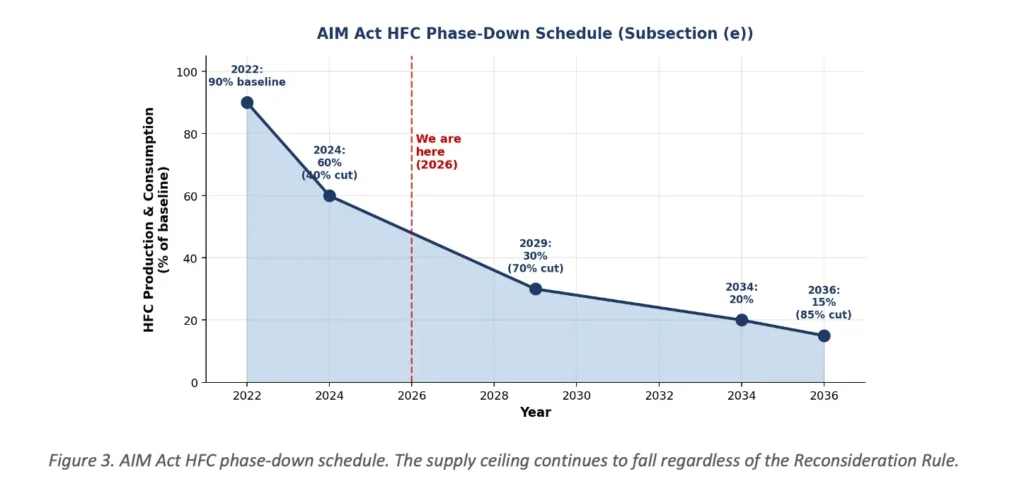
Supply continues to tighten on the original schedule — 40% cut already, 70% cut in 2029, 85% cut by 2036.
Extended runway for legacy refrigerant + falling supply ceiling = upward pressure on refrigerant prices and reclaim value.
The labeling and tagging requirement under 40 CFR 84.58 was NOT modified by the Reconsideration Rule.
Every new HFC-containing product, replacement component, or installed system in a covered subsector must still bear a permanent label that includes refrigerant identification, date of manufacture, and other required information.
The labeling effective date for each subsector moves with the GWP compliance date for that subsector, but the labeling framework itself is intact.
Operators who read the Reconsideration Rule headlines and assume tagging was pushed back, too, are creating a compliance gap unrelated to the GWP changes.
TRU Exemption Proposed (Plus Signal of More Coming)
Proposed rule published May 26, 2026. Public comment period open.
Alongside the final Reconsideration Rule, EPA published a proposed rule that would exempt Transportation Refrigeration Units (TRUs) (road and intermodal container refrigeration) from ER&R leak repair requirements.
EPA projects an additional $1.5 billion in cost savings if finalized.
More significantly for the broader operator universe, EPA announced its intent to propose changes to the 2024 ER&R Rule (the “Leak Management Rule”) in the future.
No specifics yet. No timeline announced. But the direction of travel is now visible.
Operational Read
ER&R is in force today and not changing in 2026.
TRU operators should monitor the comment period and final rule. Everyone else should continue building ER&R compliance infrastructure for the current rules.
Audit-ready records on refrigerant inventory, leak rates, repairs, and verification tests are independently required by state regulators, ESG frameworks, insurers, and customers – they are not at risk if EPA narrows federal scope later.
The Scope 1 Picture: One Data Event, Five Outputs
Every refrigerant leak event in your operation is both an ER&R compliance record and a Scope 1 emissions line item.
The math is straightforward: pounds released × GWP × (0.453592 / 1000) = metric tons CO2-equivalent.
A 12.5-pound charge of R-404A (GWP 3,922) added during service produces 22.2 metric tons of CO2-equivalent.
A 200-store chain with a similar event at each store generates 4,440 metric tons — roughly the annual emissions of 970 average passenger vehicles.
The single-data-point reality
A technician records 12.5 Ib of R-404A added to a walk-in cooler during service. That one record becomes (1) an annual leak rate calculation under ER&R, (2) a 30-day repair clock if over threshold,
(3) a 22.2-metric-ton CO2-equivalent line item in your Scope 1 inventory, (4) a SB 253 disclosure data point, and (5) an answer to the next customer ESG questionnaire. Five outputs, one input.
Operators with one source of truth get all five from one query.
📌 With a clear understanding of the main types of leak detection equipment, let’s move on to how to choose the right refrigerant leak detector for your needs.
Where the Scope 1 pressure comes from
California SB 253.
Companies with more than $1 billion in U.S. revenue doing business in California must disclose Scope 1 and 2 emissions by August 10, 2026, under the regulations CARB adopted February 26, 2026.
Scope 3 reporting begins in 2027. Independent third-party assurance required.
State-level refrigerant-specific rules.
Washington Chapter 173-443 WAC, New York Part 494, and the California Refrigerant Management Program all impose tracking and reporting requirements that operate independently of federal action.
Voluntary and market pressure.
Investor ESG expectations, customer procurement asks, EU CSRD for companies with EU operations, insurance and lending diligence, and CDP/GreenChill benchmarks all continue to require credible Scope 1 data.
What to Do This Week
1. If you are in a supermarket, cold storage, or semiconductor:
Re-evaluate your refrigerant transition timeline. You have more flexibility on the new equipment GWP than you had two weeks ago.
The 2032 deadline is real, but so is the 2029 phase-down step. Map your install decisions against the supply ceiling, not just the GWP cap.
2. Do not assume tagging requirements got pushed back. They did not.
3. If you are in trucking or refrigerated transport, watch the TRU exemption comment period.
Continue current compliance posture until the exemption is final. If your operation also includes warehouse refrigeration, those systems remain fully covered.
4. If you operate refrigerant assets, full stop:
ER&R is in force. Asset inventory, leak rate calculations, 30-day repair clock with verification testing, ALD on 1,500+ lb systems (new now, existing by Jan 2027), reclaimed HFC ≤15% virgin content procurement, 40 CFR 84.58 labeling on new equipment.
None of this changed. Build the recordkeeping system that satisfies all of it from one data source, and remember that every leak record is also a Scope 1 line item.
Best Practices for Using Refrigerant Leak Detection Equipment
Durable leak detectors are vital for consistent performance in challenging work environments.
Reliable detectors often include features like battery longevity and protective casings, enhancing their usability in demanding environments.
AKO and Carbon Connector have teamed up to deliver ALDs as a service.
It’s worth noting because EPA requirements solve one issue but the greater issue we hear from the owners/operators is how do we imprive truck rolls for our service teams.
That’s a bigger monster we are battling every day.
Bottom Line
The May 2026 EPA changes are real but narrower than the headlines suggest.
Technology Transitions GWP caps got softened for specific sectors — but labeling and tagging requirements were not touched. TRU operators may get leak repair relief if the proposed rule is finalized.
ER&R operations rules are in force and not changing. The HFC phase-down continues.
California disclosure obligations continue to march toward the August 2026 deadline.
The operators who built refrigerant management around a single source of truth (asset inventory with verified labeling, feeding leak rate calculations, feeding repair verification, feeding Scope 1 reporting) are positioned to absorb regulatory volatility on any front.
The operators who treated each rule as a separate compliance project are about to spend the next 12 months rebuilding their data architecture in response to whichever rule moves next.
Refrigerant Regulations, Scope 1 Disclosures, and Their Interconnection
Defining Refrigerant Regulations and Scope 1 Emissions
Refrigerant regulations under ER&R require operators to track refrigerant types and quantities, calculate annual leak rates on covered equipment, conduct mandatory repairs when thresholds are exceeded, install ALD on certain large systems, and maintain audit-ready records of inventory, service, repair, and reclaim activity.
Scope 1 emissions are direct greenhouse gas emissions from owned or controlled sources.
For refrigerant operators, the Scope 1 figure includes the CO2-equivalent of any refrigerant released to the atmosphere during the reporting period, calculated using the GWP of each specific refrigerant.
The quantity added during service equates to the leakage for that period, so accurate service records are the foundation of accurate Scope 1 reporting.
How Refrigerant Regulations and Scope 1 Disclosures Work Together as Operational Cornerstones
To satisfy both regimes, operators have to do the same underlying work: maintain a comprehensive asset inventory, capture refrigerant additions and removals at the service event level, calculate leak rates on a rolling basis, repair within the regulatory timeline, verify repair success, and store records that an auditor or assurance provider can review.
The same data feeds ER&R compliance, SB 253 emissions disclosure under the GHG Protocol, voluntary corporate ESG reporting, customer ESG procurement responses, and (where applicable) EU CSRD disclosures.
Operators who treat these as separate exercises end up doing the work multiple times with inconsistent results.
Operators who build one source of truth at the field level can satisfy all of them from the same data pipeline.
Treated as one operating system, refrigerant management, and Scope 1 disclosures help companies manage climate risks and improve operational resilience.
- Rules stayed since Apr 2024
- SEC ended defense Mar 2025
- Formal rescission proposed May 29, 2026
- SB 253: Scope 1 & 2 due Aug 10, 2026 (>$1B revenue)
- SB 261: enjoined, alt date TBD
- Scope 3 begins 2027
- WA Chapter 173-443 WAC
- NY Part 494
- CA RMP
- Operate independent of SEC
- Investor ESG expectations
- Customer procurement asks
- EU CSRD / ESRS for EU subs
- Insurance & lending diligence
The ER&R data infrastructure (asset inventory, leak rates, repairs, reclaim) feeds all four.
Figure 2. Where Scope 1 disclosure pressure now lives, after the SEC’s May 29, 2026 rescission proposal.
Understanding the Critical Role of Refrigerant Leak Detection in the Evolving Regulatory Landscape
Overview of the Regulatory Landscape and Scope 1 Disclosures
The AIM Act’s phase-down has already cut HFC production and consumption allowances by approximately 40 percent from baseline as of 2024.
The next major step-down comes in 2029, when allowances drop to approximately 30 percent of baseline — a 70 percent total cut. By 2036, the cut will reach 85 percent.
The Reconsideration Rule, signed May 26, 2026, did not change this trajectory. It only changes what refrigerants can be installed in new equipment in certain sectors.
Legacy systems will continue to operate, but the virgin refrigerant available to service them will keep falling, increasing transition risks for operators that remain dependent on older refrigerants.
Refrigerants such as those still marketed under legacy names like Freon are potent greenhouse gases.
Depending on the specific HFC, one pound of refrigerant released to the atmosphere can equate to anywhere from approximately 1 to over 4 tons of CO2-equivalent.
That conversion is what links leak detection to Scope 1 reporting:
Every pound of refrigerant that leaks is also a Scope 1 emissions event that has to be calculated, disclosed, and increasingly replaced from a shrinking supply pool, and the carbon emissions cost is not just physical because teams may also weigh the social cost of carbon when comparing retrofit and replacement options.
ER&R Leak Repair Requirements: Applicability and Thresholds
The ER&R leak repair requirements took effect January 1, 2026.
They apply to refrigerant-containing appliances with a full charge of 15 pounds or more, where the refrigerant contains an HFC or a substitute with a global warming potential (GWP) greater than 53.
Three leak rate thresholds trigger mandatory repair, varying by subsector:
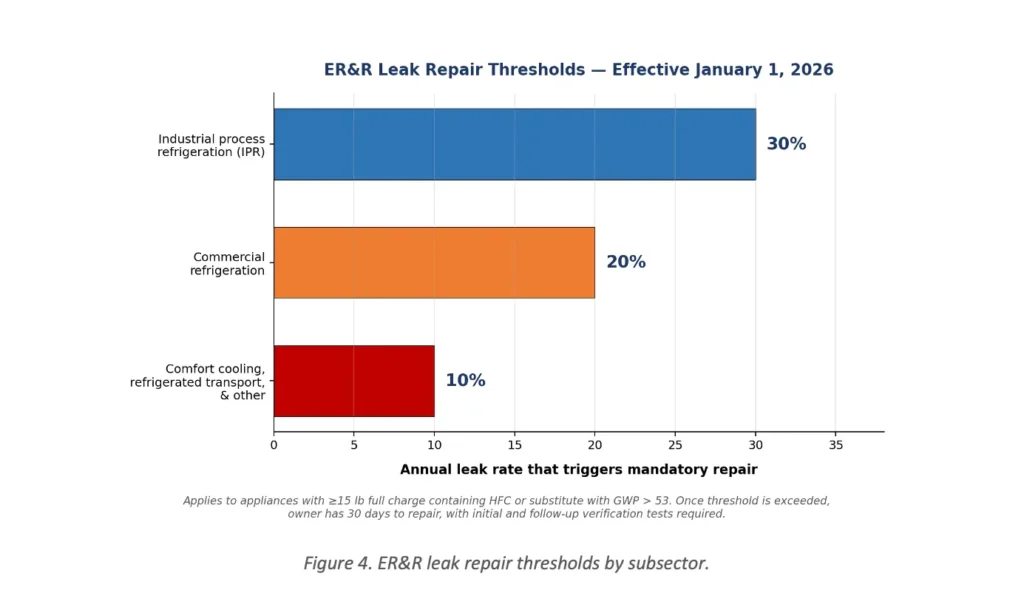
Once a leak rate above the applicable threshold is identified, the owner or operator has 30 days to complete the repair.
Repair success must be confirmed with both an initial verification test and a follow-up verification test.
Chronically leaking systems that cannot be brought below threshold trigger retrofit or retirement obligations.
Leak Detection as a Foundational Practice
Leak detection sits at the convergence of four pressures: regulatory compliance under ER&R, Scope 1 disclosure under SB 253 and voluntary frameworks, the rising cost of virgin and reclaimed refrigerant under the phase-down, and the energy waste created by undercharged systems.
None of these pressures disappears if any individual regulation is reconsidered.
The economic case for detection investment is independent of any single rule staying in place, underscoring the critical need for proactive control measures that help organizations meet compliance requirements and sustainability goals.
That posture delivers competitive benefits, not just cost avoidance.
Technical Requirements for ER&R Leak Repair
Beyond the threshold and the 30-day clock, ER&R compliance requires:
- Annual leak inspections on covered appliances, with results documented
- Leak rate calculation using a method consistent with EPA guidance (full-charge method or annualized method, as applicable)
- Initial verification test after repair, before the system is returned to service
- Follow-up verification test to confirm the repair held
- Retrofit or retirement plans for systems that cannot be brought below threshold within the regulatory window
- Recordkeeping sufficient to demonstrate compliance to an EPA inspector or third-party auditor
- These are the technical requirements that translate the regulation into operational practice. They are also the data points that feed the Scope 1 disclosure.
ALD Requirements and Installation
Automatic Leak Detection (ALD) is required on refrigerant-containing appliances with a charge size of 1,500 pounds or more in the industrial process and commercial refrigeration subsectors. There are two compliance dates:
New systems
ALD should have been installed by January 1, 2026, at installation or within 30 days.
Existing systems
(installed between January 1, 2017, and January 1, 2026): ALD must be installed by January 1, 2027
Operators have widely misread the 2027 date as a deferral of the entire ALD obligation. It is not.
New systems must have ALD now, and the rest of the ER&R framework (annual inspections, leak rate calculations, repair timelines, recordkeeping, reclaim discipline) applies regardless of whether ALD is installed yet.
ALD installation alone does not satisfy the operational intent.
Alerts only matter if they route to the right service provider, trigger dispatch within a useful window, get repaired within the 30-day requirement, and produce verifiable closure records.
The compliance value of ALD is fully realized only when paired with a detection-to-dispatch-to-documentation workflow.
The Imperative of Leak Detection in Operational Sustainability and ESG Reporting
Impact on Energy Efficiency
Refrigerant leaks make HVAC and refrigeration systems work harder. Undercharged HVAC and air conditioning systems run longer cycles, draw more electrical load, and accelerate compressor wear.
When the electricity feeding the system comes from fossil generation, the Scope 2 emissions associated with that energy waste compound the Scope 1 emissions from the leak itself.
Operators with disciplined leak detection programs consistently report lower energy bills, fewer catastrophic failures, and longer asset life than operators on a break-fix model.
The social cost of carbon can also quantify how leaks from high-GWP systems affect air conditioning and refrigeration budgets.
Financial Implications
The financial case for leak detection investment rests on four pillars: avoided refrigerant replacement cost (which rises every year as the phase-down deepens), avoided energy waste, avoided unplanned downtime and emergency service premiums, and avoided regulatory exposure.
Operators who quantify these in their internal business cases consistently find that proactive detection pays back within 12 to 24 months, even before any regulatory mandate is applied.
The reclaim picture sharpens this further. As of January 1, 2026, refrigerants sold and labeled as “reclaimed” for use in servicing equipment must contain no more than 15 percent virgin (newly produced) HFC content by weight.
This raises the bar on reclaim integrity and creates real procurement consequences for operators who have historically treated reclaim sourcing as interchangeable with virgin supply.
Every pound recovered cleanly from your own systems is now a more valuable asset.
Role in ESG Reporting
Investors and large corporate customers increasingly treat refrigerant leak rates as a leading indicator of operational maturity, and Scope 1 data is increasingly important for investors evaluating climate-related financial disclosures.
More than 90 percent of S&P 500 companies now publish ESG reports, many of which include Scope 1 emissions disclosures.
High leak rates often signal aging equipment, deferred maintenance, and reactive break-fix culture — all of which correlate with broader operational risk.
Operators with low and falling leak rates demonstrate the kind of asset stewardship that ESG frameworks and customer procurement processes are designed to reward.
For SB 253 reporting, the connection is direct. Scope 1 includes refrigerant emissions calculated as CO2-equivalent.
The leak rate calculations and refrigerant inventory records produced for ER&R compliance feed directly into the SB 253 disclosure.
Covered entities should be treating ER&R recordkeeping and SB 253 emissions accounting as a single data pipeline rather than two parallel exercises.
Weak Scope 1 disclosure can also create regulatory penalties and reputational damage.
📌 Ensure every refrigerant leak is accounted for before reporting season.
Organizational Structure and Roles
Effective refrigerant management requires a clear organizational structure with defined ownership, and forming a refrigerant management committee is a vital step for compliance requirements, emissions reduction, and sustainability goals.
The work spans operations (running the equipment), maintenance (repairing it), sustainability (reporting on it), procurement (sourcing refrigerant and reclaim services), and finance (capital planning for retrofits and ALD deployment), with legal where relevant.
The committee should include a diverse set of stakeholders and other stakeholders across these functions so companies can address the full range of refrigerant management challenges and requirements.
When these functions are siloed, compliance falls through the gaps.
Leading operators are establishing cross-functional refrigerant management committees with explicit charters covering ER&R compliance, Scope 1 reporting, reclaim procurement, ALD deployment, technician training, and emerging regulatory monitoring.
That charter should set a robust governance framework with clear roles and responsibilities tied to tactical needs and long-term strategic objectives, with primary goals that keep the program aligned to the organization’s broader objectives and resources.
The committee meets on a regular cadence, and those meetings should review progress, surface challenges, and identify opportunities for improvement.
It owns a single source-of-truth data system and produces management-level reporting that ties operational metrics (leak rates, repair completion, ALD uptime) to compliance status and Scope 1 emissions.
A key part of the committee’s work is evaluating the most suitable technologies, systems, and practices for future readiness and identifying funding opportunities for preventive maintenance and equipment upgrades.
The committee is also responsible for tracking the regulatory landscape.
With EPA actively reconsidering parts of ER&R, the SEC formally rescinding its climate disclosure rules, CARB launching subsequent rulemaking under SB 253, and state-level requirements continuing to evolve, somebody inside the organization needs to own this brief and translate it into operational decisions.
The committee should stay informed on changes in legislation, industry trends, and emerging technologies so it can revise strategy as needed, support related initiatives, and keep the program aligned with broader business model objectives.
Training and Education
The skills needed to handle modern refrigerants, install and commission ALD systems, perform verification testing, and produce audit-ready records are not the same as the skills needed to braze a copper joint.
Technician training is now both a competitive differentiator and a compliance prerequisite.
Training should cover the current EPA certification requirements for refrigerant handling, the specific characteristics of new lower-GWP refrigerants (including flammability and safety considerations for A2L and A3 classifications), ALD installation and commissioning, leak rate calculation methodology, repair verification testing, and the field documentation practices that support both ER&R compliance and Scope 1 reporting.
EPA resources, GreenChill best practice materials, and equipment OEM training programs are all useful inputs. Internal certification and ongoing recertification create the consistency that audits and assurance providers look for.
EPA’s Regulatory Advances Targeting Leak Detection and Emissions Reduction
The AIM Act gave the EPA broad authority across three subsections. The current state of play under each:
Subsection (e) — Phase-down
Production and consumption allowances continue to step down on schedule. 2026 caps are set; the next step-down arrives in 2029. The Reconsideration Rule did not touch this lane.
Subsection (h) — ER&R
In force as of January 1, 2026. Leak repair, ALD, reclaim, and recordkeeping requirements are all active. EPA has signaled future reconsideration but has not yet acted.
Subsection (i) — Technology Transitions
Significantly amended by the Reconsideration Rule signed May 26, 2026. Sector-specific GWP limits and compliance dates have been softened.
Expanded Leak Detection Requirements
ALD installation, repair verification testing, and reclaim discipline are all expansions over the prior Section 608 framework.
The ER&R rule moves leak detection from periodic inspection to continuous monitoring on large systems, raises the documentation bar, and ties reclaim integrity to a specific virgin content standard.
These are the operational expansions in force today.
What changed on May 26, 2026, is on the Technology Transitions side, not the leak detection side.
EPA’s final Reconsideration Rule extended compliance deadlines and raised interim GWP limits in several sectors:
Supermarket and remote condensing units
Interim GWP limit raised from 150/300 to 1,400 GWP starting January 1, 2026; original 150/300 limits now take effect January 1, 2032.
Cold storage warehouses
Deadline for 150 or 300 GWP limit extended six years from January 1, 2026, to January 1, 2032, with an interim 700 GWP limit until then.
Semiconductor manufacturing
Compliance date for IPR and chillers (≤100 lb charge) extended to January 1, 2030.
Residential and light commercial AC/HP
Pre-January 2025 inventory above 700 GWP can be installed until the existing stock is exhausted
Alongside the final rule, EPA published a proposed rule that would exempt Transportation Refrigeration Units (TRUs) from ER&R leak repair requirements and announced its intent to propose broader changes to the 2024 ER&R Rule in the future.
The direction of travel is now visible, but ER&R, as written, remains in force today.
Even as federal rules shift, new state laws, including California’s SB 253, make accurate refrigerant-emissions reporting material to investor relations and internal risk assessment.
Industry and Market Implications: Preparing for 2026 and Beyond
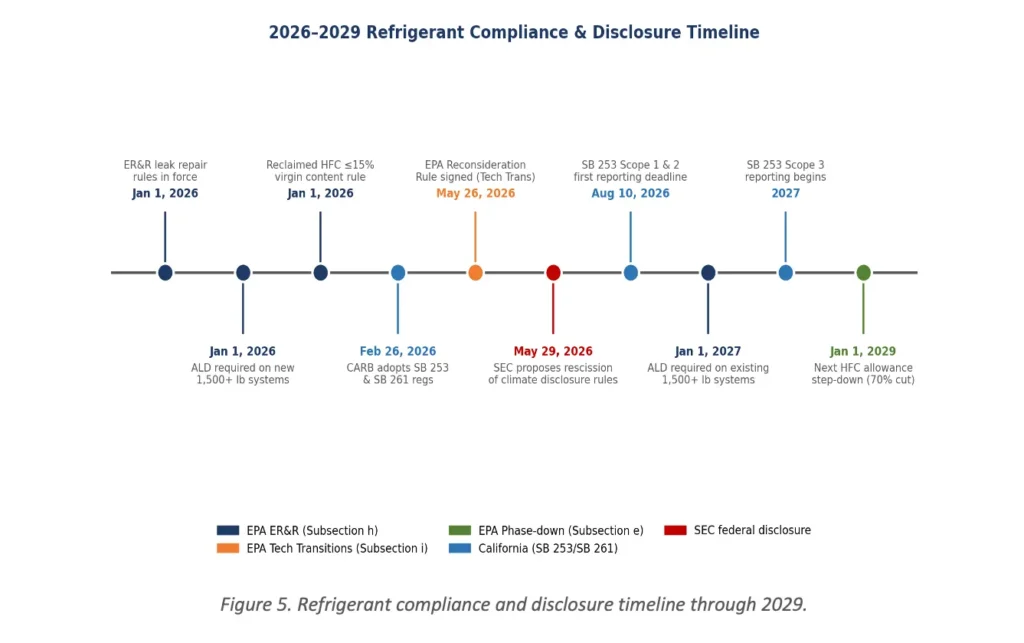
With HFC supply continuing to tighten under the phase-down, with ER&R compliance now active, and with state-level disclosure obligations like SB 253 coming due in August 2026, operators should be moving on several fronts in parallel, with environmental sustainability treated as a foundational element of operational strategy rather than a side program:
Conduct a comprehensive asset inventory
Every appliance with a full charge of 15 pounds or more is classified by refrigerant type, GWP, charge size, subsector, and installation date. Without this baseline, leak rate calculations are not credible, and ALD timelines cannot be planned.
Deploy leak detection systems
ALD for systems at or above the 1,500-pound threshold (mandatory).
Fixed NDIR or electrochemical sensors for smaller systems where the economic and Scope 1 reporting case justifies it (often does).
Operationalize the detection-to-dispatch-to-documentation workflow
Alerts route to the right responder, dispatch happens within a useful window, repair completes within 30 days, verification tests are conducted and recorded.
Plan retrofits and replacements strategically
Combine leak management with lifecycle planning.
Systems that chronically leak above threshold are now retrofit-or-retire candidates under ER&R, and the Reconsideration Rule’s extended runways make some legacy installs more viable than expected.
Tighten reclaim procurement
Verify that reclaimed refrigerant entering your supply meets the ≤15 percent virgin content standard.
Structure service contracts so that recovered refrigerant from your own systems is accounted for transparently.
Build the single recordkeeping system
ER&R compliance records and SB 253 emissions records should not be two separate databases.
The underlying data is the same, and tying it to environmental performance makes reporting more decision-useful.
Plan technician training
A2L safety practices, ALD commissioning, verification test procedures, and field documentation discipline.
Done well, this strengthens brand reputation with eco-conscious customers and investors; handled poorly, it can damage brand image in an increasingly sustainability-focused market.
Voluntary and Regulatory Programs Supporting Leak Detection
EPA GreenChill Partnership
GreenChill remains active as of January 2026 and continues to recognize food retailers for low leak rates, low-charge system design, and use of lower-GWP refrigerants.
For food retail operators, GreenChill participation is a credible third-party validation of refrigerant management discipline and a useful framework for benchmarking against peers.
Its emphasis on company-wide leak rate measurement, annual goal-setting, and public progress reporting maps directly onto the data infrastructure required for SB 253 disclosure.
SNAP Program
The Significant New Alternatives Policy (SNAP) program continues to evaluate and list approved refrigerants by end-use.
SNAP is the foundational reference for Technology Transitions compliance and equipment specification — when an operator is selecting a refrigerant for new equipment under the revised Technology Transitions framework, SNAP determines what is permitted in that end-use.
Leak Detection as a Pillar of Environmental Stewardship and Operational Excellence
The compliance landscape for refrigerant management is shifting, but the shifts do not change the operational fundamentals. They reinforce them.
ER&R leak repair and ALD are in force today and not changing for at least 12 to 18 months.
The Reconsideration Rule extended the runway for legacy refrigerant use in some sectors precisely as the supply ceiling continues to fall, which makes leak prevention more economically important, not less.
The SEC climate rule is gone, but California SB 253 picks up most of the affected universe and uses the same underlying Scope 1 data.
State regulators in California, Washington, and New York continue to impose refrigerant-specific tracking and reporting requirements that operate independently of federal action.
Voluntary corporate ESG reporting and customer ESG procurement continue to ask for the same data regardless of regulatory mandate.
The through-line:
Operators who build the asset inventory, deploy leak detection, run a real detection-to-dispatch-to-documentation workflow, and maintain audit-ready records are positioned to satisfy ER&R compliance, Scope 1 disclosure under SB 253, customer ESG requests, broader ESG strategies, and the economic pressure of tightening refrigerant supply — all from one data foundation.
The operators who are still treating refrigerant management as a reactive break-fix function will face rising costs, regulatory exposure, and disclosure gaps no matter which way federal rulemaking continues to swing.
Leak detection is no longer a maintenance task.
It is the operational pillar that environmental stewardship, regulatory compliance, financial performance, and ESG credibility all rest on, helping mitigate such risks and strengthen operational resilience as disclosure expectations continue to evolve.
This article reflects regulatory developments through May 30, 2026.
Given the active pace of EPA rulemaking and litigation around state climate disclosure regimes, readers should verify the current status of specific compliance obligations before making decisions.
Nothing in this article constitutes legal advice.
–