
On September 30th, very close to 5 PM and only 7 hours from the government shutdown, the EPA released a set of proposed changes to the technology transitions rule, which was previously finalized on December 12, 2024.
There was a set of deadlines defined by industry sector and subsector; it was and remains a very complex set of rules.
It is important to note that, whether you agree or disagree with the EPA’s plan, they were very diligent in releasing the proposed changes before the shutdown, instead of waiting, which would have caused even more chaos than the proposal will cause, due to the last minute calendar year timing.
These proposed changes are part of broader efforts to address HFCs through regulatory measures and international agreements, such as the Kigali Amendment, which is a key international agreement driving the phasedown of HFCs.
The goal is to reduce HFC emissions and transition to alternatives with lower environmental impact.
From Aisles to Atmospheres: Why the HFC Transition Must Be Seen Through Sectors, Not Molecules
If you are wondering how to understand the proposed changes to the EPA Technology Transitions restrictions, then we need to start at the sector/Subsector level and not at the refrigerant types.
We begin not in the vastness of the atmosphere, nor in the marbled halls of power, but here: in the humming, fluorescent-lit heart of modern commerce. The supermarket aisle is a critical sector defined in the Technology Transition.
Here, among fresh fruit, frozen meat, and dairy, lies a hidden ecosystem: miles of copper tubing, humming compressors, and intricate coils. It is a habitat unseen but essential, pumping cold air into every corner of modern life.
Cooling equipment and refrigeration systems form the backbone of this infrastructure, enabling the safe storage and display of perishable goods in supermarkets and other commercial settings. EPA regulations govern the management and phasedown of HFCs in these systems, requiring compliance with new standards and timelines.
The lifeblood of this system is refrigerant. And today, that lifeblood is hydrofluorocarbons (HFCs): paradoxical gases that both preserve and imperil.
HFCs are potent greenhouse gases with high global warming potential (GWP), and their release has significant environmental impacts, contributing to climate change and the accumulation of greenhouse gases in the atmosphere. HFC emissions from these systems are a major concern due to their role in global warming.
Historically, HFCs were introduced as replacements for ozone-depleting substances such as CFCs and HCFCs, which were phased out under the Montreal Protocol to protect the ozone layer.
While HFCs do not deplete the ozone layer, their environmental challenges have led to further international action, including the Kigali Amendment to the Montreal Protocol, to phase down their use and mitigate climate change.
Data Centers: Cooling the Digital World in the Shadow of the AIM Act
We step away from supermarket aisles and into the quiet corridors of data centers. These facilities are the nervous system of the modern economy, where billions of transactions, searches, messages, and even this conversation are kept alive by one simple fact: heat must be controlled. In the context of HFC regulation, data centers are recognized as critical infrastructure, making their regulatory treatment especially significant.
Unlike grocery refrigeration, where coils wrap around food cases and walk-ins, data center cooling is engineered to stabilize an invisible but relentless load: the servers themselves.
CRAC (Computer Room Air Conditioning) and CRAH (Computer Room Air Handling) units, chilled-water plants, and hybrid evaporative designs form the cold backbone of digital infrastructure.
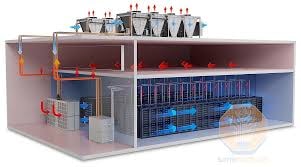
Nowhere will the effect of private governance matter more than in data centers. The freedom to act without control also provides a wild west approach to the future of their operations.
⬇️ Download the EPA Technology Transitions Summary Sheet
Understand how the 2025 proposed amendments impact your sector (from supermarkets to data centers) and plan your compliance strategy now.
The EPA’s Distinction for Data Centers
The proposed reconsideration of the Technology Transitions rule draws a critical line:
- Systems operating above –30 °C (–22 °F) are effectively exempt from GWP-based restrictions under the TT rule.
This exemption applies to the vast majority of data center equipment, since typical chilled water loops, DX coils, and CRAC/CRAH systems rarely approach the ultra-low temps required in semiconductor fabs. - Systems operating below –30 °C — rare but not absent — remain subject to the phasedown requirements. These are found in certain semiconductor fabs co-located with HPC (high-performance computing) data centers, or in highly specialized environments where sub-ambient cooling is required. For these, the caps remain: 700 GWP by 2026/2028, depending on the temperature band.
This carve-out means most of the data center fleet escapes the imminent cliff of 2026–2027. But it does not mean they are free from the pressures of the AIM Act.
🚨 Assess your cooling systems now to ensure compliance and future-proof your operations.
Data Centers: The Hidden Constraint: Supply, Not Just Regulation
Even if the equipment is exempt above -30 °C, the refrigerants inside those chillers and CRAC units are still bound by the AIM Act’s allocation system.
- Allowances are shrinking year by year, down 40% from baseline in 2024, en route to 85% by 2036.
- This means refrigerant availability for data centers will still tighten, even if installation rules look forgiving on paper.
In practice, a data center may be allowed to run a 410A or 134A system above -30 °C, but if the gas is scarce and expensive, every leak becomes a financial and operational crisis.

Data Centers: The Economic Reality of Leaks
In a supermarket, a catastrophic leak means food spoilage and cost. In a data center, a catastrophic leak risks uptime — and that is existential.
- A 500-pound CRAC system going flat could cost tens of thousands of dollars to recharge today, and three times that by 2028 as allowances tighten.
- More importantly, downtime during a leak event can mean lost transactions, customer disruption, or even regulatory penalties in sectors like finance and healthcare.
Thus, leak detection in data centers is not just environmental compliance — it is continuity insurance.
🚨 In data centers, leaks aren’t just costly: they threaten uptime, revenue, and compliance.
Data Centers: Tagging and Visibility
The EPA’s framework requires tagging through “profiles.” For data centers:
- Profile 1 applies to comfort/DX style units.
- Profile 3 applies to larger chiller plants.
Even if the equipment sits in the exempt above -30 °C category, the requirement to tag refrigerant identity, charge size, and manufacture date still stands once effective dates kick in. Every chiller, CRAC, and refrigerant cylinder must carry its identity forward.
This matters for two reasons:
- Asset management: In an environment of shrinking supply, visibility into refrigerant stockpiles is the only way to allocate resources wisely.
- Accountability: Proving compliance with federal law and audit records.

Data Centers: The Uncomfortable Truth
For data centers, the exemption above -30 °C may feel like a reprieve. But it is not a release. It is a reminder that while your equipment may be spared from the immediate bans, the refrigerants themselves remain caught in the AIM Act’s tourniquet.
The real risks are threefold:
- Economic: escalating refrigerant costs that make leaks unaffordable.
- Operational: downtime caused by unplanned failures and scarcity of gas.
- Compliance: the requirement to tag and track every asset once the effective dates arrive.
The lesson for operators is clear: do not mistake exemption for immunity. The pause buys time, but vigilance (in leak detection, tagging, and strategic refrigerant planning) remains the only way forward.
⬇️ Download the EPA Technology Transitions Summary Sheet
Understand how the 2025 proposed amendments impact your sector (from supermarkets to data centers) and plan your compliance strategy now.
The AIM Act and the Environmental Protection Agency: A Rare Consensus
The governance of this transition lies in the American Innovation and Manufacturing Act, or AIM Act. It is remarkable not only for its ambition (to cut HFC use by 85% by 2036) but also for its origins.
In 2016, two unlikely figures, Senator Tom Carper of Delaware and Senator John Kennedy of Louisiana, began to push for action. They knew that uncertainty was worse than transition — for business, for climate, for manufacturing. And by December 2020, their work culminated in a rare spectacle: the bill passed with overwhelming support from both parties, demonstrating the bipartisan support for the AIM Act, and President Donald J. Trump signed it into law.
This is not a partisan decree. It is a bipartisan contract. A recognition that invisible leaks have visible costs.
The Uncomfortable Pause
Now, this September proposed adjustment EPA has adjusted its course. A reconsideration of the Technology Transitions rule has introduced what feels like a fragile truce: an interim ceiling of ≤1,400 GWP for new supermarket and cold storage systems, effective until 2032. This reconsideration follows an interim final rule and may be followed by a final rule or subsequent final rule, as part of ongoing regulatory actions by the EPA. For industry planning and compliance, regulatory certainty is crucial, as it allows stakeholders to make informed decisions and investments with confidence.
On the surface, this appears to grant breathing space. But in truth, it is not relief. It is a pause — and like any pause under stress, the cracks are already visible. EPA intends to review and potentially revise the Technology Transitions rule through a proposed rule process.
Importantly, this pause should not be mistaken for a rollback. The EPA’s commitment to the phasedown of HFCs under the AIM Act remains firm and legally binding. The interim ceiling is a strategic adjustment aimed at managing the complex realities of industry transition without abandoning the environmental goals embedded in the final technology transitions rule. It reflects a recognition that while the urgency of reducing high global warming potential refrigerants persists, so too does the need for practical pathways to compliance.
However, this delicate balance places considerable responsibility on industry self-governance. With this interim flexibility, manufacturers, operators, and regulators must navigate the challenges of compliance deadlines, refrigerant management, and recordkeeping and reporting requirements with heightened diligence. The absence of immediate, more stringent restrictions shifts the onus onto stakeholders to proactively manage emissions, avoid premature equipment obsolescence, and prepare for future rulemakings that will likely tighten standards once again.
Self-governance in this context carries significant consequences. Without robust oversight and transparent compliance efforts, there is a risk of fragmented adherence, inconsistent application of environmental regulations, and potential market distortions. Industry leaders must therefore embrace this period not as an opportunity to delay action but as a critical window to strengthen operational practices, invest in technician training, and accelerate the adoption of sustainable alternatives and next-generation technologies.
The EPA’s approach underscores that while regulatory flexibility can ease transitional pressures, it cannot substitute for the collective commitment required to meet national and global climate goals. The fragile truce embodied in this pause is a call to action—one that demands vigilance, innovation, and collaboration across the HVACR industry and beyond.

The Central Nervous System: The Unyielding Cap
At the heart of the AIM Act lies the allocation system, a supply cap, shrinking year by year. The EPA established the allowance allocation system and phased-down schedule as part of its implementation of the AIM Act. In 2024, the nation’s HFC supply was cut by 40% below its historic baseline.
By 2036, it will be reduced by 85%. The AIM Act regulates the production and consumption of HFCs through an allowance system, meaning that both HFC production and the ability to import bulk HFCs are subject to strict allocation limits and regulatory oversight. This system is also designed to promote market stability during the phasedown.
This is why prices climb. Each pound of refrigerant is no longer counted as weight but as climate impact — carbon dioxide equivalents. R-404A, with a GWP near 4,000, consumes 4,000 units of allowance. Its price reflects this scarcity.
- R-22: today $20/LB – 2030 – $120 a pound, reclaimed only.
- R-404A and R-407A: $25 a pound, supply already cut to 40% of 2020 levels.
- R-410A: $35 a pound, barred from new systems but critical for existing HVAC fleets.
- R-448A: $25 a pound today, but virgin production ends January 1, 2033.
HFC refrigerants are subject to strict reporting requirements to ensure compliance with compliance deadlines set by the EPA.
For a supermarket, the numbers are staggering. A catastrophic leak of 2,500 pounds, once an inconvenience, now costs $62,500 to replace. By 2028, that same loss could cost nearly $180,000.

The Pathology of the Ephemeral Bridge
The EPA’s interim limit is not a reprieve but an ephemeral bridge. It is a structure built to collapse. This is a big word, and I hate to use it, but it defines the process perfectly.
Operators installing racks today with expected lifespans of 15 to 20 years are forced to use transitional blends such as R-448A. Yet these will be forbidden in 2032. The bridge guarantees stranded assets, premature retirements, accelerated depreciation, and millions lost before natural end-of-life.
Existing equipment may continue to be serviced, but new installations after a certain installation date or if imported prior to regulatory deadlines may be subject to different rules. Projects with an approved building permit prior to the new standards may have extended installation timelines.
AC Systems (Comfort Cooling & Heat Pumps) Impact from Proposed Changes
| Sector | Subsector / Products | Requirement | Compliance Date | Tag Profile | Notes |
|---|---|---|---|---|---|
| AC & Heat Pumps | Unitary small split (DX), residential/light commercial ducted | ≤700 GWP | Jan 1, 2025 | Profile 1 | Manufacture/import cutoff locked 1/1/2025; install of pre-2025 inventory still allowed. |
| AC & Heat Pumps | VRF / Multi-split systems | ≤700 GWP | Jan 1, 2026 | Profile 1 | No change from final rule; building codes drive A2L adoption. |
| AC & Heat Pumps | Rooftop packaged units | ≤700 GWP | Jan 1, 2025 | Profile 1 | Manufacture/import cutoff 1/1/2025; install of pre-2025 inventory allowed. |
| AC & Heat Pumps | PTAC / PTHP | ≤700 GWP | Jan 1, 2026 | Profile 1 | Finalized requirement, unchanged. |
| AC & Heat Pumps | Dehumidifiers (room) | ≤700 GWP | Jan 1, 2025 | Profile 1 | Appliance-class; tagging at manufacture. |
And the bridge is unstable. These transitional blends contain molecules still being phased down. Their chemistry is tethered to scarcity itself. Thus, the bridge provides time, but not relief.
The industry is increasingly shifting toward climate-friendly alternatives, sustainable alternatives, more sustainable alternatives, natural refrigerants, low-GWP refrigerants, and lower-GWP refrigerants as the ultimate goal beyond transitional blends.
🚨 Detect refrigerant leaks early and fix issues immediately to avoid costly repairs!
Refrigeration Systems Impact from Proposed Changes
| Sector | Subsector / Products | Requirement | Compliance Date | Tag Profile | Notes |
|---|---|---|---|---|---|
| Supermarkets (Racks ≥200 lbs) | Interim cap | ≤1,400 GWP | Jan 1, 2027 | Profile 3 | Proposed interim; replaces 150 until 2032. |
| Supermarkets (Racks ≥200 lbs) | Final | <150 GWP | Jan 1, 2032 | Profile 3 | Final threshold. |
| Supermarkets (Racks <200 lbs / Cascade high side) | Interim cap | ≤1,400 GWP | Jan 1, 2027 | Profile 3 | Proposed interim; replaces 300 until 2032. |
| Supermarkets (Racks <200 lbs / Cascade high side) | Final | <300 GWP | Jan 1, 2032 | Profile 3 | Final threshold. |
| Remote Condensing Units (≥200 lbs) | Interim cap | ≤1,400 GWP | Jan 1, 2027 | Profile 3 | Proposed interim; replaces 150 until 2032. |
| Remote Condensing Units (≥200 lbs) | Final | <150 GWP | Jan 1, 2032 | Profile 3 | Final threshold. |
| Remote Condensing Units (<200 lbs / Cascade high side) | Interim cap | ≤1,400 GWP | Jan 1, 2027 | Profile 3 | Proposed interim; replaces 300 until 2032. |
Data Centers & Semi Conductor Manufacturing impact from Proposed Changes
| Sub-application | GWP Limit | Compliance Date | Label Profile | Notes |
|---|---|---|---|---|
| Data Centers (CRAC/CRAH, in-row/in-rack, IT equipment cooling) | ≤700 | Jan 1, 2027 | Profile 3 (+charge size ±200 lb) | Applies to direct-expansion and room-level IT cooling. No temperature carve-outs. Remains intact in reconsideration. |
| Chilled-Water Plants serving IT loads (air- & water-cooled chillers) | ≤700 | Jan 1, 2025 (comfort chiller line) | Profile 3 | Treated under comfort-cooling chillers. Distinct from semiconductor exemptions. |
| Indirect evaporative / hybrid IT cooling systems | ≤700 (if refrigerant present) | Same as parent category (chiller or CRAC/CRAH) | Profile 3 | If sealed refrigerant circuits exist, ≤700 applies with tagging. If no refrigerant, TT does not apply. |
| Semiconductor IPR Chillers — exiting fluid < –50 °C (–58 °F) | ≤700 | Jan 1, 2025 | Profile 3 | Applies to ultra-low temp semiconductor chillers. |
| Semiconductor IPR Chillers — exiting fluid –50 °C to –30 °C (–58 °F to –22 °F) | ≤700 | Jan 1, 2026 | Profile 3 | Applies to low-temp fab chillers. |
| Semiconductor IPR Chillers — exiting fluid > –30 °C (warmer than –22 °F) | Not subject to these IPR/chiller caps | N/A | Profile 3 | Exempted in rule. This is the carve-out that does not apply to data centers. |
| Semiconductor IPR (non-chillers, by charge size) | <150 (≥200 lb) / <300 (<200 lb & cascade) | Jan 1, 2026 | Profile 3 | Non-chiller IPR applications; follow RACHHP style thresholds. |
| Semiconductor IPR — low-charge systems (<100 lb) | ≤700 | Jan 1, 2030 | Profile 3 | Special relief granted by reconsideration, delaying compliance. |
Systemic Stress: Fragmentation and Friction
The interim reprieve collides with state ambition.
- California already enforces ≤150 GWP for many new supermarket systems.
- Washington has adopted CARB’s framework.
- New York is preparing to follow.
This creates a three-tier paradox:
- Low-GWP products for advanced states.
- Mid-GWP products (≤1,400) for federal compliance.
- Legacy service for existing high-GWP fleets.
These rules affect a wide range of equipment categories, including air conditioning, air conditioning systems, and air conditioners, which must comply with varying GWP requirements depending on jurisdiction.
Heat pump equipment, heat pump systems, and the heat pump subsector are also impacted, especially within the residential and light commercial sectors, as new regulations drive the transition to lower-GWP refrigerants and updated compliance standards.
⬇️ Download the EPA Technology Transitions Summary Sheet
Understand how the 2025 proposed amendments impact your sector (from supermarkets to data centers) and plan your compliance strategy now.
Manufacturers must now design, certify, and support all three. National chains must plan to California’s rules, rendering the federal reprieve largely irrelevant. The issue of state preemption further complicates regulatory compliance, as state-level rules can override or supplement federal standards, creating additional layers of complexity for manufacturers and suppliers.
Imagine, if you will, a delicate ecosystem disrupted, not by natural forces, but by the complex dance of human regulation. Across this vast land, states march to different drums, each setting its own rhythm for the future of cooling. California leads with stringent whispers of low global warming potential, while others follow with a more measured pace.
This three-tiered symphony of compliance is a fragile truce, where low, mid, and legacy refrigerants coexist uneasily—much like species competing for survival in a changing habitat.
The manufacturers, like skilled navigators, must chart a course through these overlapping demands, crafting solutions to satisfy divergent rules. It is a testament to human adaptability amid the pressures of an evolving environmental frontier.

Yet, beneath this fragile balance lies a challenge: the timing gap between federal and state regulations. While the federal interim limit allows new systems with a GWP up to 1,400 until 2032, states such as California have already embraced a stricter ≤150 GWP limit for many new supermarket systems, with Washington and New York poised to follow.
This divergence forces those who build and supply the cooling world to confront a fragmented landscape, complicating their efforts and demanding ever greater ingenuity. Certain technologies and certain HFCs are subject to different GWP limits under state and federal rules, further increasing the complexity of compliance.
Inventory control becomes a labyrinthine task, as manufacturers must stock and manage multiple product lines to meet conflicting standards—an intricate dance in the theatre of environmental stewardship.
Industry leaders in the HVACR industry are at the forefront, adopting next-generation technologies and aligning with the alternatives policy program, the technology transitions rule, and the final technology transitions rule to ensure compliance and maintain competitiveness in this evolving regulatory environment.
And all the while, the point system—the very currency of this phasedown—has slipped to a mere 29, a stark reminder that the path ahead is narrow and fraught with challenge. Every allowance counts; every pound of refrigerant is measured not just in weight, but in its impact on our fragile climate.
The Nervous System of Compliance: Refrigerant Management and Tagging
And beneath these fractures lies another foundation: visibility.
Every piece of equipment, every cylinder, every coil must now carry its identity once its compliance date arrives. The EPA calls them profiles. They are the labels of chemistry, manufacture date, charge weight, or model year.
Without them, compliance is invisible. With them, accountability is unavoidable.
Tagging is not paperwork. It is the nervous system of this transition. Tagging is essential for meeting regulatory requirements, and companies must establish their own regulations to ensure compliance with both internal standards and external mandates.
Effective tagging also supports broader compliance efforts across the industry and is a critical part of asset tracking for compliance and inventory management.
Tagging Timeline 2025-2027
Small glimpse of tagging requirements over the next 3 years:
| Sector / Subsector | 2025 | 2026 | 2027 |
|---|---|---|---|
| Refrigerated Transport – Trucks, Trailers, Reefers | Profile 2 tagging required (model year: refrigerant, charge size, manufacturer ID) | Ongoing | Ongoing |
| Refrigerated Transport – Intermodal Containers (≥ –50 °C evap) | Profile 2 tagging required with 700 GWP compliance | Ongoing | Ongoing |
| Supermarkets (≥200 lbs racks) | — | Profile 3 tagging required (≤1,400 GWP interim cap) | Profile 3 tagging reaffirmed (≤1,400 GWP cap; prepares for 2032 final ≤150) |
| Cold Storage Warehouses (≥200 lbs) | — | Profile 3 tagging required (≤700 GWP interim cap) | Ongoing |
| Remote Condensing Units (≥200 lbs, <200 lbs, cascade) | — | Profile 3 tagging required (≤1,400 GWP interim cap) | Ongoing |
| Commercial AC & Heat Pumps (DX units, comfort cooling) | — | — | Profile 1 tagging required (≤700 GWP) |
| Industrial Process Refrigeration – Semiconductor Chillers | — | — | Profile 3 tagging required (≤700 GWP if between –50 °C and –30 °C; exempt above –30 °C) |
And in an environment defined by scarcity, visibility is survival.
The Eyes and Ears of Survival: Leak Detection
The silent seep of refrigerant leak detection once seemed trivial, a few pounds lost, a top-off, and the system carried on. Those days are gone.
Under the AIM Act’s tourniquet, every pound of lost refrigerant is both a compliance failure and a financial wound. A catastrophic 2,500-lb system loss that once cost $60,000 may soon cost nearly $180,000 by 2028 as supply tightens. Eleven such incidents were reported in supermarkets in just twelve months — each triggering multi-day downtime, spoiled food, and emergency retrofits.
Leak detection is now the eyes and ears of survival. It is the only way to transform leaks from catastrophic surprises into manageable repairs.
- Cost discipline: Every pound saved is money preserved against structural inflation.
- Operational resilience: Sensors and alarms reduce after-hours truck rolls, cutting overtime and technician strain.
- Food security: Early detection prevents the silent spoilage that accompanies undetected leaks.
Compliance will demand vigilance, but economics will drive adoption. Leak detection is no longer optional technology; it is the daily discipline that determines whether operators can survive the tightening grip of the phasedown.
⬇️ Download the EPA Technology Transitions Summary Sheet
Understand how the 2025 proposed amendments impact your sector (from supermarkets to data centers) and plan your compliance strategy now.
The Metabolic Blockage: Workforce and Infrastructure
Even if rules are aligned, the system itself falters.
- Tens of thousands of technicians are missing, untrained in the new refrigerants of high-pressure (CO₂) and flammability (propane). Workforce development initiatives are essential to address this skills gap and ensure a steady pipeline of qualified professionals.
- Reclaim, the only fallback for legacy fleets, captures less than 10% of HFCs annually.
- Specialized sectors such as semiconductor manufacturing and residential ice makers face unique regulatory and workforce challenges under the phasedown.
- Without rapid investment, scarcity will deepen, prices will climb further, and service crises will multiply.
Investment in technician training and reclaim infrastructure can lead to significant long-term cost savings for the industry, helping to offset the challenges posed by the phasedown of HFCs.
The Questions Ahead
The AIM Act remains irreversible. The phasedown will proceed. But EPA’s reconsideration has traded a near-term crisis for a guaranteed one in 2032.
And so we are left with questions:
- What does it mean to invest in 20-year equipment that will be outlawed in 12?
- How should budgets adapt when refrigerant inflation is structural, not cyclical?
- Who will train the missing technicians?
- Can it reclaim scale in time to stabilize the market?
- Will tagging systems become the backbone of compliance, or another burden?
- Will leak detection become the only reliable safeguard against runaway costs?
- Is the 1,400 GWP bridge relief, or merely a fragile truce that cannot hold?
- How will future rulemakings by the Environmental Protection Agency, under the guidance of the EPA Administrator, impact industry compliance and planning?
- To what extent will state-led initiatives, such as those by a climate alliance, shape or accelerate national policy directions?
- How does Private Environmental Governance work?

NOTE: The concept of Private Environmental Governance is a concept that provides a road map on how to think about this.
Fragile
This is the uncomfortable pause: neither victory nor relief, but a fragile truce in a longer campaign.
Beneath the supermarket lights and inside the quiet aisles of data halls, compressors hum, coils sweat, and the stakes rise. Each leak is no longer a nuisance; it is a budget shock and a compliance breach. Each label is no longer paperwork; it is the passport that carries an asset’s identity through a world of dwindling supply. Every choice (what we spec, buy, install, reclaim, and repair) echoes far beyond a single store, plant, or server room.
The bridge to 2032 stands before us. It offers time, but not shelter. It was built to be crossed and then removed. To step onto it without a plan is to accept stranded assets in the next decade and structural inflation every year between. To step onto it with discipline is to use the interval to convert fleets, train people, harden operations, and drain the risk out of leakage.
So the task is plain:
- Tag everything that turns. As effective dates arrive, every rack, condensing unit, chiller, cylinder, and transport asset must carry its Profile label—chemistry, charge, manufacture date, or model year. Visibility is survival.
- See leaks before they happen. Treat detection as an operating system, not a gadget—continuous sensing, smart alarms, documented repairs. Every pound not lost is cash preserved and downtime avoided.
- Plan to the cliff. Budget and design for the final ≤150/≤300 GWP thresholds in 2032, even as you navigate the interim caps (≤1,400 and ≤700) in 2026–2027. Avoid “buying twice.” Align procurement to the end-state wherever feasible.

Do not mistake exemptions above –30 °C in data centers for immunity; they ease installation pressure but do not loosen the AIM Act’s allowance tourniquet. Do not mistake federal interim relief for uniformity; California, Washington, and New York compress timelines and will set the effective planning horizon for national portfolios. And do not mistake reclaim for a safety net unless you help build it—collection, processing, and quality assurance must scale dramatically or scarcity will write your budget for you.
What endures through all of this is not a specific refrigerant, or even a specific machine. What endures is practice: tagging that makes assets legible, leak management that makes budgets predictable, training that makes transitions safe, and procurement that honors the 2032 finish line rather than postpones it. That is how we turn a brittle bridge into a workable path.
The phasedown will proceed. The only question is whether we arrive there prepared—with assets that still earn their keep, with teams that can service what we own, and with records that stand up when asked. This pause is not an invitation to wait. It is time purchased at a premium. Let’s spend it wisely: label it, find it, fix it, and plan it—now.
Get Involved
To participate in the rulemaking discussion and ensure your operational reality is heard.
🚨 This is not a spectator moment. EPA has opened the door for feedback, and your voice matters.
Resources for Readers
For those who want to go deeper, here are the most relevant resources:
- EPA Technology Transitions Rule (Main Page)
- AIM Act Implementation Overview
- Final Technology Transitions Rule (Dec 2024)
- September 2025 Reconsideration Proposal Fact Sheet
- CARB HFC Reduction Program
- Kigali Amendment Background (UNEP)