For facility, refrigeration, HVAC, compliance, and operations leaders running multi-site cooling — commercial refrigeration and comfort cooling (air conditioning and chillers) alike.
Anyone accountable for uptime, refrigerant cost, or regulatory exposure.
This guide covers fixed, always-on detection systems, not portable handheld maintenance tools.
📌 Key takeaways
Refrigerant leak detection has shifted from a periodic task to a continuous system.
Fixed sensors that transmit 24/7 replace technician sweeps that only see a leak at the next scheduled visit.
The 2026 EPA rules are written in pounds, not ppm.
Compliance is calculated on mass of refrigerant lost against full charge — so a detector that only reports concentration is leaving the critical math undone.
The “zero-hour edge” is where the value lives.
Continuous monitoring drives detection latency toward zero; periodic inspection leaves leaks running undetected for up to 90 days.
Distributed NDIR sensing covers every zone in parallel.
Centralized aspirated sample-draw checks zones in sequence, which reintroduces latency and creates a single point of failure.
The leak is profiled before the truck rolls.
Dual refrigerant-and-temperature sensing characterizes the leak (which rack, what type, how fast, whether it’s even real) so the dispatch is targeted, not exploratory.
The payoff is operational, not just regulatory.
Early, profiled detection turns emergency truck rolls into planned service, keeps technicians fixing instead of hunting, and protects the energy efficiency a fully-charged system was designed for.
The rules cover comfort cooling too — and the states go further.
Commercial AC and chillers are in scope alongside refrigeration, and state programs in California, Washington, New York, and Colorado often exceed the federal floor — several requiring reporting in CO₂-equivalent, which only mass quantification can supply.
What is a refrigerant leak detector?
A refrigerant leak detector is a device that identifies escaping refrigerant gas from a cooling system. The category splits into two fundamentally different forms, and confusing them is the most common mistake buyers make.
A portable (handheld) detector is a maintenance instrument a technician sweeps along equipment to pinpoint a leak they already suspect. It detects only where and when someone is actively using it — its coverage between visits is zero.
A fixed detector is permanently installed in the space, transmits continuously, and is interpreted by software. It answers a different question: not “is there a leak right here, right now, while I’m looking?” but “what is happening across every zone, every minute, whether anyone is looking or not?”
📌 This guide is about fixed systems.
Throughout, “detector” means a fixed, continuously transmitting device — not a portable wand.
What’s the difference between fixed and portable leak detection?
Refrigerant leak detectors fall into two broad categories: portable tools used on a schedule and fixed systems that run continuously.
That difference drives everything else.
For thirty years, leak detection was a task.
A technician arrived on a schedule with a handheld tool, making it easy to sweep the equipment, or used soap bubbles to find larger leaks visually, then found what was leaking at that moment and left.
Detection quality depended on who showed up, how carefully they swept, and — critically — how recently they’d last been there.
That model has a structural flaw no better wand can fix: the gap between inspections.
A leak that starts the day after a quarterly check runs undetected for up to 90 days.
By the time the next sweep finds it, the refrigerant is gone, food may be at risk, and the compliance clock has already been running.
Fixed continuous monitoring replaces the task with a system. Instead of asking a person to look periodically, the architecture looks permanently — the way always-on cameras replaced a guard walking rounds, and telematics replaced scheduled fleet service.
Detection stops being an event on a calendar and becomes a property of the building.
What does the EPA require for refrigerant leaks in 2026?
As of January 1, 2026, the EPA’s HFC Management Rule under the AIM Act requires leak repair and recordkeeping for systems with 15+ pounds of HFC refrigerant, and automatic leak detection for systems of 1,500+ pounds.
This is the change that made fixed monitoring urgent rather than merely sensible.
The threshold collapsed from 50 pounds to 15.
Leak-repair and recordkeeping obligations now apply to any appliance with a full charge of 15 pounds or more of an HFC (or substitute) with a GWP above 53 — down from the old 50-pound Section 608 standard. Thousands of previously exempt systems are now in scope.
Leak-rate limits are explicit.
Exceed them and a defined repair-or-retire process triggers:
- Industrial process refrigeration: 30%
- Commercial refrigeration (supermarkets, cold storage): 20%
- Comfort cooling, refrigerated transport, and other appliances: 10%
The leak rate is recalculated every time refrigerant is added, using (pounds added ÷ full charge) × (365 ÷ days since last addition) × 100.
Exceed the threshold, and you must repair within 30 days (120 for industrial process) or file a retrofit/retirement plan.
Records must be retained for three years.
Automatic Leak Detection (ALD) is mandated at scale.
Commercial and industrial process refrigeration systems with a full charge of 1,500 pounds or more must have an operational ALD system — new systems by January 1, 2026, existing systems (installed 2017–2025) by January 1, 2027.
Most supermarket rack systems sit well above this line.
Penalties are no longer a rounding error.
Clean Air Act penalties for refrigerant violations now reach the tens of thousands of dollars per day, per violation at the federal level (current guidance cites figures from roughly $45,000 to $70,000 per day) with state penalties stacking on top.
EPA has named refrigerant management an enforcement priority.
📌 One Caveat
The Technology Transitions Rule (which governs equipment refrigerant GWP, not leak detection) is still in motion, with EPA reconsideration proposals in 2025 and revisions finalized in 2026.
The management and leak-detection obligations above are in effect; the equipment-GWP timeline is the part still shifting.
Does this apply to air conditioning and comfort cooling, or only refrigeration?
Both. The 2026 rules cover comfort cooling (commercial air conditioning, chillers, and rooftop units) not just commercial refrigeration.
Any appliance with a full charge of 15 pounds or more of an HFC (GWP above 53) is in scope, at a 10% annual leak-rate threshold for comfort cooling versus 20% for commercial refrigeration. Residential and light-commercial AC and heat pumps are excluded.
This matters because the fixed-monitoring logic is identical for both.
A chiller plant, a mechanical room, or a rooftop unit benefits from continuous, per-zone detection for exactly the reasons a supermarket rack does: a leak caught at hour zero is refrigerant saved, a planned repair instead of an emergency, and compliance evidence already in hand.
Several states go further and name air conditioning explicitly — Washington’s rule covers “refrigeration and air conditioning systems,” and California restricts high-GWP refrigerants in AC, chillers, and ice rinks.
If your portfolio includes comfort cooling above the threshold, it is regulated — and it is monitorable.

What do state refrigerant regulations require?
Several states (led by California, Washington, New York, and Colorado) run their own refrigerant programs that often exceed the federal floor, and you must comply with both.
States are permitted to set requirements stricter than the EPA’s, and the result is a patchwork that varies by location, facility type, and refrigerant quantity.
Critically, state enforcement does not depend on federal posture: even where federal priorities shift, these state regulators continue to enforce.
California (CARB Refrigerant Management Program) is the most comprehensive: annual reporting in GWP-weighted CO₂-equivalent (not just pounds), automatic leak detection for large enclosed systems, leak repair within 14 days, and five-year recordkeeping.
Companies operating more than 20 facilities must reach a fleet-wide weighted-average GWP below 2,500 (or cut GHG 25% vs. 2019) by the end of 2026.
Separately, under SB 253, companies above $1 billion in revenue doing business in California must report Scope 1 emissions (which include refrigerant leaks) with penalties reaching $500,000 per year.
Washington (Chapter 173-443 WAC) uses phased registration by the charge size of the largest system: large facilities (>1,500 lbs) registered by March 2024, medium (200–1,499 lbs) by March 15, 2026, small (50–199 lbs) by 2028.
Inspection frequency scales with size; leak repair is required within 14 days, and medium and large facilities file annual reports.
The rule explicitly covers air conditioning as well as refrigeration.
New York (6 NYCRR Part 494) has been in effect since early 2025 (prohibitions, registration, leak management, and reporting) and uses the more aggressive GWP20 metric.
New retail-food refrigeration of 200+ lbs faces a GWP20 limit of 10; existing systems of that size, a limit of 580.
Colorado (Regulation 22), plus a growing list (New Jersey, Maryland, Vermont, Massachusetts, Oregon, Connecticut, Delaware) have adopted or are developing their own HFC management and reporting frameworks.
📌 The strategic takeaway
Several of these programs require reporting in CO₂-equivalent, which is pounds-lost multiplied by GWP.
You cannot file a CO₂e figure you don’t have the mass for.
A monitoring system that already quantifies loss in pounds (the same way across every site) is what turns a multi-state patchwork into a single, automatic data layer instead of a portfolio-wide reconciliation problem.
What is the “zero-hour edge”?
The zero-hour edge is detecting a leak at the moment it begins (hour zero) instead of at the next scheduled inspection.
It is the single concept that separates fixed monitoring from everything before it.
Every periodic model carries a hidden cost: detection latency — the time between when a leak starts and when anyone knows.
In a quarterly-inspection model, average latency is roughly 45 days and worst-case is 90.
Every one of those days is refrigerant leaving the system, mass building against your leak-rate threshold, and emissions you’ll eventually have to account for.
A continuously transmitting system drives that latency toward zero, and almost all of the value follows:
- Refrigerant saved is a function of latency. Catch a leak on day one instead of day sixty and you keep most of the charge that would otherwise escape.
- Compliance flips from reactive to evidentiary. You don’t discover you’ve breached the 20% commercial threshold after the fact; you watch the trend and act before it crosses.
- Repair economics flip too. Early detection means a planned service call. Late detection means an emergency truck roll, possible product loss, and sometimes a failed compressor.
A typical supermarket leaks 13–25% of its charge annually (EPA GreenChill data).
On a 4,000-pound system, that’s up to ~1,000 pounds per year — and with HFC supply tightening, a single recharge can now run $50,000–$100,000.
The zero-hour edge is the difference between “we caught it” and “we paid for it twice.”
📌 Stop Refrigerant Loss Today.
How do fixed leak detection technologies compare?
The right question for a fixed system is not which sensor is most sensitive, but which architecture watches every zone continuously and reports loss in the units compliance actually uses.
| Architecture | What It Senses | Coverage Model | Strengths | Limitations |
|---|---|---|---|---|
Distributed NDIR Fixed-Point Recommended |
Refrigerant concentration (ppm) at each location, continuously | Every zone watched in parallel, 24/7 |
Refrigerant-selective; low cross-sensitivity
Stable with minimal drift
Localizes leak to a zone
No single point of failure
|
Hardware in every zone
Calibration discipline required
|
Centralized Aspirated (Sample-Draw) Trade-off |
Concentration, sampled sequentially through tubing to one analyzer | One analyzer cycles through many points in sequence |
High analyzer sensitivity
Fewer sensing elements
|
Built-in latency per zone
Single analyzer = single point of failure
Tubing to maintain
|
Acoustic / Ultrasonic Situational |
The ultrasonic sound of pressurized gas escaping | Fixed arrays or handheld |
Pinpoints active pressurized leaks fast
Gas-type independent
|
Detects sound, not mass
Sensitive to ambient noise
Weak on slow seepage
Less effective on low-pressure systems
|
Portable Wand (Legacy) Legacy |
Concentration at the probe tip, while held | Only where/when a technician sweeps |
Excellent for pinpointing a known leak
|
Not a monitoring method
Zero coverage between visits
|
What is NDIR?
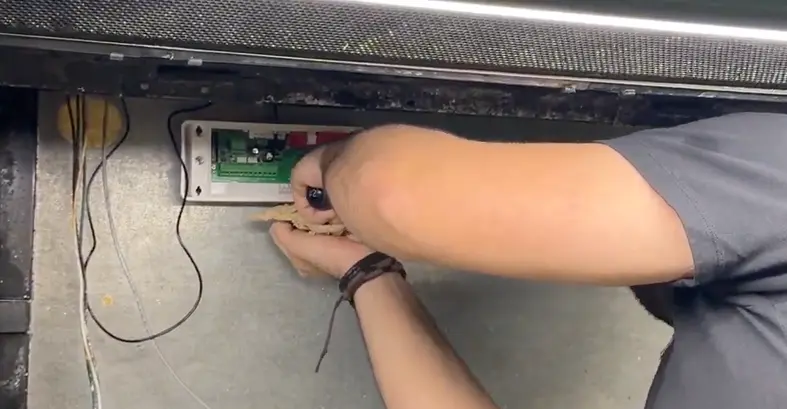
Non-Dispersive Infrared sensing identifies refrigerant by the specific infrared wavelength it absorbs, including older chemistries such as CFC.
Because it keys on the gas’s own absorption band, it is refrigerant-selective and doesn’t false-alarm on the cleaning solvents and ambient compounds that fool semiconductor sensors — which is why it holds up as a permanently installed, always-on sensor.
Infrared sensors do not physically contact refrigerant and can maintain sensitivity for up to 10 years.
By contrast, heated diode sensors are popular in handheld devices because they are easy to use and reliable.
But they can false-trigger by contaminants such as soap bubbles, cleaning solutions, alcohols, oils, fresh paint, humidity swings, and outgassing materials, and they recover more slowly while degrading with repeated refrigerant exposure.
What is aspirated sample-draw?
A centralized architecture where one analyzer pulls air samples through tubing from many zones in sequence.
Sensitive at the analyzer, but because it samples one point at a time, any given zone is only “seen” intermittently — and if the single analyzer fails, the whole store goes blind.
A current market signal: several national grocery operators have begun deploying acoustic/sound-wave detection at the rack, and a layer of algorithm-based detection is taking shape across the category.
Some newer units add features like adjustable sensitivity, a clearer display, and the ability to detect leaks as small as about 1 gram per year (0.03 oz/year).
Both are real.
Neither removes the core requirement — continuous, per-zone awareness of how much refrigerant is being lost.
And regardless of the sensing approach, exact leak location gets harder as the operating environment changes: air drafts, temperature shifts, and greater distance from the source make gas concentration more erratic.
How is a refrigerant leak actually found and resolved?
A leak is detected, profiled, dispatched, and confirmed closed as one continuous loop — and the leak is characterized before anyone is sent to find it.
This is what makes the difference between a truck roll that executes and one that explores.
Dual sensing is the foundation.
Every fixed detector reads two channels at once — refrigerant concentration and temperature.
The temperature channel is the underused half of leak detection.
A defrost cycle has a temperature signature; a real leak shows up as concentration rising while cooling performance degrades.
Correlating the two is how the system separates a genuine leak from a routine cycle.
The profile is the targeting package.
Using both channels, the patented profiling method characterizes the event before dispatch: which rack, what type of leak, how fast it’s developing, and whether it’s even real.
Leaks resolve into recognizable profiles (chronic slow seepage, isolated transient events, and defrost-cycle artifacts each look different), and that classification is handed to the field team as a known target.
The dispatch is targeted, not exploratory.
Without a profile, a truck roll is a search party: someone goes out to find the leak.
With a profile, it’s a targeted dispatch to a known location to do a known job — the searching already happened, remotely, before the truck moved.
(For non-technical audiences, the cleaner framing is imaging before a targeted procedure, not exploratory surgery.)
Aspirated sample-draw can’t supply this: it reports that something, somewhere in the sampled set, leaked, and the technician still has to hunt.
The close is confirmed in real time.
As the technician makes the repair, monitoring watches the leak’s signature collapse live.
The handshake closes on the spot (operator, servicer, and monitoring confirming together, with the outcome documented) rather than reconciling records a week later.
Detection and escalation are owned by monitoring; the closure decision stays with the operator.
What is algorithm-based (intelligent) leak detection?
Algorithm-based detection is the software layer that turns raw sensor signals into classified, quantified events — distinguishing real leaks from false alarms and converting concentration into mass.
It is the most important development in the category, and it isn’t a sensor at all.
Raw sensors produce alarms, and uninterpreted alarms are a liability: a system that pages your team every time a defrost cycle vents vapor trains them to ignore it.
The intelligence layer does three things a bare sensor cannot:
1. It tells a real leak from a false alarm.
The tell is in the shape of the curve over time: a real leak shows estimated mass loss rising and not returning; condensation and transients oscillate and settle. That difference is invisible to a single reading and obvious to a model watching the trend.
2. It converts ppm into pounds.
Concentration tells you what’s in the air. Compliance, cost, and carbon are all denominated in mass lost.
The bridge (the volumetric method) turns a concentration reading, the volume of the space, and the refrigerant’s properties into actual pounds, the unit your leak-rate calculation, your invoice, and your Scope 1 report all require.
A system that only reports ppm leaves that math to someone else.
3. It absorbs the noise so your team doesn’t have to.
Low-level chronic readings are logged and rolled up, not blasted out as 2 a.m. pages. Only genuine, classified escalations reach a person.
The principle (don’t cry wolf) is the difference between a program operations trusts and one they mute.
📌 Refrigerant Leaks Don’t Wait. Neither Do We.
How does refrigerant leak detection improve operational efficiency?
Beyond compliance and refrigerant cost, continuous leak detection improves operational efficiency by converting reactive emergency work into planned service — fewer truck rolls, better-targeted technician time, higher uptime, and less wasted energy.
For operators whose driver is efficiency rather than carbon or regulation, this is the core case.
Fewer emergency truck rolls.
A leak caught at hour zero is a scheduled service call. The same leak caught at failure is an after-hours emergency dispatch, often with inventory at risk.
Early, profiled detection moves work out of the expensive unplanned column and into the cheap planned one.
Technician time spent fixing, not finding.
Because the leak is profiled and localized to a zone before anyone is dispatched, the technician arrives with a target instead of a search area — less trial-and-error, fewer return visits, more wrench time on the actual repair.
Higher uptime, less downtime.
Refrigerant leakage is one of the most common and most costly refrigeration faults.
Catching it early interrupts the cascade (undercharge, compressor strain, capacity loss, eventual failure) that turns a small leak into hours of downtime and spoiled product.
Less wasted energy.
A system losing charge runs harder for less cooling: the compressor works longer, capacity falls, and energy use climbs.
Since refrigeration is roughly 40–60% of a supermarket’s total electricity use, even modest efficiency losses there are expensive.
Maintaining correct charge through early detection protects the system’s designed efficiency — not just its refrigerant.
From break-fix to predictive.
Continuous monitoring is the foundation of reliability-centered maintenance: the move from reacting to failures to anticipating them.
Leak detection is the entry point — the same always-on data stream that catches refrigerant loss surfaces the early signatures of the faults that follow it.
📌 Stop Refrigerant Loss Today.
What are the problems and opportunities in refrigerant leak detection?
The problems are structural to old models; the opportunities belong to operators who treat 2026 as an inflection rather than a deadline.
Problems
- Latency is built into periodic models
No inspection discipline closes the gap between visits. - False positives erode trust
Uninterpreted alarms get ignored, which is worse than no alarm. - Every modality has a blind spot
Concentration sensing misses the pinpoint, acoustic misses the mass, sample-draw misses the in-between-cycle moment. - IT and security friction stalls deployments
Anything touching the store network triggers a security review and months of delay. - The 15-pound threshold quietly tripled the regulated scope
Many operators don’t yet know how many systems are now covered. - Refrigerant cost volatility compounds every gap
The same leak costs more to recharge each year as supply tightens.
Opportunities
- Network-independent (cellular) deployment sidesteps the IT review and collapses time-to-coverage from quarters to weeks.
- Continuous + algorithmic detection turns leak management into a measurable operating discipline.
- Mass quantification makes refrigerant loss a line item you manage, not a surprise you absorb.
- Compliance becomes a byproduct
The required evidence is already generated when an auditor asks. - Scope 1 emissions reductions are among the cheapest, fastest carbon wins a multi-site operator has, and refrigerant is squarely Scope 1.
How do you evaluate a fixed monitoring program?
Evaluate on coverage, latency, units, false-alarm handling, compliance evidence, IT footprint, and operating model — not on sensor specs alone.
The questions that actually separate options:
- Operating model
Are you buying a box, or a monitored service that profiles, escalates, and closes the loop with your field team? - Coverage
Is every zone watched in parallel and continuously, or sampled in sequence? - Latency
How close to hour-zero is detection, and how is it measured? - Units
Does it report pounds lost, or only ppm? Can it feed your leak-rate calculation directly? - False-alarm handling
How does it distinguish a real leak from a defrost cycle — and what actually reaches a human? - Compliance evidence
Does it produce the records the HFC Management Rule requires, retained for three years? - IT footprint
Does it touch the store network, or transmit independently? (This decides weeks vs. quarters to deploy.)
Frequently asked questions
What is the difference between a fixed and a portable refrigerant leak detector?
A portable detector is a handheld instrument a technician uses to pinpoint a suspected leak; it has zero coverage between uses. A fixed detector is permanently installed, transmits continuously, and monitors every zone whether or not anyone is present.
What should you look for in a portable refrigerant leak detector?
Prioritize portability, durability for field use, and battery life, including a long-life rechargeable battery for convenience during service calls. A visible screen and audible alerts make the tool easier to use in different light and noise conditions. Handheld detectors work best when visibility and hearing are clear, even if field conditions are not always ideal.
Does the EPA require automatic leak detection in 2026?
Yes. Under the AIM Act HFC Management Rule, commercial and industrial process refrigeration systems with a full charge of 1,500+ pounds must have automatic leak detection — new systems by January 1, 2026 and existing systems (installed 2017–2025) by January 1, 2027.
What is the EPA leak-rate threshold for commercial refrigeration?
20% of full charge annually for commercial refrigeration (30% for industrial process refrigeration, 10% for comfort cooling and most other appliances), effective January 1, 2026.
📌 Refrigerant Leaks Don’t Wait. Neither Do We.
What is NDIR refrigerant detection?
Non-Dispersive Infrared sensing identifies refrigerant by the specific infrared wavelength it absorbs. It is refrigerant-selective, resists false alarms from solvents and ambient compounds, and is stable enough for permanent, always-on installation.
How is NDIR different from aspirated sample-draw detection?
Distributed NDIR places a sensor in every zone and watches all of them in parallel and continuously. Aspirated sample-draw uses one central analyzer that samples zones in sequence, so each zone is only checked intermittently and the single analyzer is a single point of failure.
What is the smallest refrigerant leak a fixed detector can find?
Modern fixed sensors detect refrigerant down to about 1 ppm and read continuously, so even slow chronic seepage is caught early rather than at the next inspection.
Why does continuous monitoring save refrigerant?
Because the cost of a leak scales with how long it goes undetected. Catching a leak at hour zero instead of at a quarterly inspection — up to 90 days later — preserves most of the charge that would otherwise escape.
How does leak detection reduce truck rolls and improve uptime?
By converting reactive emergency work into planned service. A leak caught at hour zero and localized to a specific zone becomes a scheduled repair with a known target, instead of an after-hours emergency dispatch and a search — cutting both the number of truck rolls and the downtime a late-stage failure would otherwise cause.
How do you tell a real leak from a false alarm?
By watching the trend over time and correlating refrigerant concentration with temperature. A real leak shows estimated mass loss rising and not returning; condensation and transient events oscillate and settle. Defrost cycles carry a recognizable temperature signature.
What does “Leak Detection as a Service” mean?
A model where detection, profiling, and escalation are operated as an ongoing monitored service rather than sold as hardware — sensors detect, software interprets, and a monitoring team escalates only genuine events and confirms closure with the field team.
Does the EPA refrigerant rule apply to air conditioning?
Yes. Commercial comfort cooling (air conditioning, chillers, and rooftop units) with 15 or more pounds of HFC refrigerant (GWP above 53) is subject to the 2026 leak-repair and recordkeeping rules, at a 10% annual leak-rate threshold. Residential and light-commercial AC and heat pumps are excluded.
Do state refrigerant regulations differ from the EPA rules?
Yes, and they often go further. California (CARB), Washington, New York, and Colorado run their own refrigerant programs with stricter thresholds, faster repair windows (14 days in California and Washington), and reporting in CO₂-equivalent. Operators must comply with both federal and applicable state requirements.

The bottom line
Refrigerant leak detection in 2026 is not done with the handheld instrument described in the older guides.
It is a fixed, continuous, algorithm-interpreted system, operated as a service, that watches every zone at all times, profiles a leak before anyone is dispatched, measures loss in pounds compliance and cost actually run on, and catches leaks at hour zero instead of at the next inspection.
📌 The regulation made it urgent. The economics made it obvious.
Several of these programs require reporting in CO₂-equivalent, which is pounds-lost multiplied by GWP.
The technology (finally!) made it possible. The only question left is whether you adopt it on your schedule or the deadline’s.
Regulatory references
EPA HFC Management Rule / Emissions Reduction & Reclamation Program under the AIM Act (final rule October 11, 2024; effective January 1, 2026); EPA Section 608; EPA GreenChill; California CARB Refrigerant Management Program and SB 253; Washington Chapter 173-443 WAC; New York 6 NYCRR Part 494; Colorado Regulation 22. Operational-efficiency figures (refrigeration’s share of store electricity; refrigerant leakage as a leading fault) draw on peer-reviewed and U.S. national-lab (Oak Ridge) supermarket-refrigeration research.
Regulatory specifics evolve, and state rules vary — verify current thresholds and deadlines against EPA and applicable state authorities before relying on them for compliance decisions.
📌 Refrigerant Leaks Don’t Wait. Neither Do We.